










For most of the twentieth century, America ran on one simple promise: produce more, and pay goes up with it.
Work harder, build more, earn more. For decades the two lines rose together, almost locked in step.
Then, around 1971, they split.
Productivity kept climbing. Factories, offices, and workers turned out more every single year. But the paycheck stopped following.
The line measuring what people produced kept going up. The line measuring what they took home flattened out, and never caught up again.
That gap didn’t vanish.
The extra wealth was real, and it went somewhere. Over the next fifty years, the gains that once would have landed in ordinary wages flowed upward instead, to shareholders, to executives, to the very top.
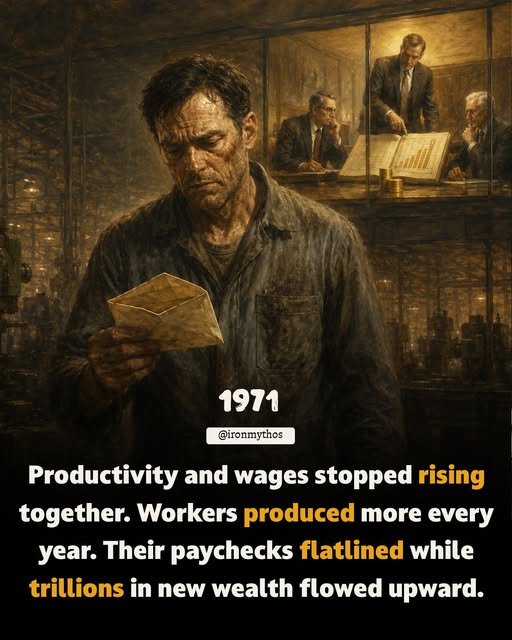
Workers baked a bigger pie every year and were handed a thinner slice. The strange part is how quiet it was. No vote. No announcement. No single villain standing at a podium.
A bargain that built the American middle class simply stopped holding, one ordinary year at a time, while the people living through it were told the economy had never been stronger.
And it had. For some.
Defenders say nobody broke a promise at all. Machines, computers, and cheap foreign labor changed what work was worth, and no policy on earth could have stopped it.
Critics say that’s the alibi, that tax law, gutted unions, and deliberate choices in Washington decided who kept the gains, and that workers lost on purpose, not by accident.
That’s the real fight.
Somewhere around 1971, the reward for hard work quietly detached from the work itself, and a generation raised on ‘produce more, earn more’ spent fifty years wondering why the math stopped adding up.
So, which was it? Automation and globalization pulling the two lines apart with no hand on the wheel, or a set of choices that decided the gains would flow up instead of out? Let readers know what you think

THANK YOU FOR SHARING WITH FRIENDS AND SOCIAL MEDIA
Share this:

Categories: United States



The wealth that American workers produced went to negroes and israel.
LikeLike
The year that currency backed by gold ended.
Have an old silver certificate dollar along with a 1960s ruble in wallet.
The globalist Nimrod worship won’t end well for all sides.
LikeLiked by 1 person
Dear Michael
According to the Rand Corporation, over the past 50 years, $80 trillion in wealth has been redistributed from the bottom 90 percent to the top 1 percent.
Mark
LikeLiked by 1 person
The Road to Perdition, Mark
LikeLike
People are fed up with high rent 2000 plus for a moldy apartments that manager refuses fix? here is what other Americans are saying is USA now scam of corporations? why top 10 percents owns 90 percent of wealth in USA ?
LikeLike
Globalists and their Nimrod worship.
It also removes all firewalls so economic contagions can spread.
A feature of the wipeout plan.
LikeLike
Bolshevik Revolution II is coming soon to USSA.
Moshe Trumpsteinberg (MIGA) bombs Iran or the tape with the 13 year old comes out.
LikeLike
Americans posting their pay check on the internet something is wrong ? no one can afford this economics and millions of Americans are going exit the USA ?
People can not retire in USA due to high prices for everything. Rental companies greed kills American spirit with no fixing the rentals. Alll issues will be yours to fix?
https://www.youtube.com/watch?v=H8r4cPbPTJ0
LikeLiked by 1 person
rents are too much increased in USA people are going broke indeed? My rent was 675 good apartments i lived 12 years , now i am paying 2250 plus electric 140.00 i am totally mad as hell?
LikeLike
American Dream can be ended if we have simple accident? Do you know what to do personal injury and claim, here are some important things you always miss when it shutters your American Dream?
What People Get Wrong About Injuries From Mystery Booms and Sky Trumpets
A sky-splitting boom rarely hurts anyone, and that one fact upends most of the arguments people have about it. The rattled windows, the pets losing their minds, the neighbor swearing something fell out of the sky — that part is real. What comes next, the confident theories about the source and who owes whom, is where the folklore starts.
You have likely heard the rumble or felt the floor jump, and watched the internet fill in the blanks within the hour.
However, most of those blanks get filled in wrong. Here are the assumptions worth taking apart, one at a time.The Boom Itself Almost Never Causes The Injury
People hear a house-shaking boom and assume the pressure wave did the damage to their body. It didn’t. The overpressure from a typical sonic boom is a fraction of what a human eardrum can shrug off, and National Geographic notes that most normal buildings hold up to roughly 11 pounds per square foot of overpressure without damage. The sound is startling. The physics, at ground level, is not.
What hurts people is the reaction to it. Someone jerks awake and trips on the stairs. A driver flinches and clips a guardrail. A worker on a ladder loses grip.
The injury is real, but the cause of the injury is a fall or a crash, not the noise. That distinction matters, because a fall down your own staircase and a fall off scaffolding at work are governed by very different rules.“Act Of God” Is Not A Free Pass For Whoever Made The Noise
When the source turns out to be mundane — a low-flying jet, a quarry blast, a construction detonation, a fuel tank rupture — people assume nobody is on the hook because it felt like weather. Liability doesn’t work that way. If a party had a duty to operate carefully and didn’t, and someone got hurt as a foreseeable result, calling it a freak event doesn’t erase the duty.
There’s precedent for this in the plain sense of the word. No lawsuit. Just a recognition that the noise had a source, and the source had responsibility.Property Damage And Bodily Injury Aren’t The Same Claim
A cracked window and a cracked wrist go in different buckets, even when the same boom caused both. People lump them together and either overshoot or give up entirely. Treat them as separate conversations from the start.
Unexplained Doesn’t Mean Unprovable
The word “mystery” in mystery boom does a lot of psychological work. It makes people assume no one will ever identify a source, so there’s no point writing anything down.
The cases that get resolved are the ones where somebody logged the time to the minute, kept the doorbell-camera clip, and saved the seismograph screenshot before it rolled off the public feed.
Sources get identified more often than the folklore suggests — military flight tests, meteor entries, industrial blasts, offshore activity. Answers can take weeks. Evidence collected in the first 48 hours is what makes those answers useful later.The Same Incident Can Trigger Very Different Cases
One boom, three neighbors, three completely different legal situations. That’s normal, and it confuses people who expect a single “the boom case” to exist. The facts around each person’s injury drive everything.
A warehouse worker who fell off a lift when the building shook is likely looking at workers’ compensation, not a lawsuit against whoever made the noise. Workplace injuries are a much larger category than most readers realize, running into the millions of nonfatal cases every year in private industry alone. A driver who swerved and hit a pedestrian is in an auto-liability conversation with their own insurer. A homeowner whose ceiling fan fell and hit them is dealing with a product or property claim.
Same boom, three lanes. Talking to an experienced injury attorney early is how people figure out which lane they’re actually in before a deadline closes the door.Waiting To See If It Happens Again Is The Worst Move
Plenty of people who felt hurt after a strange event tell themselves they’ll deal with it if the symptoms stick around. A month goes by, the headache is still there, and the paper trail has gone cold. Insurers and defense lawyers use that gap. Every week between the event and the first medical visit becomes an argument that something else caused the problem.
You don’t need to know what made the noise to see a doctor and write down what happened. Those two steps preserve the option to do something later. Skip them and the option usually closes for good.
LikeLike
glad to see someone mentioned what else happened in 1971(gold window shutting) that kicked things off, but also IMO, it was TPTB realized they were going to wrap up the whole cold war eventually, as US had peaked out from postwar boom and other bombed out nations were catching up, and USSR’s system was showing it was not going to last, so the need to have a robust middle class for the US in order to have a materially better life than the USSR ppl had was not a priority anymore. So we had a blending of both systems over the decades, strong unions and labour were no longer needed, so capital got the lions wage of economic growth, things like computers, robotics, allowed global flight of capital coupled with social engineering, women entering the workforce, DEI as AA, lifelong jobs not a guarantee anymore, pushing college degrees leading to elite overproduction causing a merger of capital and communist systems to race everyone down tot he bottom, a second world type hand to mouth existence. Think of it like two major rival TV networks with their best blockbuster shows dueling it out on the same timeslot, have peaked and now declining, so they decide to wrap them up.
LikeLiked by 1 person
Americans aren’t the only people reaching a breaking point—we’re seeing it all over the world. Enjoy the video, and please remember: we should boycott Walmart globally because they take advantage of people.
Before you buy anything, weigh it. For example, chicken wings might be labeled as 5 pounds, but you may find it’s actually only 3 pounds. So, yes—weight everything before you purchase.
In Europe, butchers are still available, and that’s an option many people can turn to be not taken advantage?
LikeLiked by 1 person