






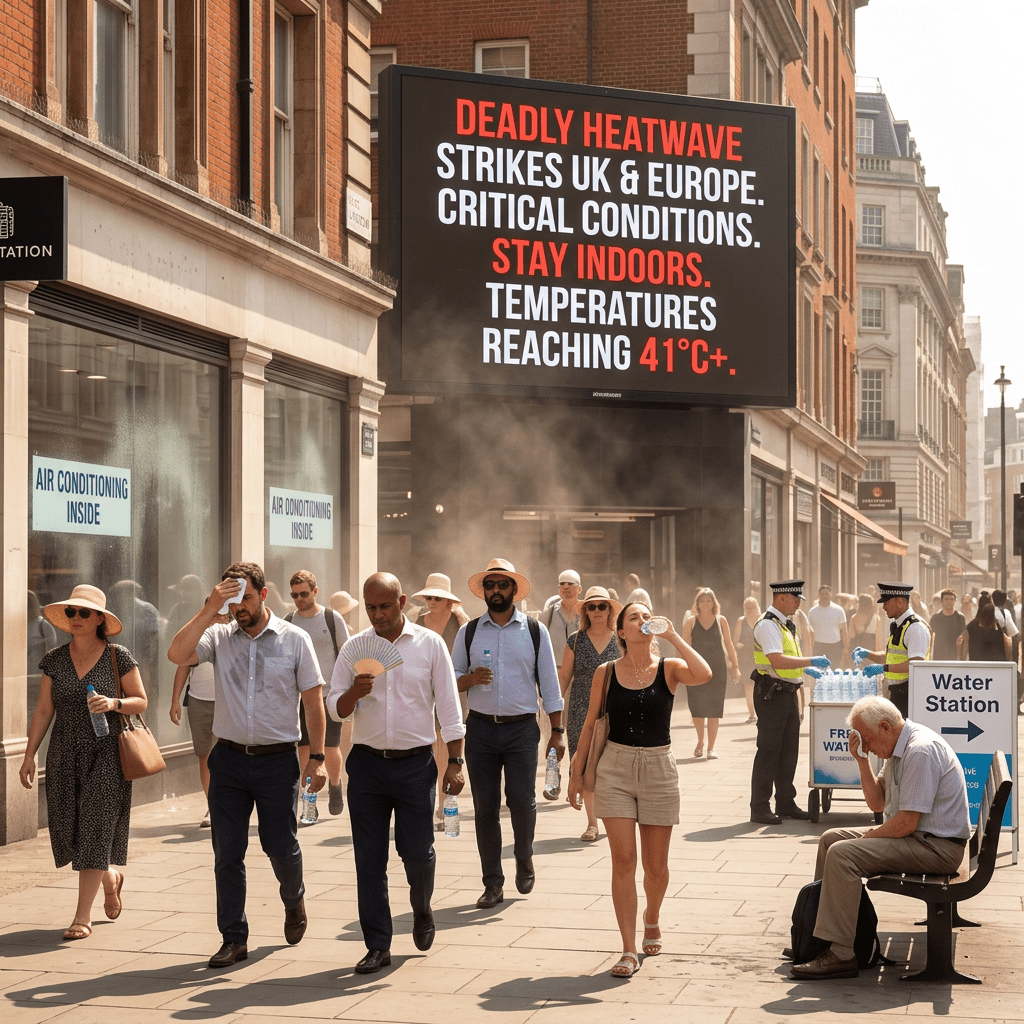
Hundreds are dead, and hundreds more are dying across Europe as a scorching heatwave shatters records.
Spain has recorded the highest death toll as temperatures top 40°C across much of the continent, reviving memories of the deadly summer of 2003.
A scorching heatwave has killed hundreds of people across Europe this week. Spain is reporting the highest death toll as temperatures surged past 40°C (104°F). Records were shattered across the continent.
Spanish authorities have linked more than 200 deaths to the extreme heat, according to the country’s mortality monitoring system.
Germany has reported more than 20 deaths, many of them drownings, as people sought relief in rivers, lakes, and pools.
France has confirmed several heat-related fatalities, including children, while Italy has also reported multiple deaths as hospitals treated growing numbers of patients suffering from heatstroke and dehydration.

The heatwave has engulfed much of Western and Southern Europe, with Paris recording its hottest June day on record at 40.9°C and Britain registering its highest June temperature ever at 36.4°C.
Switzerland also set a new June record, while authorities across the region issued red alerts, closed schools, cancelled train services and urged residents to stay indoors during the hottest parts of the day.
Meteorologists have attributed the extreme temperatures to a persistent ’heat dome’ that has trapped hot air over Europe and prevented cooler weather systems from moving in.
The conditions have been particularly dangerous in densely populated cities, where concrete and asphalt retain heat overnight, offering little relief after sunset.
The mounting death toll has revived memories of Europe’s catastrophic 2003 heatwave. The devastation is estimated to have caused tens of thousands of excess deaths across the continent. This made it one of the deadliest natural disasters in modern European history.

Experts say Europe remains especially vulnerable because much of its housing stock was designed to retain heat during cold winters rather than keep homes cool in summer.
Unlike in North America and many parts of Asia, residential air conditioning is still relatively uncommon across much of the continent, leaving millions exposed during prolonged periods of extreme heat.
Governments have warned that the death toll is likely to rise further as the heatwave persists, and are urging people to stay hydrated.
To avoid outdoor activity during peak temperatures, and check on elderly relatives and other vulnerable people. Send us your comments

THANK YOU FOR SHARING WITH FRIENDS AND SOCIAL MEDIA
Share this:

Categories: healthcare



Heatwaves are a construct of the white male patriarchy.
Equality of results for all comrades of the collective.
Forward! Yes we can.
LikeLike
Heat Wave in USA Canada , Europa killed at least over 100 people. We need follow this instructions indeed. Three Common Scenarios Where Heatstroke Risk Peaks1. Communication and Power Tower Maintenance
Heat Triggers: Metal structures absorb heat rapidly; workers are often exposed for hours without shade, wearing insulated safety gear that limits heat dissipation.
Vulnerable Groups: Telecom technicians and electrical repair staff operating on 30–100 meter-high towers are at extreme risk, especially during midday sessions. Due to limited communication during solo climbs, rescue can be delayed if preventive alerts are not in place.
Current Measures: Manual reporting, scheduled breaks, and hydration are applied, but there’s often no real-time body temperature monitoring during ascent.
Management Response: Equipping climbers with CMN wearable devices allows real-time detection of heat stress. The device provides vibration and audio alerts to signal early warning symptoms. If integrated with ground-control apps, supervisors can intervene and command descent or rest before the situation escalates.2. Bridge Structure and Underside Inspections
Heat Triggers: Workers are exposed to direct sun above and reflected heat from water or concrete structures below, especially in river-crossing or coastal areas.
Vulnerable Groups: Structural engineers and inspectors often work in static crouching positions, increasing core body temperature accumulation.
Current Measures: Use of portable fans or cooling vests is rare due to space and weight constraints.
Management Response: With CMN smart wearables sampling every 15 seconds, alerts are issued once continuous heat exposure crosses safety thresholds. Data can be synced to the cloud for exposure history, supporting better crew scheduling and shift rotation plans.
Multe Dankon tute!
LikeLiked by 1 person
I’m always floored every year that FEMA/Health Agencies don;t tell people to take a cold bath or shower, as cold as you can safely tolerate. Water removes heat from the body 25 times better than air. It’s why its used to cool machines,computers, etc. Thousands of lives would be saved. I can remember back when I was a dive instructor in the tropics, we had a guy in the pool doing basic learning for @ 30-45 mins underwater and even with a wetsuit in early summer tropical heat outside his teeth were chattering. Obv a person doesn;t have to go to that extent, but shows the cooling power of water.
LikeLike
Scott’s comment makes sense. To relieve a distressed baby in a building without air-con in Australia I rigged up wet towels on a framework and blew air through it towards the baby. A visiting doctor said it was the best thing I could have done.
In the scorching heat of Western Australia we used to put on wet T-shirts before going down to the beach.
My recommendation – wet clothes and a simple electric fan.
LikeLike
This is crazy because of green agenda took air conditioned from EUROPA NATIONALS.Is it truth please let me know… I can not say green agenda caused it !HAARP so active indeed globally.
LikeLike