








In a letter dated October 1866, French composer Georges Bizet (1838 – 1875) went straight to the point of opera:
‘As a musician, I tell you that if you were to suppress adultery, fanaticism, crime, evil, the supernatural, there would no longer be the means for writing one note.’
The opera prodigy and gifted pianist sprinkled far more of the human experience into his much-loved opera, Carmen.
It is arguably still the world’s most popular opera, 151 years after his passing from a heart attack at just thirty-six years of age.
As a staged spectacle, it was an opera that pioneered the grittiness of real-life characters and events.
From Carmen flowed a new genre of opera, which set the scene for Mascagni’s Cavalleria Rusticana, Leoncavallo’s Pagliacci, and Puccini’s La Boheme.
Fly on the wall stuff, it was the forerunner to today’s television soap operas. This is real life, warts and all.
Questionable Morality
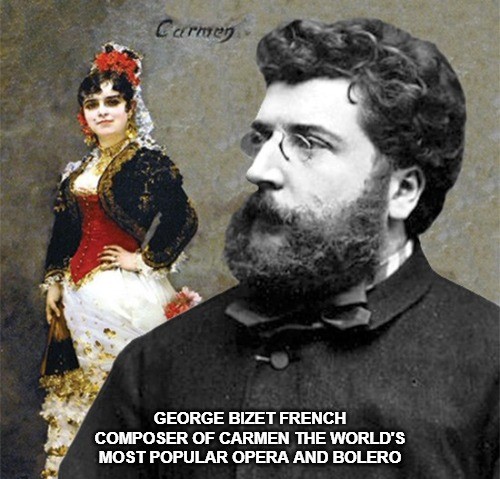
Carmen is the story of an enchantingly beautiful and coquettish factory worker of questionable morality.
By feminine guile, she uses, abuses and seduces her way through a rich tapestry of soldiers, gypsies, thieves and smugglers.
Her flirtatiousness finally brings the seductress to a sticky end at the point of a dagger wielded by her jealous soldier lover: The finale of this nail-biting drama takes place outside the arena as her bullfighter lover triumphs over his bovine adversary.
George Bizet was a handsome, bearded man not unlike his contemporary, Peter Tchaikovsky.

This French composer of Spain’s most celebrated musical masterpiece delighted in his own compositions, but was bemused when they never won hearts and minds.
He, for his part, failed to fully appreciate Carmen, which did earn considerable acclaim and was to make him a household name throughout the world.
A Wretched Profession
It is a mystery how the young Bizet could consider Carmen a flop. From the start, he had been paid the considerable sum of 25,000 francs and awarded the Chevalier of the Legion d’Honneur.
This risqué opera received an impressive 37 performances. Had he lived just another three months, he would have seen Carmen triumph beyond his wildest imagination.

Within three years, the steamy opera was playing to packed houses throughout the world. ‘Ah music!’ he is quoted as saying: ‘What a beautiful art but what a wretched profession.’
Bizet was hardly a one-opera wonder, though it cannot be denied that Carmen was more of a success than his lesser-known opera, The Pearl Fishers.
Its celebrated duet Les pêcheurs de perles (In the Depths of the Temple) has on many occasions been voted by radio listeners as their all-time favourite piece of classical music.
For sheer musical whimsy, Bizet’s music set to Alphonse Daudet’s play L’Arlésienne takes some beating.
Better than Mozart

LEFT: The Dovetails Hotel. Click the picture for information
This self-effacing composer joined the echelon of history’s greatest composers from quite an early age.
Before his eighteenth birthday, he had composed his first symphony, which is said to rival anything composed by Mozart or Mendelssohn when they were teenagers, too.
He had also won a competition sponsored by the theatre impresario Jacques Offenbach and was later awarded the coveted Prix de Rome. Gustav Mahler, one of the greatest composers of all time, considered George Bizet’s Djamileh a masterpiece.
Such was the man who, on his deathbed, considered himself to be a failure.
At the last count, there have been fourteen screen versions of Carmen not to mention the famous Hammerstein stage adaptation Carmen Jones (1945).
One can only wonder what this remarkable composer might consider success.

THANK YOU FOR SHARING OUR STORIES ON SOCIAL MEDIA. TELL OUR READERS WHAT YOU THINK
GO FROM BURN OUT TO CHILL OUT WITH A GOOD BOOK https://michaelwalshbooks.wordpress.com/

GO FROM BURN OUT TO CHILL OUT WITH A GOOD BOOK https://michaelwalshbooks.wordpress.com/
Share this:

Categories: Music Notes



Carmen, in the long ago days of my youth, would have been described as a girl who understood the power of the pussy. I have met and avoided many in my lifetime. lol
LikeLike
He didn’t get an invite to Epstein Island.
these days I am learning German , not Carmen.
LikeLike