




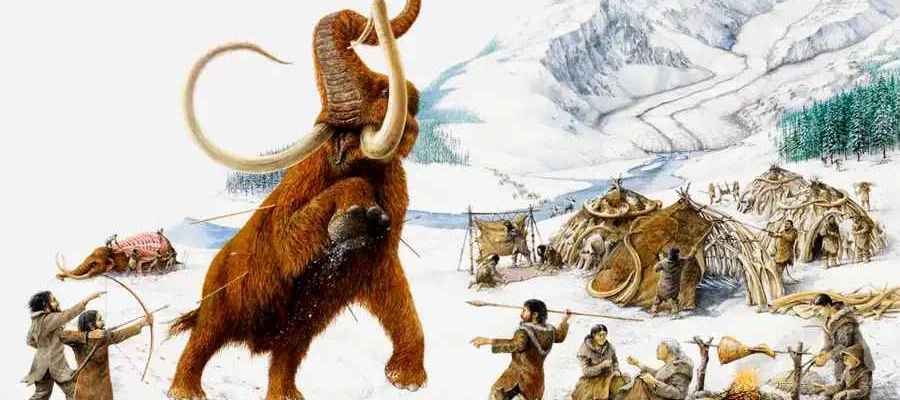

DNA from bones found in a cave in Germany has been identified as from Homo sapiens, showing that our current species endured frigid conditions there as they expanded across the continent.
When modern humans first began settling in Europe, they went straight to the cold north. A challenging excavation in Germany places our species in the region at least 45,000 years ago and supports earlier claims that our ancestors were in Britain not long after.
‘These guys came into a landscape which was quite hostile,’ says Jean-Jacques Hublin at the Max Planck Institute for Evolutionary Anthropology in Leipzig, Germany. ‘It was like northern Finland [today].’
FOR MATURE READERS WHO CAN TAKE THE TRUTH
Modern humans (Homo sapiens) are the most recent hominin to permanently settle in Europe, around 45,000 years ago. Previously, the continent was dominated for hundreds of thousands of years by Neanderthals, who vanished from the fossil record about 40,000 years ago. Modern humans and Neanderthals may have overlapped in France and Spain for 1400 to 2900 years.
‘The replacement of all archaic humans by Homo sapiens, between 50,000 and 40,000 years ago, is something that occurred all over Eurasia,’ says Hublin. It was a crucial period because, for millions of years, there had been multiple hominins coexisting, but now only one survived.
THE THINKING MAN’S NEWS: FOLLOW US TO BE THE FIRST TO KNOW

‘This is the start of one species invading all the possible habitable niches on the Earth,’ says Hublin. ‘We know it happened… but we don’t know why and how it happened.’
The transitional period is mysterious. There are several types of stone artefacts from the period that could have been made by Neanderthals or modern humans.
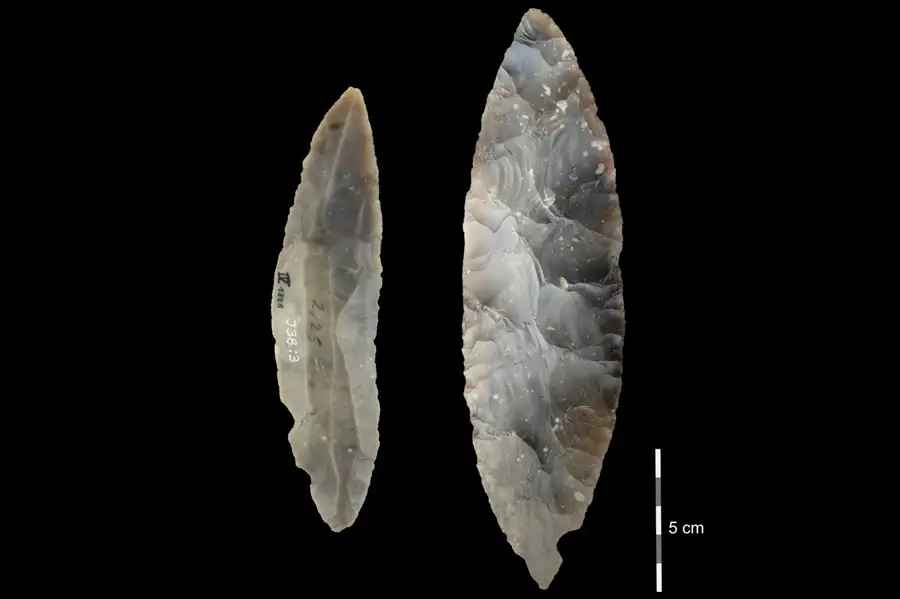
One, found in several sites in northern Europe, is the Lincombian-Ranisian-Jerzmanowician (LRJ) – characterised by long, leaf-shaped points that may have been fitted to spears. They had never been found in association with confidently identified hominin bones. ‘We had no clue who made them,’ says Hublin.
To find out, Hublin and his colleagues visited several sites that had yielded LRJ artefacts. Unfortunately, previous archaeologists had destroyed the sites with crude excavation methods.
The one exception was a cave called Ilsenhöhle near Ranis, Germany. It collapsed thousands of years ago, so the initial excavations in the 1930s were difficult and some of the site remained undisturbed. Hublin’s team re-excavated it, digging a deep shaft down to the relevant sediment layer.
FASTEST GROWING NEWSDESK FOR INDEPENDENT JOURNALISM
It was an exceptionally difficult excavation, says Marie Soressi at Leiden University in the Netherlands, who wasn’t involved in the study.
Buried in the sediments, Hublin’s team found many fragments of bone. They also re-examined similar fragments from the original excavations. By analyzing the collagen protein in the bones, they determined that 13 belonged to hominins. To identify them more precisely, the team extracted mitochondrial DNA, which people inherit solely from their mothers, from 11 of the fragments. ‘They are Homo sapiens (modern Europeans),’ says Hublin.
The techniques used were top-notch, says Soressi. No race-mixing back then: She wants to see nuclear DNA as well, to be sure, because it is possible the individuals were hybrids with Neanderthal fathers, which mitochondrial DNA wouldn’t show. However, she says this is very unlikely.
The timing of H. sapiens occupying the Ilsenhöhle fits with existing evidence. Hublin’s team previously showed that modern humans lived in the Bacho Kiro cave in Bulgaria about 45,000 years ago. However, Ilsenhöhle is much further north.

In a second study, Hublin’s colleagues used chemical evidence from preserved horse teeth to show that the climate in this part of Germany was cold at the time, especially between 45,000 and 43,000 years ago.
Again, this fits prior evidence: in 2014, Hublin’s team showed that modern humans were living in Willendorf, Austria, north of the Alps, in a cold steppe-like environment 43,500 years ago.
A third study examines the animal bones from Ilsenhöhle, revealing that the cave was mostly inhabited by cave bears and hyenas. The implication is that modern humans were only there intermittently.
This points to a ‘quick occupation by small groups of ‘pioneers’’, says Soressi.
Similar claims have been made for the cave of Grotte Mandrin in France: it may have been briefly inhabited by modern humans 54,000 years ago before Neanderthals reclaimed the site.
Now that the LRJ tools at Ilsenhöhle have been associated with modern humans, it is reasonable to assume that other LRJ artefacts were also made by H. sapiens, says Hublin.
This implies modern humans made it to Britain early on. Part of a jawbone found in Kents Cavern in Devon, England, had been tentatively identified as a modern human and dated to around 43,000 years ago – and was found with LRJ artefacts.

QUOTABLE QUOTES:
A nation can inherit nothing better, Than the customs of its fathers. When the folk-ways of a nation die out, The soul of the nation dies with it.
‘The most precious possession you have in the world is your own people, and for this people and for the sake of this people, we will struggle and fight and never slacken and never tire and never lose courage and never lose faith.’~ Adolf Hitler.
RACE AND REASON ‘A great civilization is not conquered from without until it has destroyed itself from within. The essential causes of Rome’s decline lay in her people, her morals, her class struggle, her falling trade, her bureaucratic despotism, her stifling taxes, and her consuming wars. The political causes of decay were rooted in one fact – that increasing despotism destroyed the citizen’s civic sense, and dried up statesmanship at its source.’ ~ Dr. Will Durant, The Story of Civilization, Vol. 111. BREAK THE STRANGLEHOLD OF PRESS CENSORSHIP BY POSTING ON SOCIAL MEDIA.
CLICK HERE TO PURCHASE WITNESS TO HISTORY
MY LAST TESTAMENT. LET GOD JUDGE ME. Mike Walsh. First time published, Adolf Hitler in his own words explains the origins of his fight for a free Germany, his struggle for victory over the Capitalist-Communist hydra and its downfall. Illustrated. Softcover. 195 pages.
CLICK HERE TO PURCHASE WITNESS TO HISTORY

Share this:

Categories: Uncategorized



Nice article, good memes.
LikeLike