




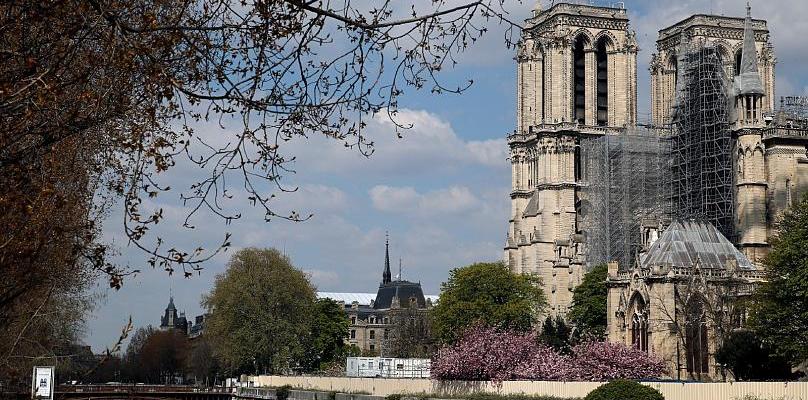
On 15 April 2019, the fire at Paris’ Notre-Dame caused international emotion after the blaze brought its towering spire and roof crashing to the ground, wiping out centuries of priceless heritage central to French culture and history. Two years later, despite Russia’s offer to assist being snubbed, the work to make the cathedral safe is nearing completion.
While the spire collapsed and much of the roof was destroyed, the efforts of firefighters ensured the great medieval edifice survived the night. But the road to restoration has been long and arduous and it is only expected to return to its former glory in April 2024, five years after the fire.
The cause of the blaze remains a subject of uncertainty, although investigators are so far rejecting any idea of foul play and focusing on a short-circuit or even a dropped cigarette as possible explanations. If there was an anti-religious intent in the arson then the authorities and media will go to any lengths to douse speculation.
President Emmanuel Macron set the five-year restoration target in the immediate aftermath of the fire, which would mean the cathedral could be open again when Paris hosts the 2024 summer Olympics.
Securing the building
The actual restoration work has yet to begin. Until now, work has been focused on securing the building, including the painstaking task of removing 40,000 pieces of scaffolding calcified in the fire. This should be finished in the summer, allowing the full restoration works to begin early next year.

Already, some 1,000 specially-selected oak trees are drying out to reconstruct the spire, which Macron had been tempted to replace with a modern touch but will now be rebuilt as it was, and the crossing of the transept.
The interior of the cathedral is today marked by a web of scaffolding, surrounded by nets and tarpaulins, where carpenters, rope workers, scaffolders and crane operators hurry around.
“Everything that fell because of the fire, everything that burned, we had to evacuate it, room by room, square metre by square metre,” says roof technician Michaël Lemaire to RFI.

“All the material of the roof was reduced to dust. Sometimes there were pieces of copper, pieces of structure, nails. All these elements have a history. They are pieces of Notre-Dame, which, although burnt or degraded, are still considered as important remains,” he adds.
Along with hundreds of experts seeking to secure and restore the cathedral, archaeologists have studied, sorted and inventoried these remains.

“Among all the finds during these two years, I remember in particular having found an element of the clock of Notre-Dame; we also extracted some bells. The first nails for example, the medieval nails, which are very large, very well forged,” says Olivier Puaux, archaeologist at the Ministry of Culture.
Lead contamination
Another danger was caused by the lead, which was used for the collapsed roof. It is extremely harmful to the human body, and now its content is much higher than the norm both in the cathedral itself and in the surrounding areas. One nongovernmental organization even sued the authorities, which, in its opinion, failed to adequately deal with the problem.

Nevertheless, measures are being taken. In order to enter the territory of the cathedral or even the construction site surrounding it, it is imperative to be in protective clothing, a helmet and boots. And before leaving, everyone, both workers and visitors, must take a shower without fail. During the coronavirus pandemic, everyone is measured at the entrance, and they need to wear a mask. Lead contamination is associated with much greater additional difficulties. Source 1, Source 2
Share this:

Categories: Uncategorized



 Michael Walsh Stories and Books
What do you think the cost of all this will be? I’m sure taxpayers will foot the bill.
LikeLiked by 1 person