



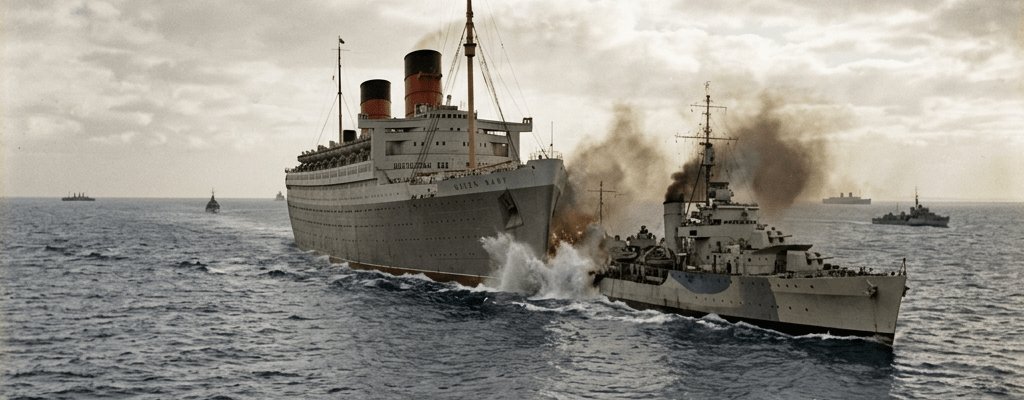

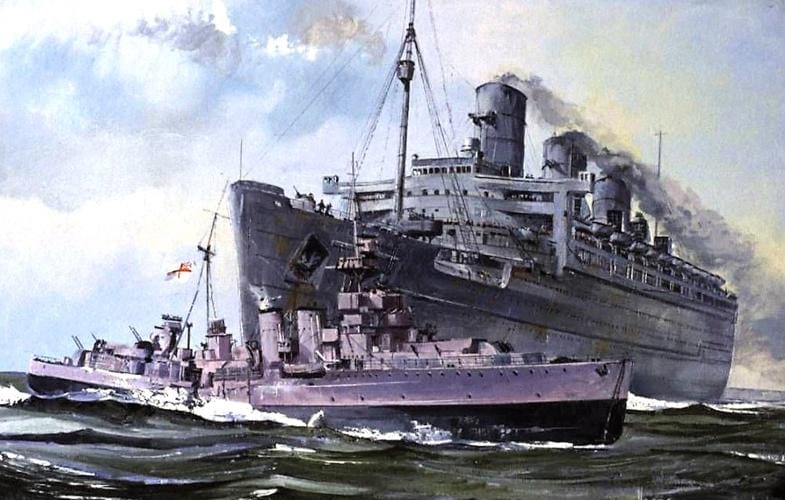
A British destroyer and its crew, consisting of 337 officers and men, were sunk by the Cunard company’s RMS Queen Mary.
On the morning of 2 October 1942, the Royal Navy destroyer HMS Curacao rendezvoused north of Ireland with the ocean liner RMS Queen Mary. The iconic superliner was carrying approximately 10,000 American troops of the 29th Infantry Division.
The Cunard liner was steaming an evasive Zig-Zag Pattern No. 8 course at a speed of 28.5 knots (52.8 km/h; 32.8 mph), an overall rate of advance of 26.5 knots (49.1 km/h; 30.5 mph), to evade U-Boat attacks.
The elderly battleship remained on a straight course at a top speed of 25 knots (46 km/h; 29 mph) and would eventually be overtaken by the liner.
Each ship’s captain had a different interpretation of The Rule of the Road, believing his ship had the right of way.
Captain John Wilfred Boutwood of HMS Curacao kept to the liner’s mean course to maximise his ability to defend it against enemy aircraft.
Commodore Sir Cyril Gordon Illingworth of the Cunard superliner Queen Mary continued their zig-zag pattern, expecting the escort cruiser to give way.
‘We could see our escort zig-zagging in front of us; it was common for the ships and cruisers to zig-zag to confuse the U-boats. In this particular case, however, the escort was very, very close to us.
‘I said to my mate ‘You know she’s zig-zagging all over the place in front of us, I’m sure we’re going to hit her.’
And sure enough, the Queen Mary sliced the cruiser in two like a piece of butter, straight through the six-inch armored plating.
Alfred Johnson, eye witness, BBC: ‘HMS Curacao Tragedy’: At 13:32, during the zig-zag, it became apparent that the Queen Mary would come too close to the cruiser, and the liner’s officer of the watch interrupted the turn to avoid HMS Curacao.
Upon hearing this command, Illingworth told his officer to: ‘Carry on with the zig-zag. These chaps are used to escorting; they will keep out of your way and won’t interfere with you.’
At 14:04, Queen Mary started the starboard turn from a position slightly behind the cruiser and at a distance of two cables (about 400 yards (366 m)).
Boutwood perceived the danger, but the distance was too close for either of the hard turns ordered for each ship to make any difference at the speeds that they were travelling.
The Queen Mary struck Curacao amidships at full speed, cutting the cruiser in half. The aft end sank almost immediately, but the rest of the ship stayed on the surface a few minutes longer.
RIGHT. Click the picture for details
Acting under orders not to stop due to the risk of U-boat attacks, Queen Mary steamed onwards with a damaged bow.
She radioed the other destroyers of her escort, about 7 nautical miles (13 km; 8.1 mi) away, and reported the collision.
Hours later, the convoy’s lead escort, consisting of Bramham and one other ship, returned to rescue approximately 101 survivors, including Boutwood.
Lost with HMS Curacao were 337 officers and men of her crew, according to the naval casualty file released by The National Archives in June 2013.
Most of the lost men are commemorated on the Chatham Naval Memorial and the rest on the Portsmouth Naval Memorial.
Those who died after the rescue, or whose bodies were recovered, were buried in Chatham and in Arisaig Cemetery in Inverness. Under the Protection of Military Remains Act 1986, Curacao’s wreck site is designated a ‘protected place’.
LEFT: Click the picture for access to details
Those who witnessed the collision were sworn to secrecy due to national security concerns.
The loss was not publicly reported until after the war ended, although the Admiralty filed a writ against Queen Mary’s owners, Cunard White Star Line, on 22 September 1943 in the Admiralty Court of the High Court of Justice.
Little happened until 1945, when the case went to trial in June; it was adjourned to November and then to December 1946.
Mr Justice Pilcher exonerated Queen Mary’s crew and her owners from blame on 21 January 1947 and laid all fault on HMS Curacao’s officers.
The Admiralty appealed his ruling, and the Court of Appeal modified the ruling, assigning two-thirds of the blame to the Admiralty and one-third to Cunard White Star. The latter appealed to the House of Lords, but the decision was upheld. Artist unknown.

THANK YOU FOR SHARING WITH FRIENDS AND SOCIAL MEDIA. WE WELCOME READERS COMMENTS

Share this:

Categories: Sea Stories



 Michael Walsh Stories and Books
Been watching the AI generated destroyer rams U-boat videos.
One had a pirate style small arms battle after the destroyer blasted 88 mm deck gun right off.
If they would have had the 1943 amount of subs at the start and a four engine bomber, it could have prolonged the war.
LikeLike