




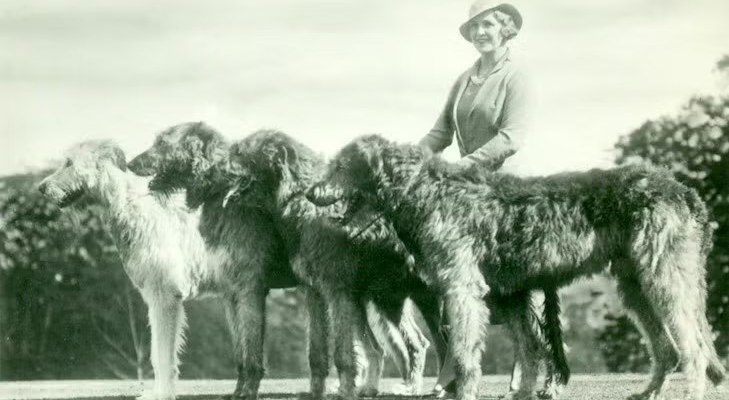

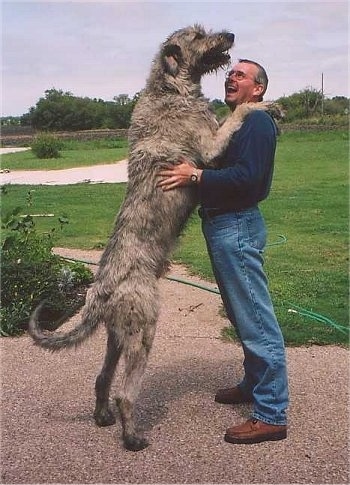
The majestic Irish wolfhound, known in Ireland as the Cú Faoil, famed in history and mythology, is one of the largest and strongest dog breeds in the world.
It is certainly one of the tallest, reaching over seven feet in height when standing on its hind legs!
As it was known in ancient times, the great Irish hound was held in such high regard that by ancient Brehon law, only kings, chieftains and nobles were allowed to own them, or a poet could have two.
If a dog were stolen, it might be cause for a battle or even a war. They wore chains and collars of gold and silver, often being given to notables as valuable gifts.
Wolfhounds were used to protect property and livestock from thieves and predators, and if brought to battle, would pull warriors down from chariots or horseback!
Their ferocity in war was notorious, and the war-chief of the High King and leader of the Fianna, Fionn Mac Cumhaill, owned more than five hundred of them, three hundred adults who fought alongside his men as well as two hundred puppies.

As it was written in the legends, Fionn’s favourite hound, whose name was Conbec, could head off and bring back any elk in Ireland to Fionn’s feasts. It was said that “no hound but Conbec did ever sleep in the one bed with Finn.”
There was no beast they would not hunt, from wild boar to stag to giant Irish elk and even to wolves.
It was said that Irish Wolfhounds were the only dogs fast enough to run down a wolf and strong enough to kill it afterwards, tracking mostly by sight and speed.
The Cú Faoil originally came to Ireland about nine thousand years ago. When Celtic tribes attacked and laid waste to Delphi in the third century BC, horrified survivors spoke in hushed tones of the great hounds that had fought alongside their masters.
Julius Caesar wrote of them in his book, “Gallic Wars”, and the Consul Symmachus received seven of them as a gift from his brother at the end of the fourth century, which “all Rome viewed with wonder”.
Cú Chulainn got his name when he slew a mighty guard dog watching a smith’s house and swore to take the dog’s place until a replacement could be found. At that time, it wasn’t unusual for a king or hero to place the word cú, meaning “hound”, before his name, to show they were worth respecting.
They were so tall that their heads reached the height of a man’s chest.

“I will give thee a dog which I got in Ireland. He is huge of limb, and for a follower equal to an able man. Moreover, he hath a man’s wit and will bark at thine enemies but never at thy friends. And he will see by each man’s face whether he be ill or well-disposed to thee. And he will lay down his life for thee.”
FORTY SHADES OF VERSE Michael Walsh. Packed to the last page with illustrated stories and heartfelt verse, the perfect gift for those inspired by Ireland. GETS TO THE HEART OF IRELAND. https://books.by/michael-walsh#forty-shades-of-verse
Their lithe bodies and slender heads were depicted in many places in Irish knotwork and decorative design, always ending in infinite interlacing convolutions. They featured on the coats of arms of early Irish kings, and remain strongly linked to the old Irish royal lines.
As to the enemy for which they were named, wolves were very common in old Ireland, stalking through the thick and almost impenetrable darkling forests and across misty moors.

One of the reasons ring forts were built was to protect livestock from their depredations, and Brehon law insisted that wolves must be hunted. So many were they that the town of Coleraine was attacked by a giant pack of hungry wolves in the hard winter of 1650!
Travellers were attacked by packs of wolves near Lisburn and Drogheda around the same time, and some began to refer to Ireland as “Wolfland”. As late as a century afterwards, there were tales of marauding packs of wolves in Wexford and close to Cork.
Although they were considered to be evil creatures, wolves also formed an important part of early medicine, which involved eating a dish of wolf meat to prevent a person from seeing phantoms, and sleeping with a wolf’s head under the pillow to prevent nightmares.
Although the last of the Irish wolves died out in 1786 at the teeth of a pack of wolfhounds, rumours still persist of strange doglike beasts crossing country roads late at night and howling in the most remote corners of Ireland.
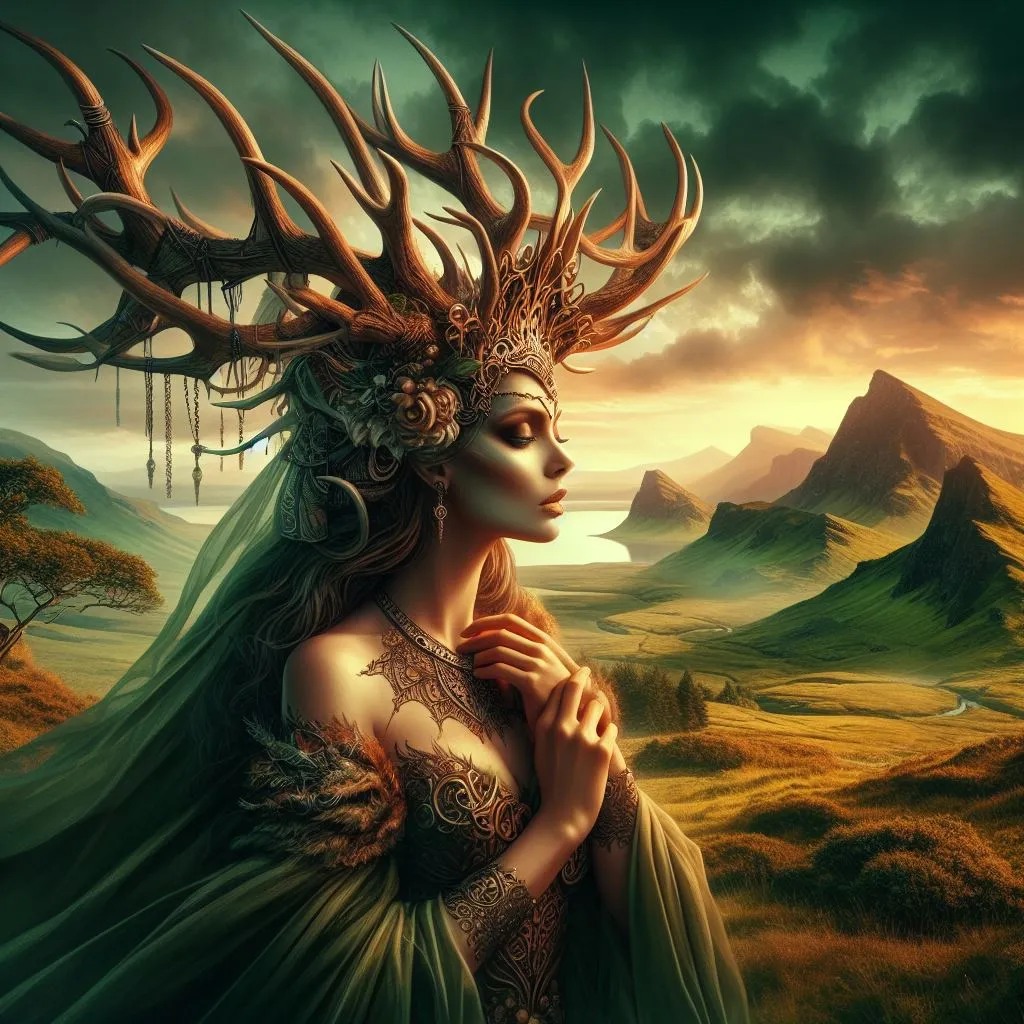
In 2012, some hikers in County Fermanagh reported a sighting of nothing less than prehistoric dire wolves in their rambling – stocky wolves with wide heads and short ears!
With the end of the time of the wolf in Ireland, the need for wolfhounds also decreased and they almost followed their wild cousins into extinction. We owe their survival to the Scottish Deerhound breeder, Captain George Augustus Graham, who collected over three hundred pedigrees which he then bred.
Oliver Goldsmith wrote at the end of the eighteenth century, “The last variety and most wonderful of all that I shall mention is the great Irish Wolfdog, that may be considered as the first of the canine species…bred up to the houses of the great… he is extremely beautiful and majestic in appearance, being the greatest of the dog kind to be seen in the world… they are now almost worn away and only very rarely to be met with.” TELL US WHAT YOU THINK
PLEASE SHARE OUR PUBLIC INFORMATION STORIES

https://books.by/michael-walsh#forty-shades-of-verseFORTY SHADES OF VERSE Michael Walsh. Packed to the last page with illustrated stories and heartfelt verse the perfect gift for those inspired by Ireland. GETS TO THE HEART OF IRELAND: https://books.by/michael-walsh#forty-shades-of-verse

Share this:

Categories: Animal Stories



 Michael Walsh Stories and Books