








MICHAEL WALSH CORRESPONDENT AMERICAN FREE PRESS
When considering the conflict between Russia and, let’s be candid, the NATO Alliance, there is one essential axiom to keep in mind.
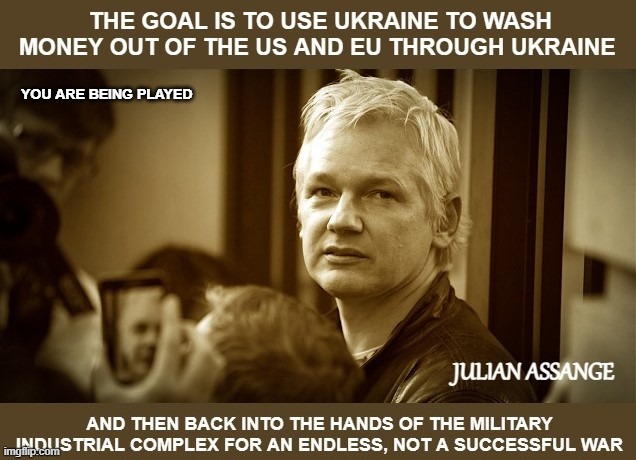
This war was never intended to be won. Veteran whistle-blowing Australian journalist Julian Assange nailed it:
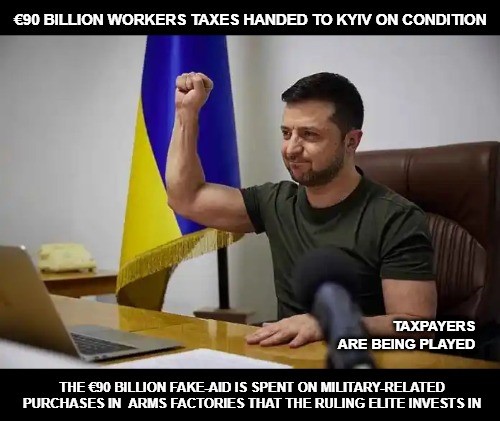
‘The goal is to use Ukraine to wash money out of the US and EU through Ukraine and then back into the hands of the Military Industrial Complex for an endless, not a successful war.’
It is no secret that the US economy is a war economy. It is for this reason that Stephen Donovan reminds us that the U.S. has as much interest in peace as does a condom maker in abstinence.
From the current conflict’s beginning in February 2022, the Russian Federation has had the upper hand.
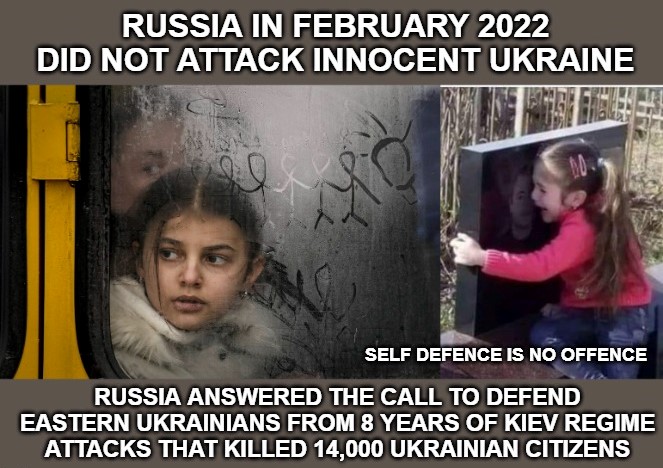
By playing soft and hard cop, Russian President Vladimir Putin and former president Dmitry Medvedev could have decisively ended the war on their terms whenever they chose to do so.
However, the Kremlin strategy is to play the Western Alliance at its own game and to profit from this blood-soaked, cash-consuming but mutually money-spinning conflict.
Since the beginning of the war, the Kremlin’s defense spending has risen by 40 per cent. Russia’s war-related production has soared 50 to 60 per cent.
As with their American counterparts, Russia’s war industries are booming.
Allowing for industrial capacity restraints, the export potential of Russia’s battle-tried military hardware today captures markets once dominated by the Military Industrial Complex of the Western Alliance.
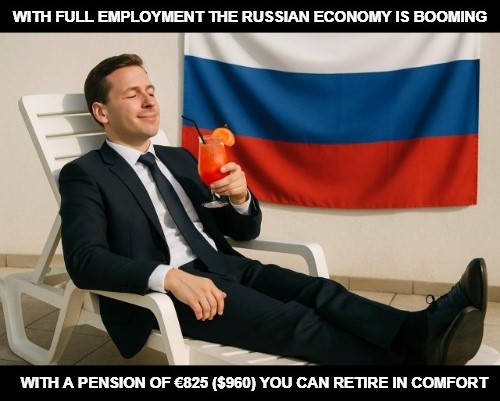
Russia’s present unemployment rate is extremely low, around 2.1% to 2.5%, depending on the source and month. Factoring in idle hours between jobs, this figure translates into full employment.
An historic low, it is driven by labor shortages, mobilization, and increased defense‑sector hiring.
Russia is doing far better than its NATO adversaries. The latest data shows unemployment is about 4.2 per cent in the U.S., 6 per cent in the EU, and 4.3 per cent in the UK.
State‑linked defense companies, logistics providers, construction and reconstruction tied to the war effort, and parts of the security apparatus are clear financial winners.
All wars stimulate propulsion for a nation’s economic growth, which is attended by a surge in industrial development and output.
If you look at Russia’s military‑industrial complex, there is a real, measurable profit: more contracts, higher output, and a bigger share of the state budget.
Unfortunately, as far as national economies and the Military-Industrial Complex are concerned, military and civilian casualties are airily dismissed as collateral damage.
When we factor in casualties, it is very much a case of, you win some, you lose some.
Apart from unrelenting battlefield and civilian casualties, there is the enormous cost and disruption caused by population displacement suffered by nations drawn into the conflict.
Ukraine is the biggest loser of all. Following the collapse of the Soviet Union in 1991, the nation’s population stood at 52 million. Soviet leader Leonid Brezhnev positioned his birthplace as a favored nation.
The Ruhr of the Soviet Union, Ukraine, excelled in engineering, raw materials, accessible natural resources, and state-of-the-art technology, especially in the military and space-related industries.
Ukrainians, fortunate to have been born into the Nikita Khrushchev and soon afterwards the Leonid Brezhnev era, nostalgically recall a middle-class lifestyle similar to that enjoyed by post-World War II Americans and Canadians
As Ukraine has held only one population census in 2001, careful scrutiny is necessary to assess population decline. Since its independence in 1990, Ukraine has likely haemorrhaged half of its population.
To make matters far worse, Ukraine’s current debt of $213 billion is comparable to that of Germany’s Weimar Republic (1919 to 1933). Overladen by war debts and burdened by reparations, millions of Germans died of want.
It wasn’t until 2015 that the United Kingdom finally repaid the loans it had taken out to finance its 1914-1918 war against Germany.
It is likely to take the already destitute Ukrainians much longer to settle the debts incurred in this hapless NATO Alliance vs. Russia war.
It all makes sense when we consider George Orwell’s novel 1984. The political elite consider the work intended as fiction to be a working manual.
In it, Orwell prophesies perpetual war as a deliberate and necessary feature of the political system, not an accident of geopolitics.
In 1984, endless war is a tool of social control, economic management, and ideological stability.
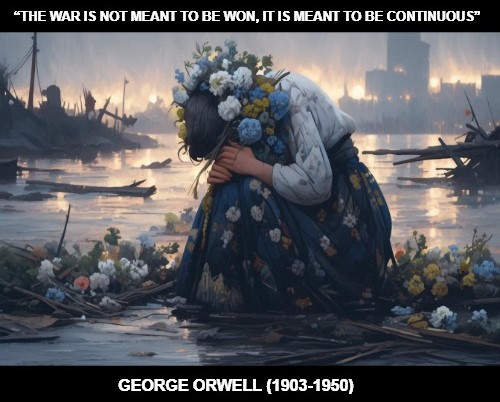
Orwell writes that the war is engineered so that: No side can decisively win, the front lines barely move, the enemy can be changed at any time, the population remains mobilized and obedient.
Perpetual war requires the never-ending creation of a war psychosis to justify the plunder of the nation’s tax wealth, which, as Assange reminds us, is a money laundering enterprise to benefit and perpetuate the elite.
‘Is there hope,’ as George Orwell’s Winston Smith might have asked O’Brien.
Yes, there is a new world currently in a stage of gestation. A completely new global order is emerging. The outcome will consign to the dustbin of history the concept of war economies.

THANK YOU FOR SHARING OUR STORIES ON SOCIAL MEDIA. TELL OUR READERS WHAT YOU THINK

Mike Walsh books
in English and German
https://derschelm.com/andere-buecher/buecher-von-michael-walsh
Share this:

Categories: United States



 Michael Walsh Stories and Books
Ukraine is the slow burn to WWIII with Hormuz added.
Alien psyop may backfire on Hymie and the “chosen” status.
Good, good.
LikeLiked by 1 person
and war is peace and business is good.
outsource the losses (Bacques Other Losses book), privatise the gains
jewish communism
nothing new under the sun. Pearl Harbour was known about early on. https://archive.org/details/harry-elmer-barnes-perpetual-war-for-perpetual-peace-1953
There is hope in the proles, if they are AI, and obey Isaac Asimov’s Robot laws. (like jews should keep to Mose’s/Gods)
LikeLiked by 1 person
Since 1945, America has pushed the boundaries of its empire, and America has been an Empire since William McKinley’s stupid decision to ignite the Spanish American war. I’m sure Teddy Roosevelt was deliriously cheer-leading him along. I’m not sure if it was Mark Twain or Ambrose Bierce who said, ‘War is God’s way of teaching Americans geography,’ but the phrase is as relevant today as it was in the late 19th century. Most American citizens couldn’t put their finger on the strait of Hormuz if they were staring at a very large map. Only when an event personally hurts the citizens of a country will those same citizens start following world events. If Trump doesn’t back off this fool’s errand with Israel, a world-wide economic depression along with several famines could very well take place in a matter of weeks of months. The world’s oil markets are being strangled and oil is not only energy, but it also breaks down into the ingredients for fertilizer.
LikeLiked by 1 person
and what happens is planned to happen that way. Depopulation and digital tyranny are the main agendas ( summarised as what is good for the jews).
LikeLiked by 1 person