







FASHION TIPS: Do you remember the expression: ‘She is the epitome of sartorial elegance’?
If you do not, it is because you have never had the pleasure of encountering a person who understands and practices fashionable flair and style.
When and why did modern men and women stop dressing up, dressing to suit the occasion and the mood?
Dressing for the theatre
I was once at an opera premiere. The show itself was jaw-dropping. Even more jaw-dropping was the sloppy attire of members of the audience. Surely, this was a time when it was an opportunity to dress to impress? If you imagine the audience spreading across the vast theatre hall
Unedifying as a bucket of worms

Festive attire and the drab, shapeless everyday life, where many looked as if they hadn’t come to the opera, but rather stopped at the supermarket after work.
You can accuse me of haughtiness. But I am not talking about people being poorly dressed. I’m talking about psychology.
About the psychology of how the difference between the drab everyday life and a celebration (like an opera) disappears.
Going out clothes
I understand the arguments about personal comfort and individualism. About how people don’t owe anyone anything. All of that is true.
But the problem isn’t that people have started dressing more simply. The problem is that the very idea of ‘exit,’ ‘transition,’ ‘performance’ has disappeared.
‘Going-out clothes’ was never just about clothes. It was a way to switch off or switch on.

Putting on the style
It was a way to enter a different state (including a cognitive one). To turn an event into a memorable occasion.
When a person wears ‘the same thing, only clean,’ they’re not just saving time. They’re giving up inner and outer variety; they no longer care about their appearance.
People once took pride in their appearance; they rejected what was ugly. People dressed to present several different versions of themselves:
They dressed for home, work, partying, going to Church, visiting friends and relatives etc. Clothes helped them switch between them.
The ugliness of sameness

Dressing was all about expressing yourself by wearing clothing that marked you out as an individual with a mind and taste of your own.
Many modern women in their pyjamas drop the kids off at school and carry on to the supermarket: what next, Church in their nightwear?
Now, more and more often, there’s just one version: ‘I’m in comfortable sweatpants.’
Drabness the new uniform
But comfort is a poor director for life. It simplifies everything, including joy. we were sold the idea of freedom through simplicity. But simplicity has become the new uniform.
People stopped obeying dress codes and began obeying formlessness. Culture is always about complexity and redundancy.
By simplifying clothes and eliminating different versions of ourselves, we supposedly save time, which is a fallacy.

Saving time? Really?
Everyone complains about the lack of time. So, this argument doesn’t work. When the dress factor disappears, it is not just style that disappears.
What disappears is respect for others and the places you visit. The feeling that something special is happening right now vanishes.
Everything becomes simple and uniform: a business meeting, a date, the theater, dinner. We work with people and see that when life lacks ‘transitions’ and ‘dress changes.’
The fact is that monotony is not just boring, it is an eyesore, an offence to human respect and dignity.
Does your dress code suggest idleness?
We abandoned the ‘ceremony’ for the sake of comfort and saving time. But no savings resulted.
The richness of life faded. We began looking for eye-catching, ostentatious substitutes for ‘vivid emotions,’ ‘real life,’ ‘genuine spirituality,’ and ‘meaning.’

Does your dress code signal your lack of imagination?
Sometimes the difference between ‘living’ and ‘functioning’ begins with what you wear before going out.
And perhaps the problem isn’t that people have stopped dressing up. Perhaps they’ve stopped considering themselves worthy of it.
Radiating personality
Larisa Pavele is a stylishly attired, thoroughly modern miss who turns heads and hearts with her carefully chosen outfit. Her outfit speaks eloquently for her.
How? Simply by carefully choosing the dress style with which she wants to express herself and radiate her personality.
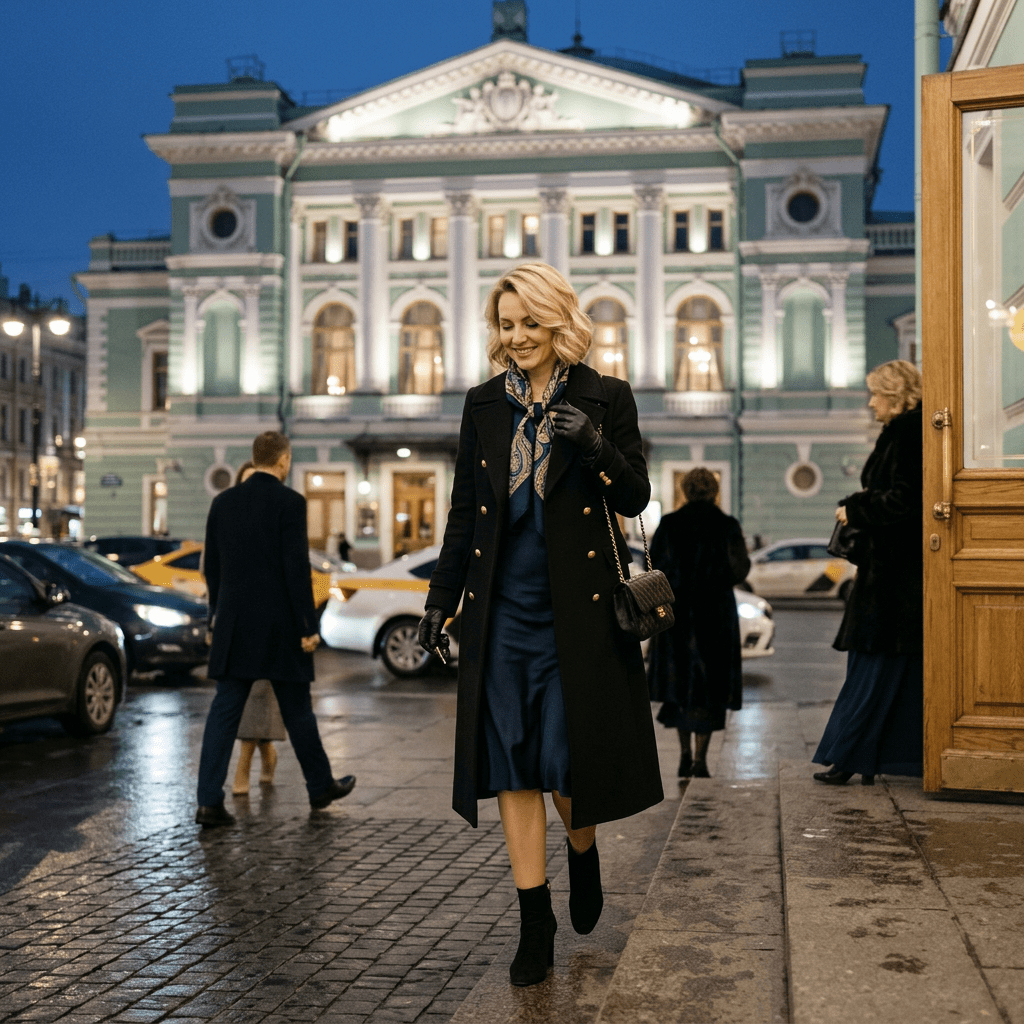
Mariinsky Theatre
Larisa says not all opera houses observe dress codes. “I was most astonished whilst attending the Mariinsky Theatre in St. Petersburg.
Many tourists were dressed inappropriately for such an event. Everywhere there were wrinkled T-shirts, ugly footwear, even flip-flops and sandals, and shorts.
I was shocked. I understand that tourists wear travel clothes, but there needs to be a certain understanding: is it the beach or the opera?

THANK YOU FOR SHARING OUR STORIES ON SOCIAL MEDIA. TELL OUR READERS WHAT YOU THINK
A BOOK AT BEDTIME. A NEW GENERATION OF ROMANTIC NOVELS is by Michael Walsh, the magical weaver of romantic dreams. THE ENIGMA OF TIFFANY, SOUL MATES and THE DOVETAILS HOTEL. https://michaelwalshbooks.wordpress.com/


Share this:

Categories: fashion



 Michael Walsh Stories and Books
Everything shabby like an Eastern Bloc apartment is part of the demoralization plan.
You’ll own bug chitin and Jarvanka coin if the AI data center says you have enough social credit score.
LikeLike