




How did a squadron of U.S. bombers break the rules of the sea in an action that led to the loss of tens of thousands of Allied seamen from autumn 1942? Few stories illustrate the power of the half-lie better than Allied propaganda relating to the ‘infamous Laconia Order’. This was Hitler’s instruction that forbade German shipping from picking up distressed survivors at sea, which was usual practice before the sinking of the Laconia.
The Laconia Order is recycled to show the Germans in a bad light – but why was the order given? On September 12 1942, the British troopship Laconia, in accordance with the rules of engagement, was sunk off the West African coast by the German U-boat U-156.
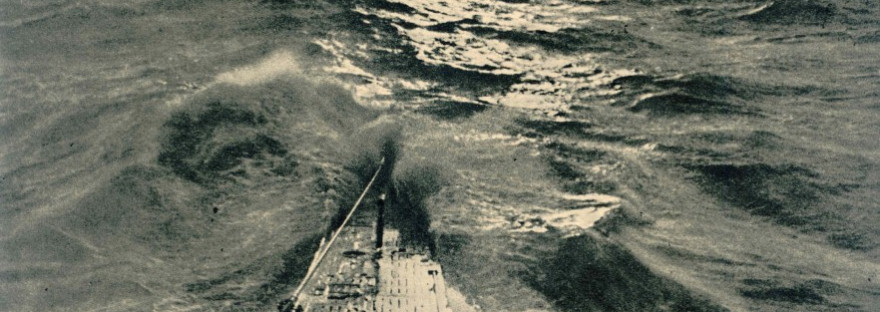
Under the command of Werner Hartenstein, the U-Boat crew immediately set about rescuing survivors of the sinking. As the German Navy sailors carried out the rescue the U-Boat commander relayed a rescue signal on an open channel. The U-boat’s skipper requested ships in the vicinity to assist in saving the seamen floundering in the waters or already in lifeboats.
The crew of the U-156 was soon joined by another German U-boat. As the submarines were rescuing seamen they were bombed by a squadron of American aircraft that had picked up the rescue signals.
Unsurprisingly, the under attack submarines immediately stopped their attempts at rescuing the distressed seaman and submerged and 1,792 of the liner’s passengers and crew lost their lives. Many of those lost were Italian prisoners-of-war. In order to save the lives of German Navy officers and ratings Adolf Hitler issued the Laconia Order. This order forbade all German vessels, irrespective of type or size to pick up allied survivors. The outcome was that tens of thousands of Allied sailors and passengers, who might otherwise have been saved, lost their lives.
The Laconia incident was one of many examples of the Allies contempt for the Laws of the Sea and the Rules of Engagement. The telling of it reveals also the appalling standards employed by journalists and palace publishers when compiling the ‘propaganda of the victors’.

On November 18, 1944, two British Beaufighter warplanes attacked the 4,820-tonne German hospital ship Tubingen in the Adriatic near Pola. The attacks were repeated nine times despite the vessel displaying international insignia that revealed it as a hospital ship.
The weather was clear and the sea calm. Lifeboats were launched from the stricken vessel thus saving most of the crew and medical personnel. However, six crew members lost their lives. Westminster apologised and claimed the attack had been carried out in error. The pilots responsible were never court-martialed although under the terms of the Geneva and other conventions they were clearly war criminals.
The British Royal Navy undoubtedly had its moments of glory but a number of atrocities brought shame on the so-called Senior Service. One of the Royal Navy’s most shameful atrocities followed the sinking of a Greek cacique by the British submarine, HMS Torbay.
As the small fishing vessel sank, members of an Alpine Regiment stationed on a nearby island were left floundering in the sea. Whilst attempting to swim away from the sinking vessel, the distressed servicemen were machine-gunned.
The order was given by HMS Torbay’s Commander Meir. Official reports never mentioned that the helpless sailors were slaughtered in cold blood; only that ‘they perished.’
Royal Navy sources claim that Commander Meir’s logbook admits that the crew did machine-gun survivors. This incident is believed to have caused near mutiny among the crew of HMS Torbay. There were several caciques and their crews slaughtered in the same casual manner by Royal Navy crews.
The outcome of this dreadful act was that the 38-year-old Commander Anthony Meir’s was later awarded the Victoria Cross in ‘recognition of his services.’ He died in July 1985 at the age of 78.
If there was any good at all that resulted from this infamy it was the outrage expressed by Captain Stephen Roskill, the Royal Navy’s official war historian. He broke ranks and spoke of the machine-gunning of prisoners in the Mediterranean off Crete as ‘disgraceful.’
There was a similar incident in April 1940 which followed the sinking of the German destroyer Erich Giese in Norway. A number of German survivors were shot out of hand. Interviews with German survivors, including the captain of the destroyer, Commander Karl Schmidt. Inspection of British and German logbooks relating to the incident revealed that an unspecified number of Germans were killed instead of being made prisoners of war.
THE ALL LIES INVASION Michael Walsh is an illustrated best-selling compilation of the failures of Allied propaganda up to, during and after World War II.

ARE YOU AN UNPUBLISHED NOVELIST

If you have written a novel or biography but lack the skills to bring your work to retail standard Michael Walsh can help you.
Enquiries invited from writers who have already written or are well advanced in writing their novels. There is a demand for fiction, real-life stories, mystery, romance, crime, erotica, and romantic comedy.
Contact: keyboardcosmetics@gmail.com or euroman_uk@yahoo.co.uk
Find more on our new website https://michaelwalshwriter.com/
Share this:

Categories: Sea Stories



 Michael Walsh Stories and Books
Awesome website you have here but I was wanting to know if you knew of any forums that cover the same topics discussed here? I’d really love to be a part of online community where I can get advice from other knowledgeable individuals that share the same interest. If you have any suggestions, please let me know. Thank you!
LikeLike
Excellent article. I certainly appreciate this website. Keep writing!
LikeLike