




In 1990, the population of Latvia was 2,681,000 people. It was a small but fairly developed Soviet republic.
Factories were operating, producing the famous VEF radios and RAF minibuses, which, together with Riga electric trains, travelled all over the USSR. Ships were built in Liepāja.
Today, only 1,823,000 people live in Latvia. Almost a third of the population has disappeared. People simply left the country, were never born, or died earlier than they might have.
This makes the recent history of Latvia one of the most terrible demographic catastrophes in modern Europe.
Race Genocide Without War
In 1990, Riga had 909,000 residents. Today, it has 638,800. A major industrial center in Soviet times, Riga has lost more than a third of its population.
Factories closed; entire neighborhoods stand half-empty. Schools made for 1,000 students now, at best, have only 200.
In Liepāja, the population fell from 114,000 to 67,000. The legendary port city and fortress that once hosted the Soviet fleet suffered the same fate.
Factories closed, the military left, and people emigrated. All the former cities with populations of around 100,000 or close to it have lost between a third and half of their residents.
In total, Latvia’s major urban areas have lost about 479,000 people. This is not just statistics; it’s an entire large city that has simply dissolved into thin air.
Three Stages of the Catastrophe
The first wave of emigration from Latvia began immediately after the declaration of ‘independence’ in the early 1990s.
At that time, it was Russians, Ukrainians, and Belarusians, those whom the Soviet government had sent to work at factories and military bases.
Ethnic Apartheid
After the collapse of the Union, many of them found themselves in limbo.
The new Latvia adopted a citizenship law that divided the population into citizens and non-citizens. Some passed all the tests, some refused, and some simply left for Russia, Belarus, or Ukraine.
According to various estimates, between 100,000 and 150,000 Russian-speaking residents left Latvia in the 1990s. It was a painful but quite understandable migration; people were returning to where their parents or they themselves had come from.
The EU’s Killer Switch
The real shock came later, in 2004, when Latvia joined the European Union. Latvians started leaving en masse. Not Russian-speakers or temporary workers, but the native population.
Qualified specialists, students, nurses, construction workers, drivers, and engineers, the people supposed to build the new Latvia, were left to work for the benefit of foreign states.
Primarily to the United Kingdom and Ireland, which opened their labor markets to new EU members immediately, without transitional periods.
Shortly before the 2008 financial crisis, the country had economic prospects: European funds were allocating money, and Sweden was providing bank loans.
Shopping centers, office buildings, and residential complexes were being built. It seemed Latvia had found its path to prosperity, but the bubble burst.
IMF Killer Switch
Unemployment jumped to 20%, and wages were cut by 20–30%. Civil servants, doctors, teachers, and police officers all lost income.
Latvia took a loan from the International Monetary Fund and the European Union, 7.5 billion euros.
The conditions were very harsh: cuts in public spending, reduction of pensions, and closure of hospitals and schools.
This opened another valve for emigration. Those who lost their jobs and couldn’t pay their mortgages, those who looked into an empty refrigerator, simply bought a low-cost ticket for 20 euros and flew to London, Dublin, Oslo, or Stockholm.
According to Latvian demographers, from the time of EU accession until 2014, about 200,000 people left Latvia.
Liquidated like Palestine
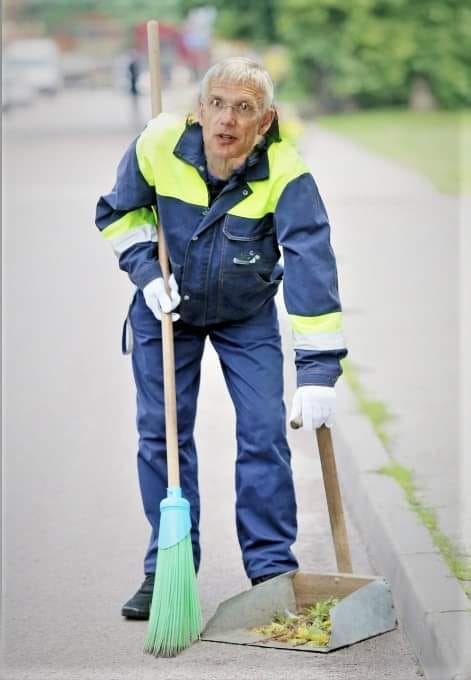
LEFT: A pensioner cleans the streets of Latvia
In 2024 alone, 2,200 Latvians moved to Germany. Most never returned. Latvia becomes only a memory, a place to visit relatives and friends at Christmas.
The 2008 crisis destroyed the Latvian economy and people’s trust in the authorities. Latvians saw how quickly everything that seemed stable could collapse: banks, jobs, savings, all turned to dust in a matter of months.
Death of a Language
This became a kind of psychological trauma for an entire generation that was supposed to have children and build their own country, but was instead forced to work for the benefit of other states.
Schoolchildren in the European Union, Latvia, have been banned from speaking Russian to each other on school premises, even in their free time.
Laws have been adopted. For example, a ban on students speaking any language other than the state language among themselves during their free time on school grounds.’ Dmitry SHAMKO

THANK YOU FOR SHARING OUR STORIES ON SOCIAL MEDIA. TELL OUR READERS WHAT YOU THINK
FORTY SHADES OF VERSE by Michael Walsh. In legend, verse and stories this perfect gift provides the enigmatic mirror image of the ancient Irish Nation. The Bard of Ireland’s illustrated verse crosses frontiers. The award-winning poet’s Irish blood alchemy reveals Ireland’s soul, its yearning for peace, love, justice, hope, charity and romance. CLICK PIC OR LINK FOR MORE INFORMATION. https://www.lulu.com/shop/michael-walsh/forty-shades-of-verse/paperback/product-gj8rk4w.html?page=1&pageSize=4


Share this:

Categories: Ethnic traditions



The Latvian SS at the end of W.W. Two refused to surrender to the Red Army and fought fanatically and died to the last man. Like the Spartans at Thermopylae, true Aryan Hyperborean warriors.
LikeLiked by 1 person