


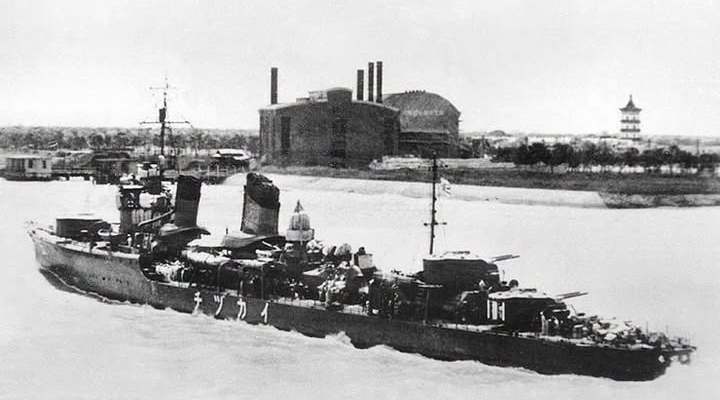

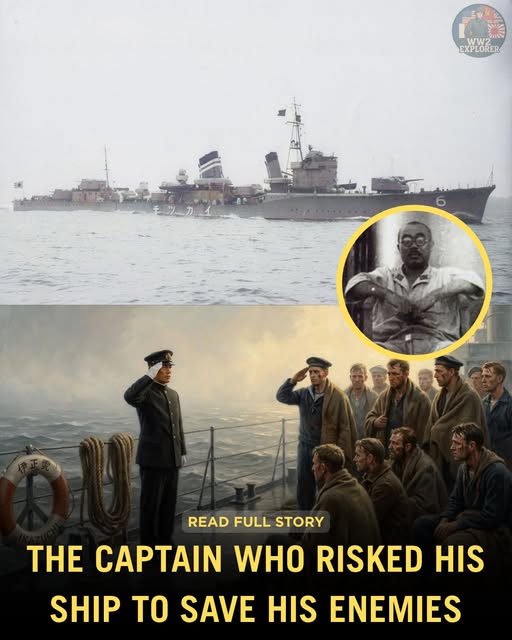
On March 2, 1942, Japanese destroyer captain Shunsaku Kudo stopped his warship in the Java Sea to rescue more than 400 British and American sailors.
Their ships had been sunk the day before.
The survivors had been drifting for about 20 hours, coated in fuel oil, many of them blinded by it. Some were so afraid of the sharks that they asked their own doctor for poison.
Rescue in Progress
When the destroyer Ikazuchi appeared, they expected machine guns. However, Kudo raised the international flag signalling ‘Rescue in Progress’.
Nothing required him to stop, and everything argued against it. A stopped ship is an easy target for a submarine. He had 220 crew, and he was about to bring roughly twice that many enemy sailors onto his deck.
His crew pulled them up anyway, for hours.
They cleaned the oil off with cotton, alcohol, and their own fresh water. They handed over their own shirts and trousers, and sewed more for the men who had none.
Kudo’s only rule for his prisoners was no smoking after sunset, so that no submarine would spot the glow. Then he came down from the bridge, saluted the British officers, and addressed them in English.
You have fought bravely
‘You have fought bravely,’ he told them, and called them guests of the Imperial Japanese Navy.
The next day he handed them over, and they spent three and a half years as prisoners of war. There is no record that Japan ever punished him, and he went on to command other ships.
WITNESS TO HISTORY (Original). MIKE WALSH. From 1934, the British, Soviet, and American empires provoked war with trade rival Germany. The Christian Reich was overrun, plundered and occupied. This epic illustrated best-seller tells you what the victors won’t tell you. Click the picture for details.
The Ikazuchi was later sunk with every man aboard, the same crew who had done the rescuing. Kudo survived the war, moved to a quiet town in Saitama, and never said a word about it.
He died in 1979.
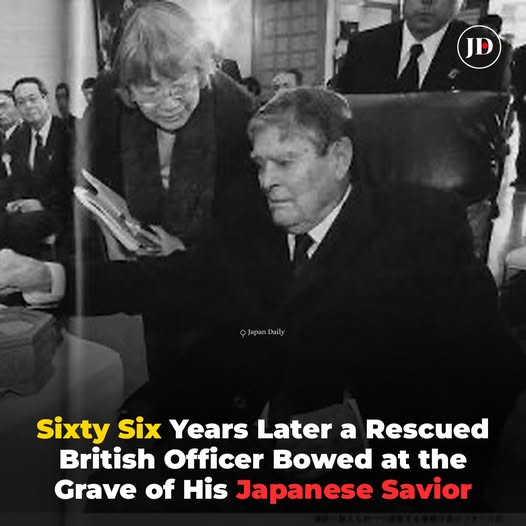
One of the men he saved, Sam Falle, became a British ambassador and never forgot his name. In 2008, at 89, Falle stood at Kudo’s grave in Japan.
Kudo’s own family learned what he had done from the Englishman he pulled out of the sea.

THANKS FOR SHARING WITH FRIENDS AND SOCIAL MEDIA
Share this:

Categories: World War II



There are so many stories like the one above. We have only heard them from survivors of that horrible war. My Father fought on the Russian front and toward the end of the war suffered life threatening insures. He was saved by one of his comrade, a cook in the SS Tank division, who was also a medic. Without this man’s quick action and knowledge , my father would have succumbed lying on the frozen snow during a massive assault. Under heavy artillery he was dragged through the frozen snow to a somewhat save area at a near by forest, from there transported on a dilapidated truck about 30 km west to a make shift lazarette. Drifting in and out of consciousness, he woke up on a surgery table, overhearing two surgeons talking about amputating his left leg after first taking care of the wide and deep hole ( Steckschuss ) in his back, which was lodged about 4 mm next to his heart, causing heavy bleeding ). One of the surgeon was a Russian ( Cossack, a Major ) the other a German general. Weak from much blood loss, my Father begged to not take his leg, but let him die. Both surgeon then promised to do everything to save his left leg from what was left. When he came out of surgery, he could overhear the moans and groans of other soldiers. He could hear them calling out in Russian, Italian, German, Czech, Romanian, Mongolian. My father spoke four languages and could understand. They were later taken to a Red Cross ship and transported back to a military hospital in Eisenach in East Germany which after the war had ended, was controlled by Russians, then by American and British forces. He was a Prisoner of war in that hospital for three years and was not well taken care of under the western forces, except for two young er Sergeants, who complained to the officers in charge about the neglect of the patients. For this they were told to shut up or be transferred. Anyhow, they secretly shared their rations with my father and other patients and were able to smuggle in food and some pain medications coming from the outside through barter and the black market. When my father was finally released at the end of 1948, he was a shadow of a once healthy, vibrant young man. My grandmother who had lost her husband ( my grandfather ) in the final weeks during the brutal battle in Berlin said, that my father was not recognizable when she saw him. Both were forcefully relocated to the western Zone, shortly before Germany was divided up into East and West, which tore up the few in my family who had survived the horrors of WWII.
My grandmother believed that a person with consciousness makes the difference by holding up morale and strength in the worst of time. She, herself, almost died at the hands of drunken Russian and Mongolian soldiers who brutally raped and murdered their way through the ruins of Berlin.
LikeLiked by 1 person