






MICHAEL WALSH MUSIC Eric Clapton was deep into a guitar solo. Something in the front row pulled his focus away from the music.
Twelve thousand people were on their feet, cheering, shouting, swaying with the rhythm. And right in the middle of all that noise, a teenage girl sat perfectly still.
September 23, 1992. The National Exhibition Centre in Birmingham, England. Clapton was midway through his Journeyman tour, riding the high of a sold-out crowd.
But in the third row, center section, one person wasn’t moving. Her name was Sarah Mitchell. She was sixteen years old. And she was profoundly deaf, born that way.
She couldn’t hear Clapton’s guitar. Couldn’t hear the screaming fans. Couldn’t hear the amplifiers shaking the building. Clearly, she adored Eric Clapton.

Her mother, Linda, had tried for years to prepare her. Music, she explained gently, wasn’t something Sarah would ever experience the way other people did. Sarah refused to accept that.
She learned music through vibration. She pressed her hands to the speakers at home. She studied concert videos, watching Clapton’s fingers until she memorized every motion.
She learned to read lips so she would follow lyrics she’d never heard. She didn’t need sound, she insisted.
For her sixteenth birthday, Sarah wanted one thing: to see Eric Clapton live.
Linda hesitated. She worried her daughter would feel isolated, surrounded by people reacting to something she couldn’t hear. But Sarah signed back with certainty: I don’t need to hear it. I can feel it.
So, Linda bought the tickets. Third row. Center. Money she couldn’t really spare.

That night, Sarah sat with both hands pressed to her chest, feeling the bass travel through her body. Her eyes never left Clapton’s hands.
She wasn’t clapping; she couldn’t hear when songs ended. She wasn’t singing; she’d never heard her own voice. She was absorbing everything in her own way.
Clapton noticed her halfway through ‘Layla.’ At first, he thought she might be unwell. While everyone around her jumped and screamed, she sat completely still, focused, intense. He kept playing, but he couldn’t stop watching her.
Then he noticed her hands.
They pressed against her chest in perfect rhythm with the beat. She couldn’t hear the music, but she was feeling it. Clapton realized instantly: she was deaf.
In the middle of the song, he stopped playing.

The band froze. The music cut out. Twelve thousand people became silent. Clapton walked to the edge of the stage. He pointed into the crowd.
‘You,’ he said into the microphone. ‘Come here.’
Sarah didn’t react. She couldn’t hear him. She was trying to understand why the vibrations had suddenly stopped.
Linda grabbed her arm and began signing frantically: He’s pointing at you. Eric Clapton is pointing at you.
Sarah shook her head in disbelief. No. That couldn’t be right.
Clapton gestured again, this time to security. Moments later, guards were guiding Sarah down the aisle as the crowd parted, whispering. Linda followed, crying.
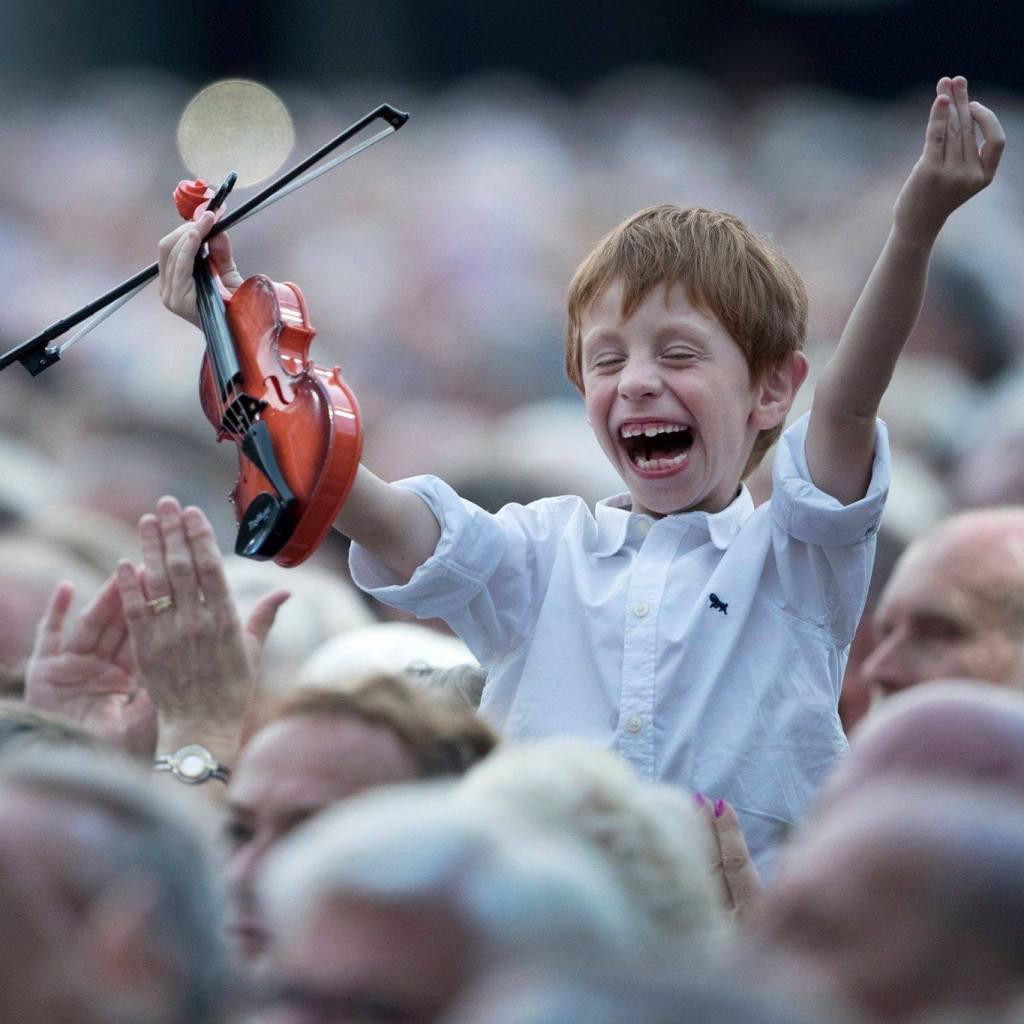
At that stage, Clapton knelt and reached out his hand. That’s when he saw it clearly, the unmistakable way deaf people study mouths, searching for meaning.
He turned to his crew. A chair was brought out and placed center stage.
Clapton gently helped Sarah sit down.
Then he did something no one expected. He turned his amplifier up, far louder than usual. Low, powerful bass rolled through the arena.
Then he moved the amp directly behind Sarah’s chair so the vibrations traveled straight through her body. His sound engineer panicked.
Clapton stepped to the mic.

‘Ladies and gentlemen,’ he said quietly, ‘this is Sarah. She’s been experiencing this concert in a way most of us never think about. She can’t hear the music, but she feels it. She watches it. She understands it.’
Then Clapton turned back to his guitar. And he played for her. Not louder. Not faster. Just deeper.
Sarah closed her eyes as the vibrations wrapped around her. Tears streamed down her face as the music moved through her bones instead of her ears.
The crowd didn’t make a sound. For the rest of the song, Eric Clapton played to a single person, proof that music isn’t only heard. Sometimes, it’s felt.

THANK YOU FOR SHARING OUR STORIES ON SOCIAL MEDIA. TELL OUR READERS WHAT YOU THINK
FORTY SHADES OF VERSE by Michael Walsh. In legend, verse and stories this perfect gift provides the enigmatic mirror image of the ancient Irish Nation. The Bard of Ireland’s illustrated verse crosses frontiers. The award-winning poet’s Irish blood alchemy reveals Ireland’s soul, its yearning for peace, love, justice, hope, charity and romance. CLICK PIC OR LINK FOR MORE INFORMATION https://www.lulu.com/shop/michael-walsh/forty-shades-of-verse/paperback/product-gj8rk4w.html?page=1&pageSize=4


Share this:

Categories: Music Notes



 Michael Walsh Stories and Books