




Winter was vicious in Hamburg in 1962. The Beatles had already achieved a considerable following. The Liverpool group then included drummer Pete Best and bass guitarist Peter Sutcliffe.
LEFT HAMBURG HARBOUR
During the early hours, four or five shipmates decided to leave the bars scattered along the notorious Reeperbahn. Home that wintery night was our vessel moored to the harbour’s dolphins in the middle of Hamburg harbour.
On reaching the ferry terminal we ‘fab five’ discovered that the first ferry to service the offshore ships was at 6 a.m. It was now 2 a.m. The terminal’s cheerless waiting room was bitterly cold whilst outside, snowflakes the size of pillowcases were floating down. The city and harbour were in near Arctic conditions.
What to do? Were we expected to spend the rest of the night in the waiting room? Nearby was moored an off-duty tug perfect for commandeering and getting us back to our ship. It didn’t have a crew so that was our role which you can call self-service.

Slipping unseen onboard the harbour support vessel we finally figured out how to get the vessel’s engines purring. Our only failure was our inability to find the ship’s navigation lights.
Even the tug’s wheelhouse was in darkness. Problem, sailing without lights was bound to draw attention but what else could we do but take a chance?
Our fears weren’t unfounded. We had barely slipped the lines when we spotted a fast police patrol boat approaching with its awesome searchlight trained on our hijacked boat.
Michael Walsh, author of 70 stories in The Leaving of Liverpool: “ Like rabbits held in the glare of headlights, we freebooters tried to shield our eyes from the glare of the approaching vessel’s searchlight fully trained on us.“
Distinctly heard across the frozen harbour were cries in the German language. Realising we were being asked our nationality and for a reason that I still cannot fathom, I called back, ‘Svenska!’
‘Ach, du bist Englisch,’ was the returned salvo.

The game was up. What were we to do but haul down the crew’s version of the Jolly Roger and replace it with the ignominious White flag of surrender and humiliation? No, that wasn’t an option.
Hotter than Hamburg: The King Arthur’s crew ‘celebrate their being marooned 100 km up the River Congo during the Congo Crisis (1960-1965).
In the darkness, the police patrol circled our highjacked tug in a vain attempt to thwart our progress. Meanwhile, we the buccaneers weaved, ducked and dodged across that ice-covered pitch-black Hamburg harbour.
Finally realising we couldn’t shake the port’s cops off we swashbucklers made a beeline for the pier where several small craft were already moored.
There being no time for berthing the tug in a conventional manner we ‘secured’ our fleeing vessel by ramming and jamming the luckless vessel between an already moored fishing boat and the quay. From that point on it was every man to himself.
We deckies fled along quays and piers a foot deep in snow which muffled our steps. Scattering in the frozen darkness, we could hear cries that recalled those we had heard called after prisoners fleeing from Germany’s wartime prison camps.
The rest of our night was spent killing time again in the now near-empty bars scattered along the city’s notorious Reeperbahn.
Sadly, one of our party was presumed to be ‘missing in action.’ We consoled ourselves with the thought that the deserted bars were more comfortable than a prison cell or a ferry service’s waiting room.
Morning arrived and the ferry service resumed. We fugitives, thinking we had gotten away with our sins were looking forward to finally returning to our moored vessel in the harbour.
Finally, aboard the ferry we escapees scanned the horizon for our vessel’s silhouette set against the wintry skyline. It was with some relief that we finally spotted our ship.
DEVIL’S CAULDRON – The River Congo current exceeds 14 knots.
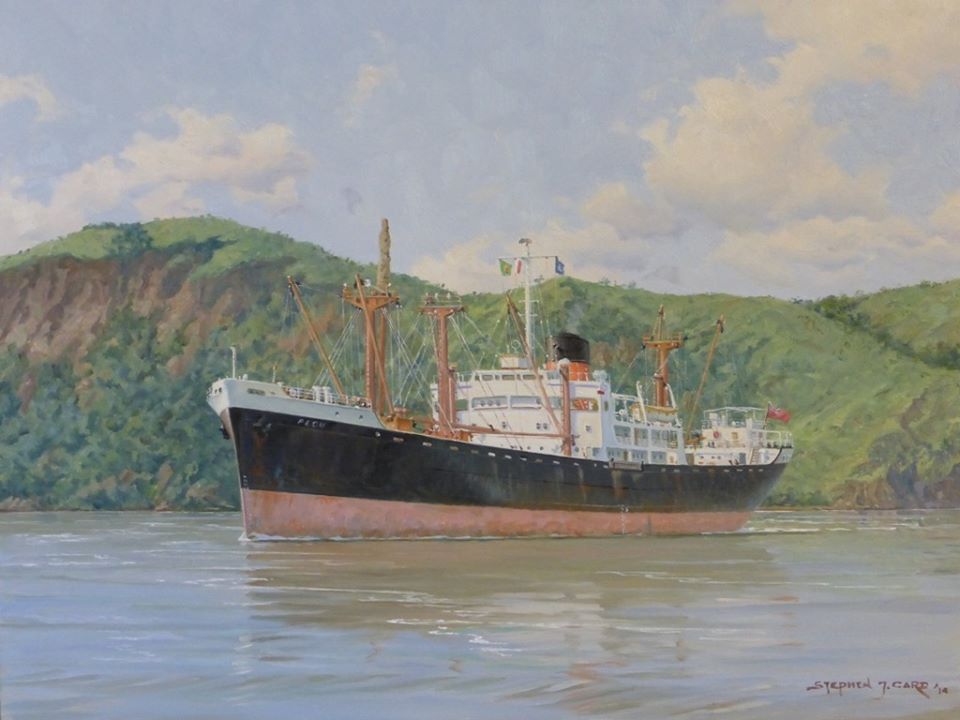
Our hearts and spirits plummeted. It was with considerable distress that we caught sight of a police launch awaiting our arrival. How could the harbour cops know that our crew had been responsible for the incident?
Simple: when we had leapt from the tug onto the snow-covered wharf hours earlier, the ‘missing in action’ crew member for some reason unknown had leapt into the harbour. The police had hauled him out from between the ice floes before setting out in pursuit of us.
What followed was a lengthy interrogation in the officers’ mess by both the police and the ship’s officers. We hijackers were informed that such behaviour merited a lengthy prison sentence. It was explained that several parts of the tug had been damaged when our fleeing vessel head-butted the port’s quay.
Left to stew in our juices for a while a compromise was reached. A court appearance and prison term were to be avoided by the confiscation of our meagre savings held in the ship’s account.
We were soon to see the back of Hamburg. It occurred to me later that the shipping company likely coughed up enough to compensate the port authorities. After all, getting a 5,300-ton freighter back to England without a crew isn’t easy; even a crew that cannot find a ship’s navigation lights. Story 29 of 70 similar illustrated stories published in the illustrated edition of The Leaving of Liverpool by ex-deckhand Michael Walsh.

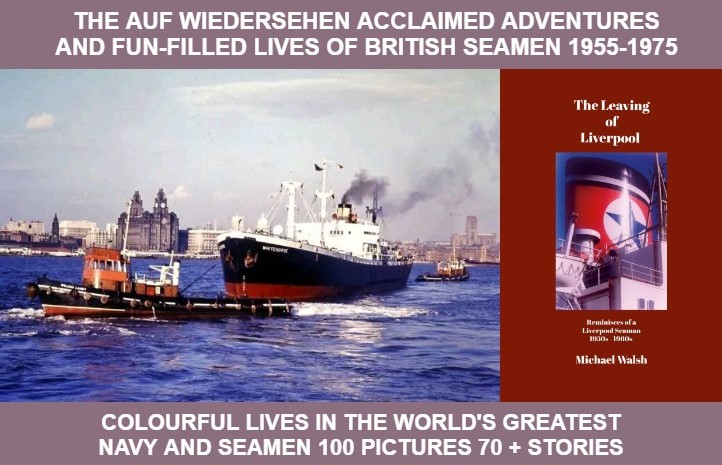
THE LEAVING OF LIVERPOOL ex-Liverpool seaman Michael Walsh, regular television, radio and newspaper personality. Bestseller: 70 stories and over 100 pictures. A first-hand account of the British ships, seafarers, adventures and misadventures (1955 – 1975). A tribute to the ships and seamen of the then-largest merchant marine in history. CLICK PIC FOR BOOK DETAILS.
BRITANNIC WAIVES THE RULES The Last White Star Liner (1845-1960) by Michael Walsh, a regular television, radio and newspaper personality. In 68 lavishly illustrated stories the company’s last deckboy vividly recalls shipboard life. The liner’s colourful characters and jaw-dropping incidents both on board and in New York’s notorious Hell’s Kitchen. A unique collector’s item. CLICK THE PICK FOR BOOK DETAILS

Share this:

Categories: Uncategorized



 Michael Walsh Stories and Books
Typical of British Seamen, to get into a merry state. Porto comes to mind, where we gathered in the First and Last, that.was until the 3rd mate walked in and shouted all hands on deck we sail in 2 hrs, No Buts all hands on deck, to batten down, drop the sticks and make ready for a rough sea. That mountain of a bosun pulled the plug on the Juke Box heaved it up onto his shoulder, and out we marched. The 3rd mate settled up with the barman, and we settled up with him, and the ship had a proud Juke Box to keeps us happy. Four months later skipper radioed Porto and asked for a 30 minute stop while we to the Juke Box back to the First and Last. Happy days and lasting memories. Take care Michael.
LikeLiked by 1 person
Super story….. made my day. Mike
LikeLike
Memories just keep coming back Mike, if only I’d had the talent to write them years ago, well pleased you like my little stories, got a few involving Sake and Anaset. But I love your stories,
LikeLiked by 1 person
Ray, we are all, team members – small but essential compontents
LikeLike