





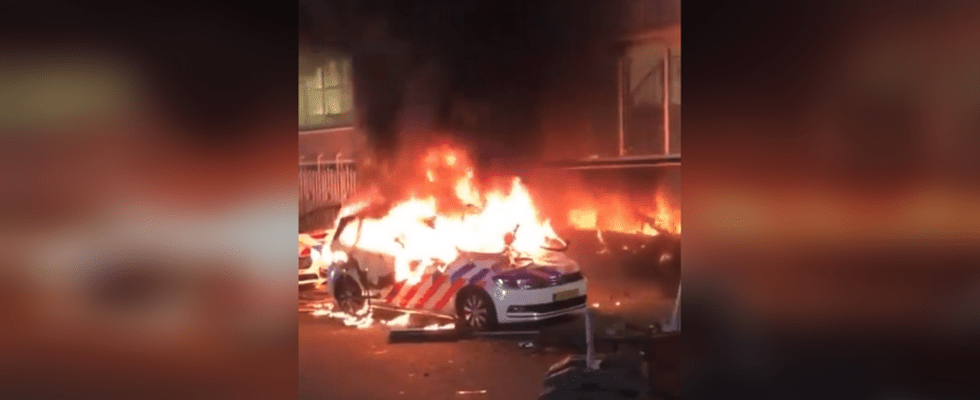
At least two people were wounded by police gunfire in the Dutch city of Rotterdam after a protest over government repression spiralled into a violent riot, seeing demonstrators torch a squad car and clash with officers.
A large crowd of protesters showed up at Rotterdam’s iconic Coolsingel Street on Friday evening to condemn a new round of what government and media describe as pandemic measures. These include an ongoing partial lockdown, a ban on New Year’s Eve fireworks displays, as well as fears the government will impose a ‘2G’ pass system allowing only the vaccinated and those who’ve recently recovered from the virus to enter a long list of public places.
‘For a virus that is officially rated by national health bodies as similar to that of the common flu. Anyone who believes this international unrest is a consequence of legitimate government desire to ‘save the people’ really do need to catch up,’ says Michael Walsh, international journalist and historian.
At least two anti-regime protestors were wounded during the demonstration. A local police agent told the media the injuries were the result of ’direct shots fired because the situation was life-threatening’ to law enforcement.
SOME NEWS STORIES ARE UNPUBLISHED BECAUSE OF LOW FINANCIAL SUPPORT
To Help Contact Michael Walsh, Editor euroman_uk@yahoo.co.uk
Footage of the heated protest circulated online, some clips showing a police operative car fully engulfed in flames after it was apparently torched by rioters.
Demonstrators were also seen launching fireworks at the regime’s uniformed agents, who responded with large quantities of tear gas, which at one point blanketed the area. A common strategy used by Soviet police operatives during the collapse of the Soviet Union in the late 1980s.

Local law enforcement said that operatives deployed a mobile riot control unit to Coolsingel and unleashed water cannon on protesters who refused to clear the streets, also noting that some arrests were made after an emergency order was imposed to cordon off the area.
The Dutch government announced the fireworks ban earlier on Friday, saying it is meant to ’prevent, as much as possible, extra strain on healthcare, law enforcement and first responders.’ However, while private displays are prohibited, officials said that local governments may still put on fireworks shows.
The Netherlands currently has a ‘3G’ rule in place, allowing the vaccinated, the recently recovered, as well as those who test negative for the virus to enter most public spaces. But as the country remains under a partial three-week lockdown, officials are now mulling the stricter ‘2G’ scheme, prompting the intense demonstrations seen on Friday night.

Meanwhile, France has imposed a curfew on its overseas territory of Guadeloupe in the Caribbean and is sending extra police to the island, citing days of violence, unrest and vandalism in response to harsh pandemic restrictions.
‘Given the ongoing social unrest and acts of vandalism, the prefect of Guadeloupe has decided to establish a curfew starting today from 6 pm to 5 am,’ Alexandre Rochatte, who represents the archipelago as prefect, said on Friday.
Earlier on Friday, the French Interior Ministry noted that 200 French police officers and gendarmes would be shipped into Guadeloupe in the coming days to crack down on the ’violence’ and ’restore republican order.’
The move comes after nearly a week of heated protests over local Covid-19 policies, which include mandatory vaccinations for healthcare staff and other ‘essential’ workers, among other things. Demonstrators have torched cars and erected burning barricades in the streets, while doctors, firefighters and other professionals have walked off their jobs in protest, according to Reuters.
In footage circulating online earlier this week, men purported to be protesting firefighters were seen soaking police with a water hose hooked up to a nearby fire hydrant. Officers quickly shut off the spigot.
As in mainland France, residents are also required to present proof of vaccination, a negative PCR test or show they recently recovered from the virus in order to enter a number of public establishments, including restaurants and museums.
Those policies have proven unpopular for many locals, with trade unions launching indefinite strikes in protest over the past week, joined by other residents in street demonstrations. Like this story? Share it with a friend!




Share this:

Categories: Uncategorized



 Michael Walsh Stories and Books
Hello! I just would like to give a huge thumbs up for the great info you have here on this post. I will be coming back to your blog for more soon.
LikeLiked by 2 people
Thank you, Pianino.
LikeLiked by 1 person