




An exhibition has opened in Berlin dedicated to the 14 million ethnic-German expellees who were expelled by the triumphant Soviet, British and American allies from their former German homelands at the end of World War II.

After the British and American forces gifted huge swathes of German territory to the Soviet Union from 1944, 14 million ethnic Germans were driven out of their homelands of 1,000 years by the marauding UK/US sponsored Red Army.
The subject of Allied mass murder amounting to multiple genocides has long been a taboo topic. The tragedy of the Expulsion of Ethnic Germans is largely ignored and unknown in the Russian Federation and their Capitalist West cohorts.
Washington-approved Chancellor Angela Merkel opened the Centre for Flight, Expulsion, Reconciliation on June 21th. It is an exhibition that takes pains to put the experiences of Germany’s 14 million World War II displaced expellees, and of the experiences of refugees throughout the 20th and 21st centuries.
The permanent exhibition begins with eyewitness videos and information panels as well as exhibits. Visitors to the thought-provoking exhibition are immersed in the global history of politically motivated genocide and migration, up to and including the Syrian, Iraq, Somali and Libyan crisis which result from Washington / NATO regime changes.

It can be assumed that the story of the deliberate territory reduction of the pre-war German nation and the genocidal reduction of these lost territories 14 million ethnic Germans would not have been permitted to open had the German expellees not been grouped together with refugees.
Their only crime was that they were Germans for which sin they were driven from their ancient homelands to the territorial reduced Germany. Today, Germany is less than half the size it was before World War I. Germany’s prosperous worldwide colonies were seized as prize of war (plundered) by the Allies in 1919. As Russian President Putin surmised, ‘World War II was the sole responsibility of the Western powers.
The fate of 14 million ethnic Germans following World War II is far different. In the case of defeated Germany, Allied genocide of ethnic Germans was inspired and fuelled by a deliberate policy of population reduction to remove any possibility of Germany ever again being a trade or viable National Socialist rival to the interests of the Allied Communist / Capitalist colossus: The Washington / Moscow Axis was described by Adolf Hitler as ‘two sides of the same coin’.

The next section of the politically correct exhibition guides the visitors through the National Socialist period (1933-1945). The sole intention of the exhibition is to brainwash visitors with a fake understanding of Allied war crimes and the need to launder Allied crimes assisted by their controlled mainstream media and palace publishing houses.
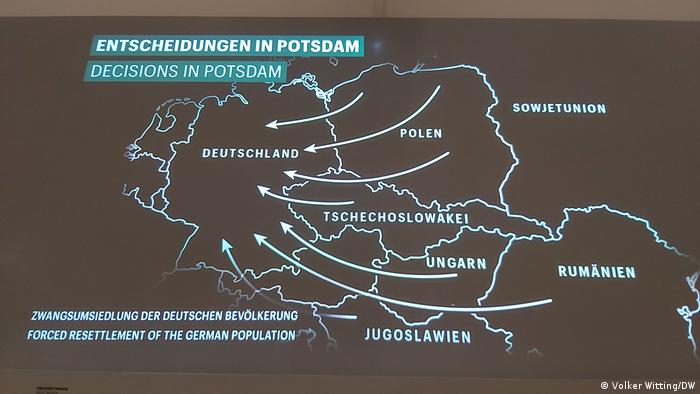
Millions of trekking expellees passed through former German towns, cities and villages in regions of Germany the Allies had gifted to Stalin’s murderous regime in 1946.

The third section of the centre’s permanent exhibition puts this in a larger context of millions of other Europeans from the territory dismemberment of Allied overwhelmed Europe including Poland and Hungary who made their way westwards to the hauntingly disastrous Allied occupied zones of the Soviet Union, British Empire and the American behemoth.
This heavily-biased Allied approved exhibition reveals the stories of displaced persons (expellees) in the British, Soviet and American occupation zones, such as those of the then 14-year-old Stefan Ferger, whose family had to flee northern Serbia, then part of Yugoslavia, to escape the Red Army.

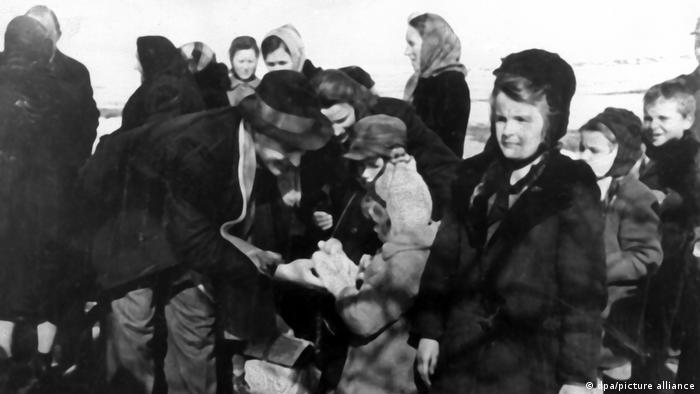
In the Soviet zone of eastern Germany alone, it has been estimated that about a quarter of all inhabitants were expellees. At first, these unfortunate aged, women and children, orphans of conscripts lost to war, were mostly not welcome despite the region being their own country. It took some 22 years for the museum to be opened to the public. This was shame, guilt, embarrassment, and avoid shining a light on shameful Allied responsibility.
It’s a question that became entangled incontemporary German politics partly because one of the originators for the centre was Erika Steinbach, along-time Bundestag member for Merkel’s conservative Christian Democratic Union (CDU), who has since switched her support to the far-right Alternative for Germany (AfD).
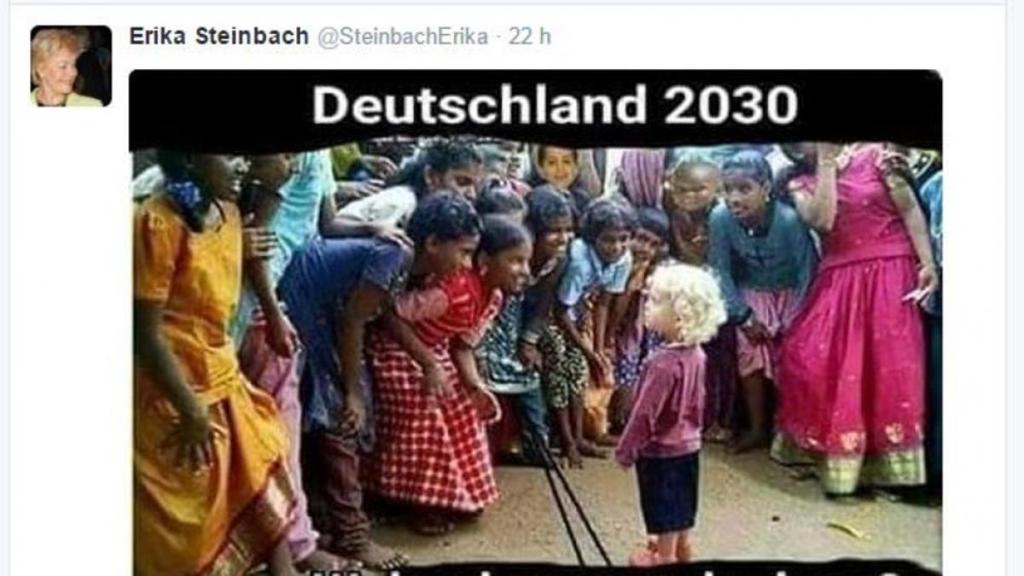
From 1998 to 2014, Steinbach was the influential president of Germany’s Federation of Expellees (BdV), an organisation with some 1.3 million members that represent the interests of the families of Germans who fled or were expelled from Eastern Europe. Steinbach’s campaigning and pronouncements about Germany’s post-war border and German families’ claims on stolen lands outside it have often complicated relations with the country’s eastern neighbours now squatting on what was for thousands of years German lands, farms and towns, even cities.

Many of the expellees in West Germany later banded together in so-called Landmannschaften and other associations, most of which were notably conservative and nationalistic in political orientation. But they represented a major constituency: In the early years of the Federal Republic of West Germany, expellees and refugees made up more than 20%of the electorate.
In Soviet Occupied East Germany, those driven out of their homelands of generations by the Soviet, British and American Axis were called ‘re-settlers’ and initially received integration assistance. But from around 1950 onward, the subject of expulsion was taboo in the GDR and throughout Western nations. In effect, the Russians and Western Powers were holocaust deniers.

That the exhibition can now be opened is a small miracle. Disputes by apologists for countless Allied War Crimes arose over the location, orientation and organisation of the project, and even led to diplomatic disagreements with the Czech Republic and, above all, Poland. Suspicions arose that the exhibition would be used by the Germans to present themselves as victims, which assuredly they were.
The German Bundestag decided to establish a foundation devoted to the project in 2008, which was when Steinbach began to lose her influence. Still, she attended the symbolic ground-breaking ceremony for the exhibition alongside Chancellor Merkel in 2013.

‘The Documentation Centre is about the flight and Allied expulsion of ethnic-Germans, but also about the many other people,’ said Gundula Bavendamm, a scholar who is the director of the centre. She sees it as a place of learning and remembrance where just one principle guides everything: Understanding what loss means.’
The exhibition is housed in Berlin’s Deutschlandhaus, a 1920s building that was renovated for the purpose. The Foundation Board of the Documentation Centre includes representatives of the government, the German churches, the BfV, but also politicians like Stephan Mayer, a Bundestag member for the conservative Christian Social Union (CSU).


Mayer said the centre is particularly close to his heart as a grandson of Germans from the Sudeten area in the Czech Republic. He told DW that the memorial contributes to the ‘reconciliation of the Germans with themselves.’ The expellees now finally have a place, he said,’ where their fate is commemorated and the process of coming to terms with this last chapter of World War II is advanced.’
When he was asked at a press conference why it took so long to establish the centre, Bavendamm replied that for ‘painful chapters’ in their history,’ societies often need a certain amount of time.’ The Documentation Centre Flight, Expulsion, Reconciliation will be open to the public from June 23rd. Admission is free.
NOTE: WORLD WAR II war profiteers raked in $933 every time blood was spilt anywhere in the world. Every time an American fell in battle the Wall Street tills rang up $52,000 blood profits.

Share this:

Categories: Uncategorized



 Michael Walsh Stories and Books
Reblogged this on MICHAEL WALSH QUALITY BOOKS.
LikeLike