




Children under 6 years of age are as nature intends very good at memorising any information. It’s not news at all that the best and most pleasant way to develop children’s memory is poems and songs.
We develop memory from an early age. The very first and most important factor in the development of children’s memory is nothing more than a lullaby that the baby hears every day from mommy.

Starting from 5 months, the baby’s memory is trained thanks to simple rhymes. Despite the fact that at this age the kid does not understand what the verse is about, he will still be fascinated to listen to the changing intonations, rhymes and rhythm of the verse.
In addition, reading poetry to a child has other positive aspects, for example, it provides close communication with the baby. Observing the movement of the mother’s lips, the little one himself will try to imitate the sounds and movement of the lips, and a little later he will pronounce the words.

From the age of one and a half, a child can begin to study and independently reproduce poems and songs. You will be very surprised how quickly whole poems will be deposited in a small head! The practice of memorising poetry will not only help develop memory but will also have a beneficial effect on the speech and richness of the baby’s vocabulary, as well as develop imagination and broaden horizons.
Short quatrains and fairy tales will help. If the child likes the text, he will remember it almost from the first time. A universal way of memorizing verses is to read it aloud 2-3 times, then take a break and try to reproduce the verse with the baby.
Michael Walsh, thought to be Britain’s most accomplished living poet says, ‘I learned to love poetry because my mother, having benefited so much from poetry, taught me to love verse.’
He goes on to say that his mother even in her eighties could recall word for word poetry she had learned in the classroom as a child.

‘Knowing that any story true or fable can be misinterpreted and exaggerated with the onward telling, the news was usually conveyed by troubadours and minstrels from village to town in the form of verse. By keeping the story in verse form it travelled across the regions without being distorted by the retelling.’
Any kid is special and each has its own individuality, therefore not all children can be interested in learning a verse. If your baby is one of these children, then try to go for some tricks. Start reciting the verse out loud, as if to yourself, and pretend to forget a word. Ask the toddler to help remember him.
An alternative method of involving the child in memorising poetry is to ask them to show the rhyme with gestures or try to draw it.
We all know that the main driver of human endeavour is motivation. To increase the child’s enthusiasm, provide him with grateful listeners. Let it be grandmothers, aunts, neighbours and other guests who would deservedly admire the efforts of the kid, and he will be much more willing to give such ‘concerts’.

THE CHILDREN’S POEM

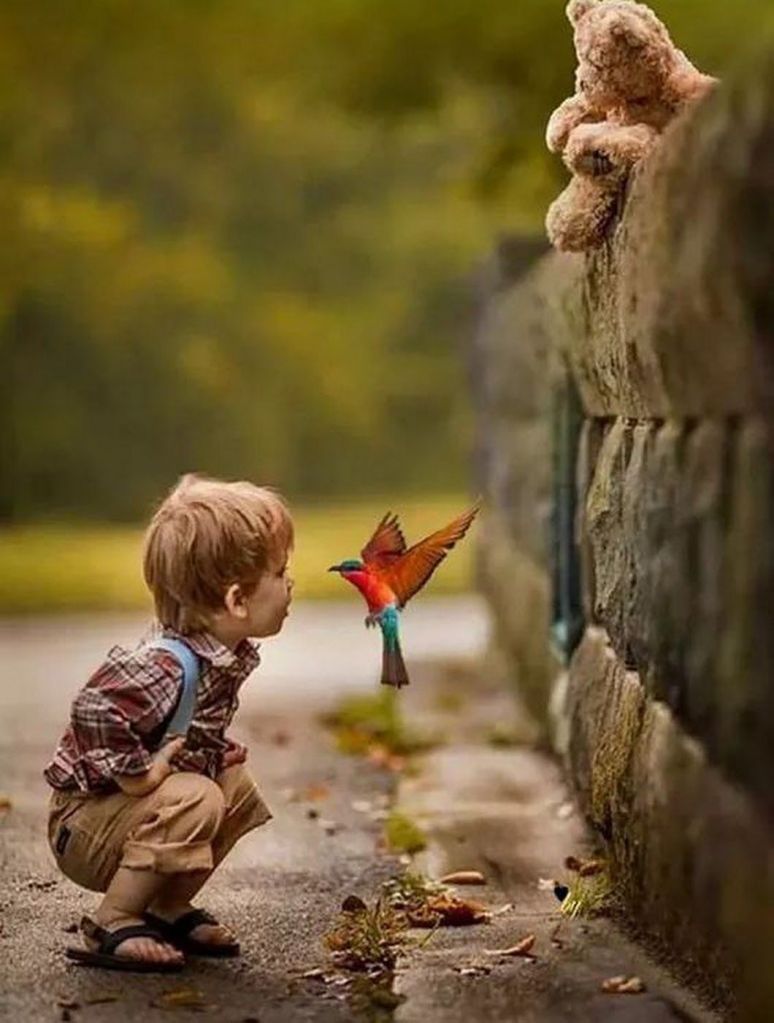
Conversation between the child and the bird

Hi funny feet, I thank the Lord,
I don’t have feet like you;
But you do not have wings like me
Nor do the things I do,
When funny feet are swinging,
On a branch, you’re far below,
You, my friend, must always plod,
And follow toe-to-toe.

Hey funny beak, I sure am glad,
I haven’t lips like you,
How do you kiss or smile or smirk,
Like all good humans do?
At least I have a mouth, my friend,
No dentists shall I see,
I never wished to be like you,
Far better be like me.

You don’t have arms, no fingers, hands.
You are a dreadful sight,
But, sir, what kind of life is it,
To never soar in flight?
You have no wings;
Your lips are gone,
You plod with feet of lead,
Yet I can cling, I sing and fly,
For I’m much better bred.

 Michael Walsh Poetry

ARE YOU AN UNPUBLISHED NOVELIST

If you have written a novel or biography but lack the skills to bring your work to retail standard Michael Walsh can help you.
Enquiries invited from writers who have already written or are well advanced in writing their novels. There is a demand for fiction, real-life stories, mystery, romance, crime, erotica, and romantic comedy.
Contact: keyboardcosmetics@gmail.com or euroman_uk@yahoo.co.uk
Find more on our new website https://michaelwalshwriter.com/
Share this:

Categories: Family & Parenting



 Michael Walsh Stories and Books
Reblogged this on MICHAEL WALSH QUALITY BOOKS.
LikeLike