



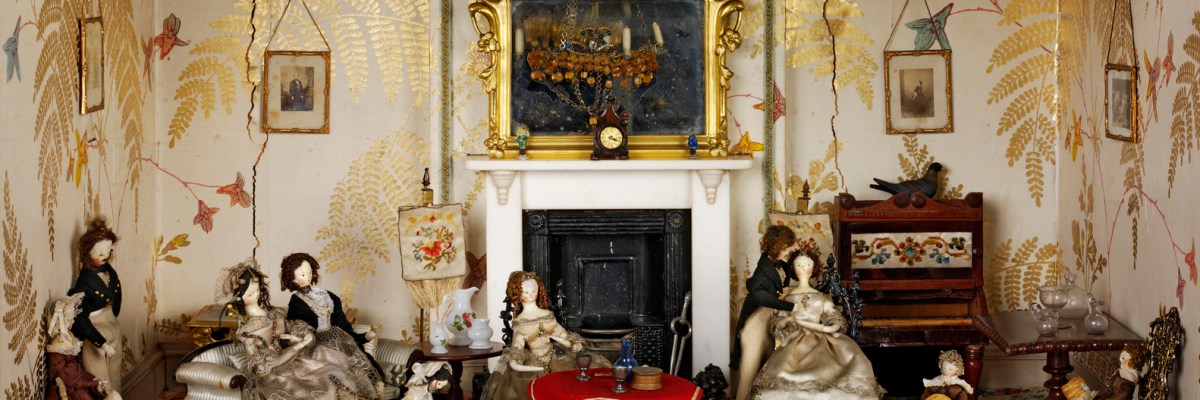
What of the origins of doll’s houses? Where does the interest come from – for our children to love to play with them, for so many adults to love to collect exquisite miniatures like this?

Well, it seems to have begun as far back as the mid sixteenth century when Albert V, Duke of Bavaria, commissioned a copy of his own home to be crafted and then displayed as a show of his wealth and eminence. In later centuries more and more scaled down copies of real homes were exhibited as display cases to be filled with objects of aspiration, with many of the finest examples costing as much to create as a full-sized residence.
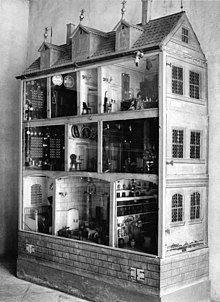
Only in the Victorian era were the houses used as playthings – albeit being limited to those children whose families were rich enough to afford to pay the craftsmen who possessed the necessary skills to craft such delicate objects.
However, the industrial revolution resulted in mass production which affected many aspects of life – and as far as doll’s houses were concerned it rendered them more affordable, very soon becoming a mainstay of any respectable nursery.
The German manufacturers – whose houses and furniture were the most prized – were Hacker, Moritz Gottschalk, Elastolin, and Moritz Reichel. In America there was the Bliss Manufacturing Company. In England there was Silber and Fleming, Evans and Cartwright, and Lines Brothers – who later became known as Tri-ang.
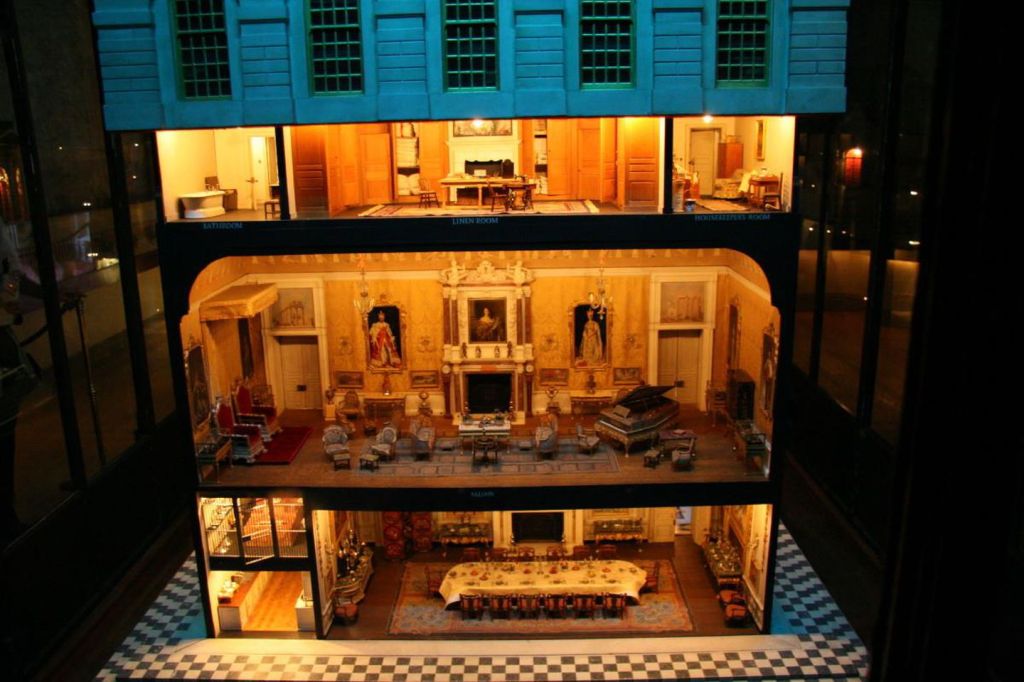
Should you wish to see some fine historical examples today, the VV recommends a visit to the V&A’s Museum of Childhood, situated in London’s Bethnal Green. There, the following examples of doll’s houses are displayed –

The Tate House was created around 1760. Modelled on an eighteenth century Dorset house, it can be separated into different sections – originally so that the mistress of the house could more easily take the ‘baby house’ along on her travels. The furniture is not contemporary. It is thought to be have been updated in 1830. Even the windows have been ‘modernised’ to appear as Victorian sashes when before they would have had twelve panes.
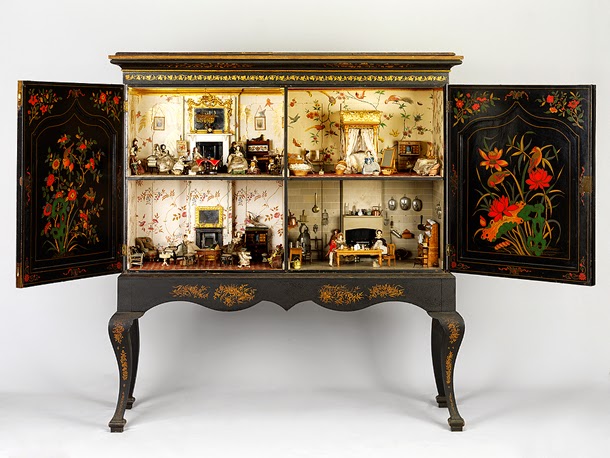
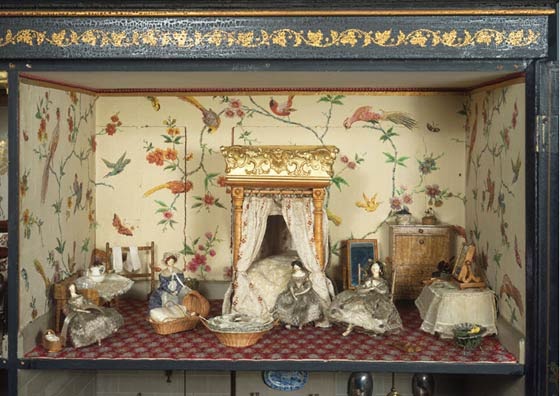
The Killer Cabinet House was commissioned by the Manchester doctor, John Egerton Killer around 1835. (The VV is trying not to smile at that unfortunate professional name.) The cabinet was made to indulge his wife and daughters in their hobby of making miniature domestic objects. It has four rooms – a drawing room, a morning room, a bedroom and a kitchen.

The Amy Miles House – circa 1890 – was made for the little girl of that name. It includes a billiard room and school room and, before it was damaged in the second world war, there was also an artist’s studio situated above a bathroom.

Love is love and love will stay,
When lifeless hand has slipped away.
THE DOLL’S HOUSE
Working hard for many months, he built her little home,
The fitted kitchen, windows too, the bathroom taps of chrome,
The gable end was sculptured as the image of her face,
And every chair and table had its special little place.
He handed her the key that day, his daughter’s eyes were wide,
Oh, that day was special as he showed her round inside,
Nothing missed; her face was bliss, the tiny kitchen stove,
Who knows what dreams will whisper,
When enchanting thoughts are wove.
His daughter loved that little home and each and every day,
She dreamt of guests arriving and the compliments they’d say,
The entrance door and staircase, the bedrooms all complete,
The furniture and carpet laid for countless little feet.
Her home her own, her reveries, would never disappoint,
The house to her was real enough and size beside the point.
Those careful chosen curtains and the little family placed,
Each child will have their fantasies reflected in their face.
The years passed by and he did too for time demands its toll,
Yet often in her mother days, she played her childhood role,
Then came an offer for the house, to cross her palm with gold,
But gold when young still turns to rust but children can’t grow old.
Irish writer and poet Michael Walsh
The poem Doll’s House from Michael Walsh’s book Heart to Heart Volume 2
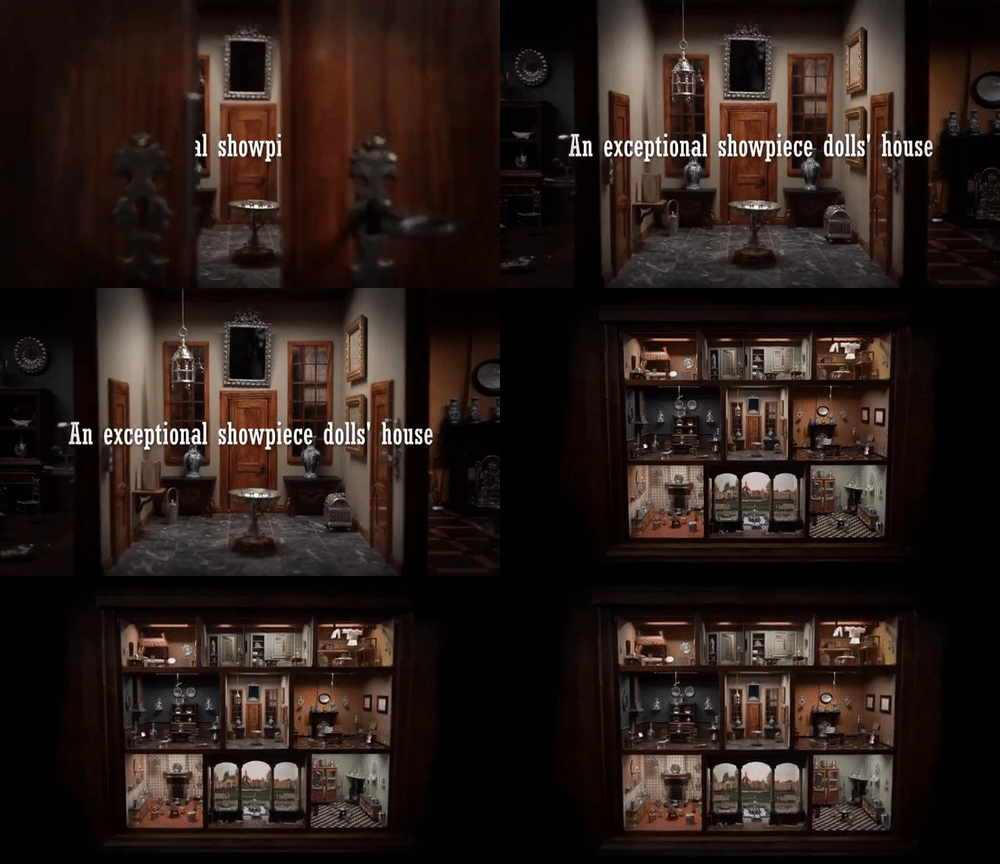
12 Dollhouses That Trace 300 Years of British Domesticity
© Victoria and Albert Museum, London
Share this:

Categories: Amazing



 Michael Walsh Stories and Books
Reblogged this on MICHAEL WALSH QUALITY BOOKS.
LikeLiked by 1 person
We appreciate your work and we are grateful for your truth. There is an entire life filled education available through just your works alone. Humanity is able to transform all the falsehoods they believe in by their looking into your writings.
You present to us the best about humanity, but also its deplorable side which is demonstrated by the average. You have gone way beyond the ‘average’ with your genius and special love for truth.
Thank you!
LikeLiked by 1 person
Thank you, dear Janice: Two souls with one thought, two hearts with one beat.
LikeLike
Very nice article. I certainly love this site. Keep writing!
LikeLike
Hey there, I think your website might be having browser compatibility issues. When I look at your blog site in Ie, it looks fine but when opening in Internet Explorer, it has some overlapping. I just wanted to give you a quick heads up! Other then that, awesome blog!
LikeLike