




FORBIDDEN REAL HISTORY Field-Marshall Lord Allenby described World War I (1914-1918) as a lengthy period of general insanity.’
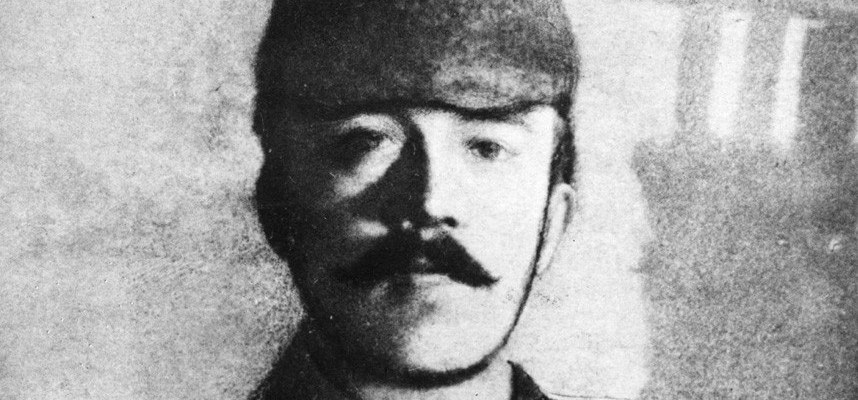
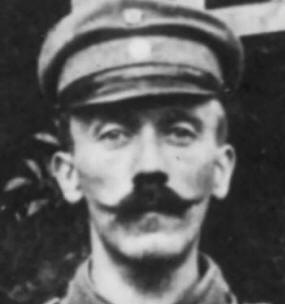
The then 24-year-old Austrian Adolf Hitler, believing in Imperial Germany’s cause, expressed himself thus:
‘For me, it was a deliverance. I am not ashamed to say it today: I fell on my knees and thanked God.’
As for many years, he had been afflicted with tuberculosis, Hitler need not have been destined for the armed forces.
On February 5, 1914, months before the outbreak of the Great War, Adolf Hitler applied for military service. He was prohibited as ‘Unfit for the army or auxiliary corps; too weak, rejected.’
As for many years, he had been afflicted with tuberculosis, Hitler need not have been destined for the armed forces.
Passionate about the unification of German and Austria the landlord of his Munich lodgings, Herr Popp, recalled the small plaque posted over his young lodger’s bed.
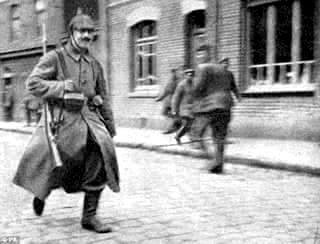
RIGHT: 26-year-old Adolf Hitler pictured in 1915#
It read ‘freely with an open heart, we are waiting for you. / Full of hope and ready for action. / We are expecting you with joy. / Great German Fatherland, we salute you.’
Adolf Hitler did everything in his power to overturn this rejection. On the 3rd August 1914, he sent a personal letter to the King of Bavaria. In this letter, he begged to be allowed to enlist as a volunteer.
His plea was accepted, and he joined the 6th battalion of the 2nd Bavarian Infantry Regiment.
During the German advance on France on October 20, 1914 and conflict with the 2,000,000-strong British army of the empire, Hitler, in a letter to Frau Popp his landlady, confessed:
‘I find it hard to contain my enthusiasm. How many times have I wished to test my strength and prove my national faith?’
For four long years, Hitler fought along the frontline trenches of the Western Front’s most furiously contested battlefronts.
These apocalyptic conflicts included the names of places still renowned for their valour and the heartbreaking number of lives lost.
All graced the colours of many German and British regiments: Yser, Ypres, Flanders, Neuve Chapelle, La Bassee, Arras, Artuis, Somme, Fromelles, Alsace Lorraine, Aillette, Montdidier, Soissons, Rheims, Oise, Marne, Champagne, Vosle, Monchy, Bapaume.
During those terrible years, the future leader of the German people displayed exemplary courage. This courage was evident in a conflict that involved more than forty battles.
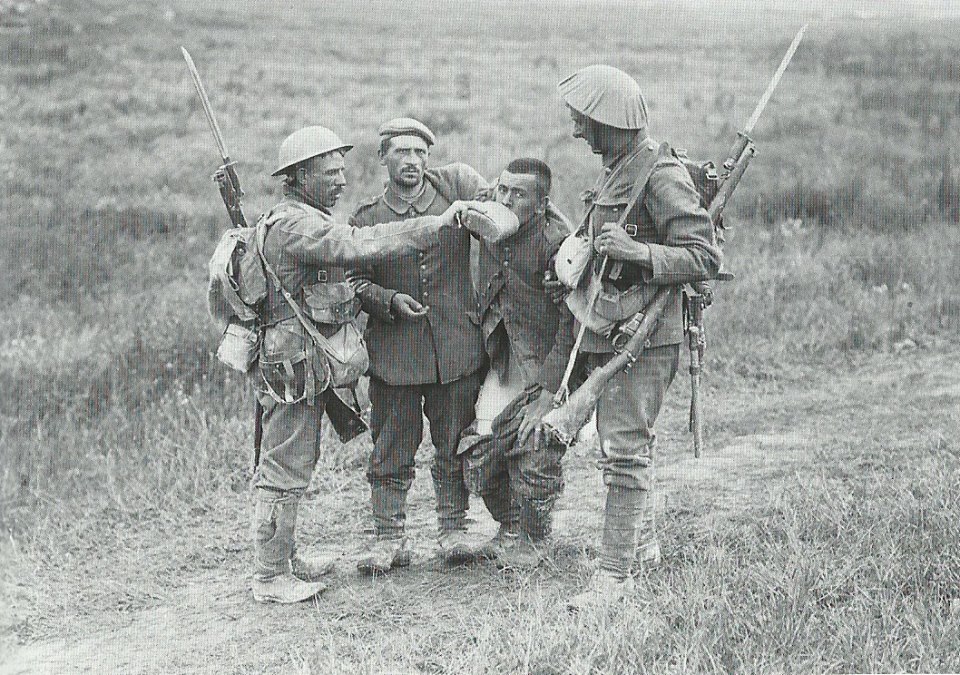
Adolf Hitler was wounded and hospitalised for two months on October 5, 1916. He was back at the front until October 15, 1918, then hospitalised again for gas poisoning.
Throughout the course of the war, Adolf Hitler was cited for valour and distinguished conduct in the field.
He was awarded the Iron Cross 2nd class on December 2, 1914. He was also awarded the Bavarian Military Medal, 3rd class, with a bar, and later the Iron Cross, 1st class. He received, as did all wounded soldiers, the Cross of Military Merit.
Lieutenant Colonel Godin made an official request for Hitler to be awarded the Iron Cross 1st Class. He stated: ‘He was a model of coolness and courage in trench warfare. He also showed bravery in assault combat. He was always ready to volunteer for carrying messages in the most difficult and dangerous situations.’
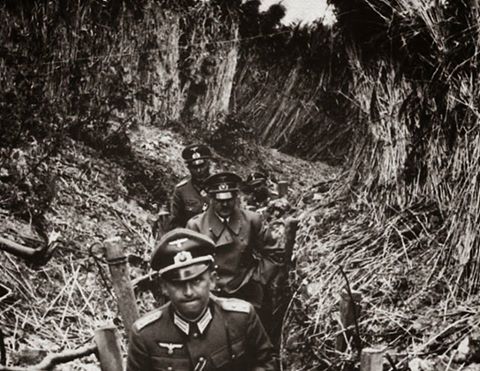
LEFT: Adolf Hitler revisits the trenches of his 16th Reserve Regiment
On awarding this recognition Colonel Anton Tubeuf stated:
‘He was always ready to help out in any situation, always volunteered for the most difficult and most arduous, and the most dangerous missions, and to risk his life and wellbeing for the Fatherland. On a human level, I felt closer to him than to any of the other men.’?
Of him, World War One Veteran Colonel Spatny, then in command of the 16th Regiment, was equally affirmative:
‘Hitler inspired all his comrades. His fearless courage and devotion to duty, particularly in combat impressed them. His qualifications, modesty, and his admirable sobriety earned him the greatest respect of his comrades and superiors alike.’
Werner Maser, former head of the Institute of Contemporary History at the University of Munich, wrote a neutral biography called Hitler, Legend, Myth and Reality (Harper and Row, 1971).
The objective record is clear: ‘Hitler’s wartime record, campaigns, decorations, wounds, periods in hospital and on leave, is fully documented.
In addition, there is evidence to show that he was comradely, level-headed, and an unusually brave soldier. A number of his commanding officers singled him out for special mention.
In 1922, at a time when Hitler was still unknown, General Friedrich Petz summarised the High Command’s appreciation of the gallant and self-effacing corporal as follows:
‘Hitler was quick in mind and body and had great powers of endurance. His most remarkable qualities were his personal courage and daring. These qualities enabled him to face any combat or perilous situation.’
Historians least favourably disposed towards Adolf Hitler, such as Joachim Fest, conceded that ‘Hitler was a courageous and efficient soldier.’ They agreed he was always a good comrade.’
The same historian noted: ‘He faced the deadliest fire with courage and composure. This demeanor made him seem invulnerable to his comrades.
As long as Hitler is near us, nothing will happen to us, they kept repeating. It appears this deeply impressed Hitler. It reinforced his belief that he had been charged with a special mission.’
John Toland, historian wrote: ‘In the course of the preceding months he had escaped death on innumerable occasions. It was as though he had been wearing a good luck charm.’
The noted French historian, Raymond Cartier, expressed a rueful thought. He mused that ‘Corporal Hitler was probably one of the German soldiers who got closest to Paris in 1918.’
In another of history’s ironies, Adolf Hitler was part of a patrol. This patrol nearly captured the French Premier Clemenceau. However, that is another story.
RIGHT. Any book worth banning is a book worth reading. Click the picture for details
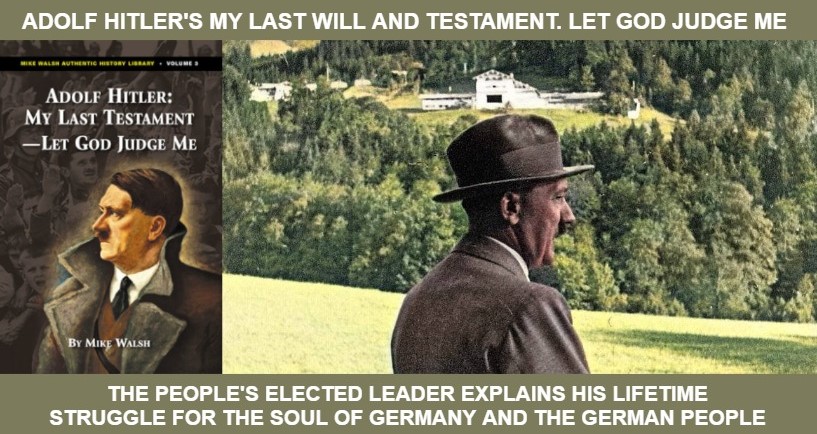
The times that Hitler cheated death became a legend that has baffled historians ever since.
In one corner of conflict, the troops of Liszt Regiment were typically held down in shell craters. The trenches had already been destroyed. This all occurred among the ruins of a village called Le Barque.
Of the nine regimental couriers, seven had just been killed. In the command post, such as it was, there were ten officers and two couriers.
Suddenly, a British bomb exploded at the entrance to the refuge. There was just one survivor, Adolf Hitler.
Adolf Hitler, far from being a loner, was comradely. Ever his own man, his daily routines were characterised by civility.
He was never known for embracing trench crudities or brothel humour and was generous to a fault.
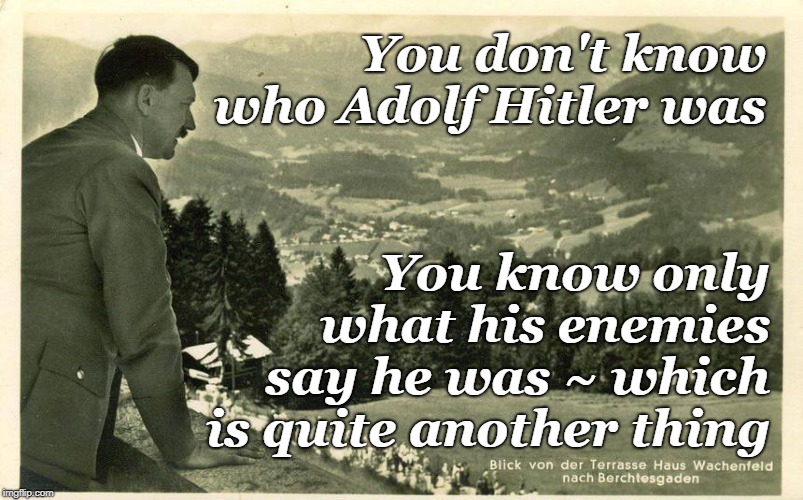
Yet despite having a personality that usually draws disdain, the soldier Adolf Hitler was highly respected by his comrades.
Sebastian Haffner was a Jewish writer. He was also a fanatical Hitler hater. Yet, he was forced to admit ‘Hitler had a fierce courage unmatched by anyone at the time or since.’
Another Jew named Karl Hanisch shared lodgings with Hitler. He recalled Hitler as ‘a pleasant and likeable man.’ Hitler took an interest in the welfare of all his companions.
He later recalled that his fellow lodger was neither proud nor arrogant. He was always available and willing to help.
If someone needed fifty hellers for another night’s lodging, Hitler would provide whatever he had. He did this without another thought. On several occasions, I personally saw him take the initiative and pass the hat for such a collection.’

Thank you for sharing our stories on social media. TELL OUR READERS WHAT YOU THINK
WITNESS TO HISTORY Mike Walsh. This illustrated book was banned by all major book publishers. Despite this, it defied all odds. It became the most widely read and acclaimed revisionist history of the Rise and Fall of the Third Reich.
Witness to History stands out among all the written source materials I have read concerning Adolf Hitler. It is the most compelling. It offers a realistic overview of the Third Reich. This realism comes from events being told by those who made them. ~ Marc Roland. https://barnesreview.org/product/witness-to-history-the-reich-legend-uncensored/


Share this:

Categories: Great Europeans



 Michael Walsh Stories and Books
I love learning any and everything about Hitler and await your Clemenceau-related article. How I wish such articles could occasionally slip into “mainstream” news. – Robert
LikeLiked by 1 person
Pretty rare for a corporal to get the Iron Cross in bankster war I.
LikeLike
Thank you.
LikeLiked by 1 person