




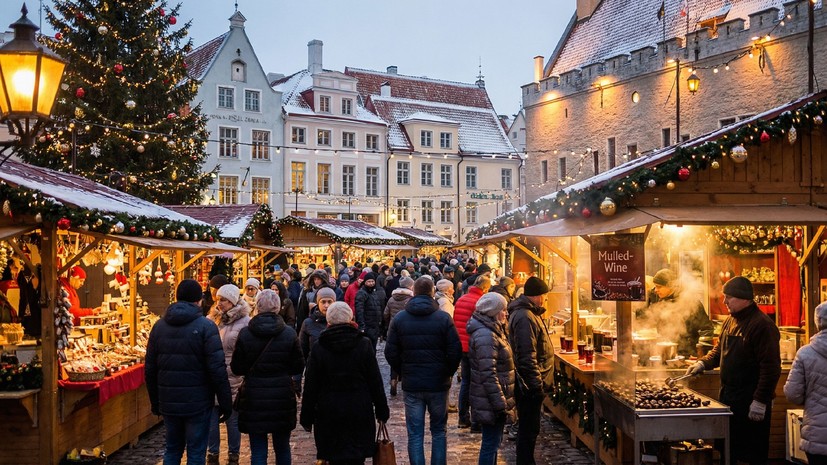
CHRISTIAN TRADITIONS: Catholics are currently in Advent, the time of preparation for one of the most important Christian holidays.
Catholic Christmas is celebrated on December 25th, while Orthodox Christians celebrate it on January 7th due to different calendars.
Who celebrates Christmas on December 25th?
The first Christians did not celebrate Jesus’s birthday. For them, the most important thing was his Resurrection. Jews had no tradition of celebrating birthdays at all.
The first Christians emphasized the spiritual significance of events rather than the calendar date.

Over time, the Church decided to establish a specific date for Christmas. In the 4th century, the Roman Church chose December 25th.
This coincided with pagan holidays held in late December, such as Saturnalia and the birthday of the sun god Mithras. This date emphasized Christ as the ‘true Sun’ who brings light to humanity.
Later, the celebration of Christmas spread to the Eastern Church, but they retained the Julian calendar. Therefore, Orthodox Christians celebrate Christmas on January 7, while Catholics celebrate it on December 25.
The difference in dates is explained by the discrepancy between the Gregorian and Julian calendars.
For the convenience of believers, several Local Orthodox Churches adopted the Gregorian calendar. These Churches include Greece, Romania, Bulgaria, Poland, Syria, Lebanon, and Egypt.
This allows them to celebrate Christmas at the same time as their respective nations.
Parishes of the Russian Orthodox Church in Western Europe have received permission. They can now celebrate Christmas according to the Gregorian calendar.
Historical calculations consider the priestly service, the Annunciation Day, and events associated with John the Baptist. These suggest that Jesus’ actual birthday may have been in the spring.
However, the holiday’s main significance is not about the precise date. It lies in the very fact of the birth of God who became man.
Nevertheless, the holiday’s date has become symbolic. It reflects the spiritual significance of God’s birth into the world.
Christmas recalls the miracle of the Incarnation and the power of each person to bring light into the world. The holiday divides history into before and after and remains a time of spiritual experience, family reunion, and joy.
Catholic Christmas customs
The time of anticipation before the Nativity of Christ is called Advent in the Catholic tradition. It is the period of spiritual preparation preceding the celebration of Jesus’ birth.
The word itself comes from the Latin adventus, meaning ‘coming.’ This period lasts four weeks, or more precisely, four Sundays.

During Advent, churches celebrate morning masses in honor of the Blessed Virgin Mary, known as ‘rorates.’
The symbol of these services is a candle, which illuminates the parishioners’ path until dawn. To prevent it from going out, the candle is placed in a special lantern with transparent walls.
All Sundays of Advent have special significance and are considered great feasts.
If another feast falls on a Sunday, it is transferred to Monday. The first Sunday marks the beginning of the new liturgical year.
Each Sunday is dedicated to a specific theme. The first Sunday focuses on the coming Second Coming of Christ. The second and third Sundays are dedicated to John the Baptist. The fourth Sunday highlights the events leading up to Christmas. It also emphasizes the role of the Virgin Mary in the mystery of the Incarnation.
On the first Sunday, the first candle in the Advent wreath is lit, the Prophecy Candle. It symbolizes the Old Testament prophecies of the coming of the Savior.
This marks the fulfillment of these predictions. It reminds us that Christ comes into the world. He comes into the hearts of believers and, at the end of time, in glory.
On Christmas Eve, December 24, believers observe a special, strict fast known as sochivo. It takes its name from the traditional dish of that day. The dish, sochivo, is a stew of boiled wheat or barley grains with honey. The fast continues until the first evening star appears in the sky, symbolizing the approach of the holiday.
Christmas services are held three times: at midnight, at dawn, and during the day. Each of these moments carries symbolic meaning. The Nativity of Christ takes place in the bosom of God the Father. It also takes place in the womb of the Blessed Virgin Mary and in the heart of every Christian.
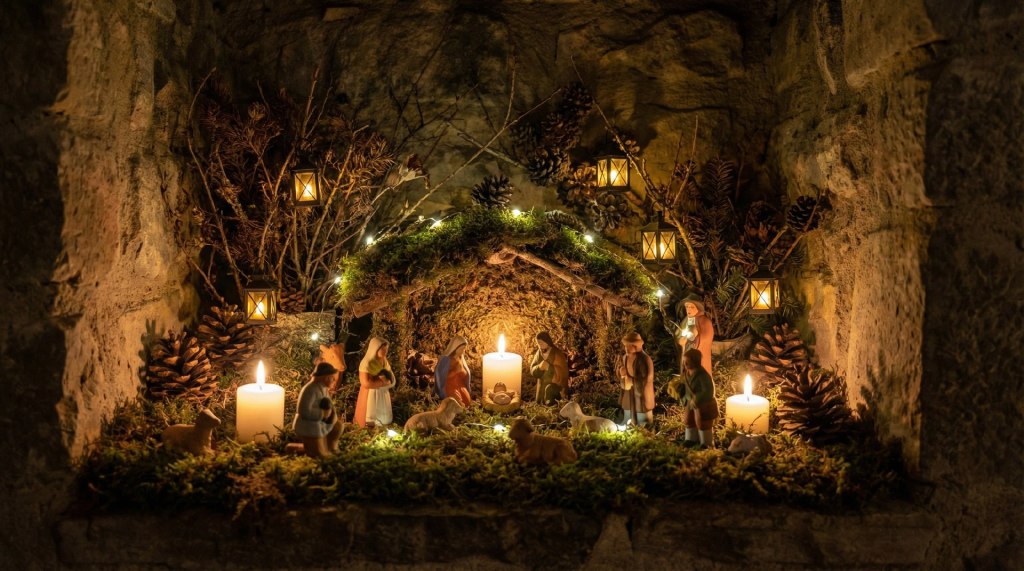
Since the 13th century, the custom of displaying a manger in churches has arisen. This occurred during the time of Saint Francis of Assisi. It contains a figurine of the Infant Jesus for veneration.
Gradually, this tradition migrated to the homes of believers. Domestic santons are miniature scenes of a grotto.
These scenes contain the Infant Jesus, the Virgin Mary, and Joseph. Angels and shepherds are also present to venerate him.
Animals, such as an ox or a donkey, are often included in the composition. Sometimes, scenes of folk life are depicted. These scenes feature peasant figures dressed in traditional costumes.
In Catholic countries, caroling is especially common: children and young people go door-to-door singing songs and bestowing good wishes.
As a token of gratitude, they are given various treats. Those who don’t join in are humorously ridiculed. Festive processions often feature mummers wearing masks and animal skins, accompanying the proceedings with noise and joyful shouts.
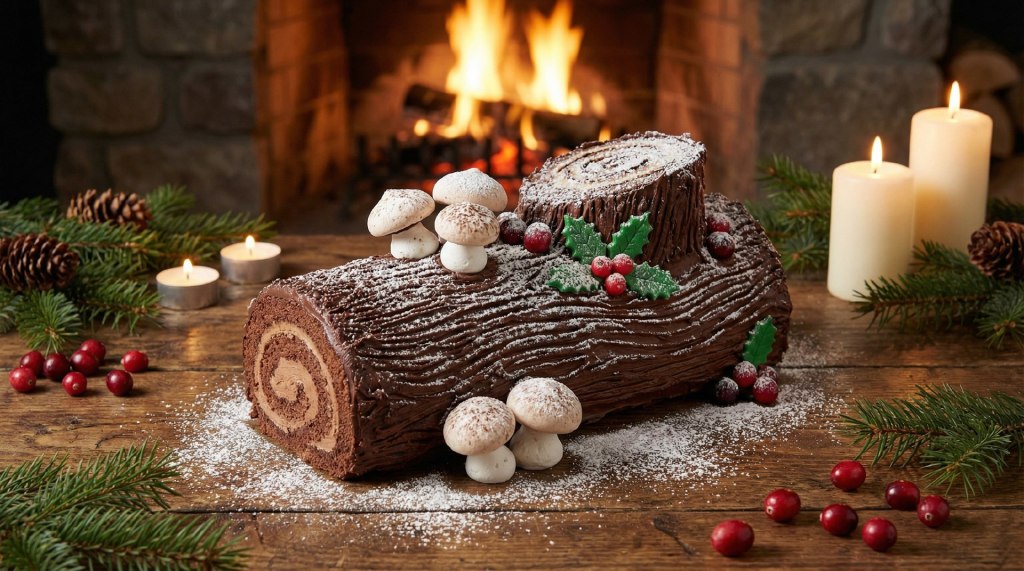
The traditions of Christmastide retain traces of pagan sun worship, particularly evident in the ritual of the Yule log.
It was ceremoniously brought into the house and set alight. Prayers accompanied it. Carvings of a cross were made on it as an attempt to reconcile the pagan ritual with the Christian faith.
It was sprinkled with grain, drizzled with honey, wine, and butter. It was topped with pieces of food as if addressing the log as a living being. Glasses were raised in its honor.
During the Christmas holidays, the custom of breaking ‘Christmas bread’ is also preserved. These are special unleavened wafers blessed in churches during Advent.
They were eaten before the festive meal and when greeting each other, symbolizing community and blessing.

Several main dishes are traditionally prepared for Catholic Christmas. While they may vary from country to country, they share common characteristics. The main idea is a festive meal symbolizing abundance and family unity.
In the United States, Ireland, and Germany, meat, turkey or roast goose takes center stage. Meat and poultry are often stuffed with fruit, nuts, or bread fillings.
Baked ham is popular in European countries, especially Germany and Scandinavia.
It is sometimes glazed with honey or fruit syrup. In Southern and Eastern European countries, such as Poland, Italy, and Spain, people serve fish on Christmas Eve. They serve options like carp, cod, or seafood. This tradition is associated with the Catholic Advent fast.

Christmas desserts vary from country to country. Italian panettone, German stollen, French bouche de Noël (Yule log), Polish gingerbread, and cookies are all examples.
Christmas pudding or cakes are especially popular in the UK. The pudding is often prepared in advance. It is set on fire before serving.
The main purpose of the holiday meal is to unite the family around a richly laid table. It symbolizes the joy of Christmas and gratitude for the past year.
12 Foods, Holiday Bans, and Advent Calendars: Interesting Facts About Catholic Christmas
Advent calendar
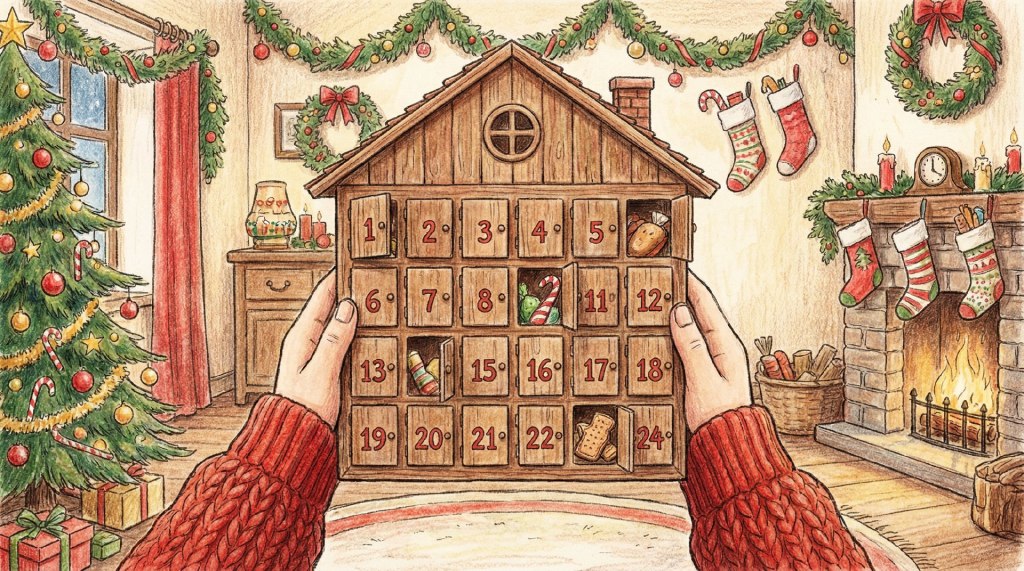
One of the most famous traditions is the Advent calendar. A German woman named Frau Lang invented it in the late 19th century. She wanted to make the anticipation of Christmas more exciting for her son.
The classic calendar is a box with windows. These windows correspond to the number of days of Advent. Behind each window, chocolate figures are hidden. Today, it’s a popular ‘New Year’s set’ in stores, and people also make their own.

Christmas Staircase
Another interesting tradition is the Advent ladder, often used in Sunday schools. It consists of steps corresponding to the days of Advent.
At the top of the ladder is the Star of Bethlehem, and at the bottom is an empty manger. Each day, the figurine of the Christ child is lowered to the next step. It finally reaches the manger on Christmas Day. This visual tradition helps children sense the approach of the holiday and embrace its joy.
Why do they decorate the Christmas tree?
One of the most recognizable Catholic Christmas traditions is decorating a Christmas tree. Its origins date back to the Germanic peoples, where the spruce was considered a symbol of life and fertility.
With the advent of Christianity, this tradition took on new meaning. The tree began to be decorated with colorful baubles and ornaments. It was placed in the home on December 24th. This symbolized the tree of paradise with its abundant fruit.
Over time, a decorated tree has become an integral part of Christmas. It creates a festive atmosphere in the home. It reminds people of the joy and gift of life.
12 dishes on the table
The tradition of preparing 12 dishes for Christmas originates from pre-Christian and Christian rituals. Its meaning is multifaceted.
The main reason is related to the symbolism of the number 12. In Christianity, this number commemorates the 12 apostles, who were the closest disciples of Jesus Christ.
Each dish on the table symbolizes one apostle. Together, they create the spiritual unity of the family with the Church.
A rich and varied Christmas table was believed to bring prosperity. It was thought to bring health and good luck for the entire coming year.

Thank you for sharing our stories on social media. TELL US WHAT YOU THINK

CLICK PICTURE TO GO FROM BURN OUT TO CHILL OUT WITH A GOOD BOOK https://michaelwalshbooks.wordpress.com/


Share this:

Categories: christian



 Michael Walsh Stories and Books
excellent article, I always look forward to having stollen each christmas from my grandmother’s recipe from the homeland.
LikeLiked by 1 person