




ETHNIC LOYALTY: It is a story of resilience, memory, and a journey that shaped the world and Ireland itself.
The Irish displacement is not simply a story of departure. It is a story of resilience, identity, and memory. These aspects are carried across oceans and generations.
Today, over 70 million people worldwide claim Irish ancestry, more than ten times the island’s current population.
This movement of people is one of the most remarkable cultural phenomena of modern history. It is not because it was planned or triumphant. It is remarkable because it was endured.
The Irish journey outward, from forced exile to economic migration, shaped not only other countries. It also shaped the soul of Ireland itself.
Irish Diaspora
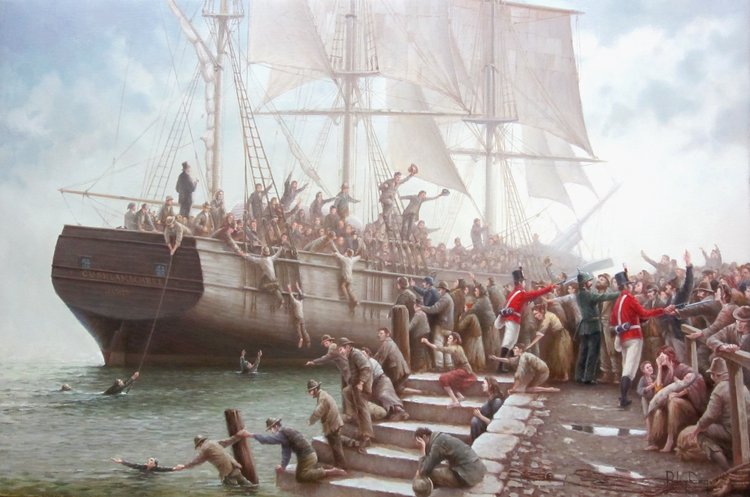
Mass emigration from Ireland began in earnest during the 18th and 19th centuries. The reasons were many: Colonial pressures, including dispossession under British rule
Religious discrimination, especially against Catholics. Chronic poverty and limited opportunity in a rural economy, the Great Famine (1845–1852), a catastrophe that halved the then population of 8 million through death and departure
The Great Hunger
Over a million people fled during the Famine alone. Many sailed to North America, others to Britain, Australia, and beyond. These journeys were often traumatic, undertaken in ‘coffin ships’ where disease, starvation, and loss were common companions.
What does it mean to be Irish in a new land?

For many emigrants, identity was forged in hardship, in ghettos, workhouses, and unfamiliar cities.
It also found expression in the sacred. This was evident in churches and wake houses. It appeared in music and stories and in language spoken softly at home.
The migration carried Ireland with them in the beads of the rosary. It was felt in céilí dancing on basement floors. The rhythm of memory was passed down over dinner tables.
The Empire Builders

In America, thousands of Irish labourers built canals and railroads, later rising to political and civic life.
In Canada, they shaped frontier towns and early settler identity. In Australia, some arrived in chains, yet their descendants helped shape the nation. And in Britain, they rebuilt cities after the war, while facing persistent discrimination.
These stories are not uniform, but they are connected.
The diaspora never fully left Ireland behind. In songs like Danny Boy, or tales of the ‘old country,’ a sense of longing remains. Family stories often kept Ireland alive, even when language was lost.
Family Roots
In recent decades, there has been a strong movement of return. People are tracing family roots. They are walking ancestral lands. They are reconnecting with a part of themselves that never left.
In this way, the diaspora does not dilute Irishness; it renews it. It widens what it means to belong. The diaspora never truly left Ireland behind.
In songs like Danny Boy, or family stories about ‘the old country,’ a sense of longing remains. Even when language was lost, identity often endured, carried in gestures, names, stories, and quiet traditions.
The Act of Return
In recent decades, the act of return, literal and symbolic, has become more visible: People tracing ancestry through parish records and DNA kits, visiting towns their great-grandparents left behind, lighting candles in the ruins of old churches, or walking fields where family once farmed
For many, it is not about reclaiming the past, but reconnecting with what was never entirely gone.
Myths of Departure, Truths of Endurance
There are myths that all who left did so by choice, or that life abroad meant swift success. The truth is more complicated and more honourable.
Many left with nothing. Some never returned. Others faced fierce prejudice. But they endured. In the end, they passed on something powerful. It was not just Irishness. It was a way of being in the world.
The diaspora is not a fairy tale. It is a legacy of survival, adaptation, and belief, in kin, in memory, and in the worth of holding on.
The Irish Displacement Still Matters
To understand Ireland, one must also understand what it means to leave it, and to remain Irish nonetheless.
The diaspora did not merely export people. It exported a way of seeing: poetic, loyal, wounded, enduring. From New York to Newfoundland, Melbourne to Manchester, Irishness left a mark, one that’s personal, cultural, and deeply alive.
In remembering the diaspora, we honour those who kept the light of Ireland burning far from its shores. SOURCE: Irish Roots.

You can and should share this story on social media. TELL US WHAT YOU THINK

FORTY SHADES OF VERSE by Michael Walsh. In legend, verse and stories this perfect gift provides the enigmatic mirror image of the ancient Irish Nation. The Bard of Ireland’s illustrated verse crosses frontiers. The award-winning poet’s Irish blood alchemy reveals Ireland’s soul, its yearning for peace, love, justice, hope, charity and romance. CLICK PIC OR LINK FOR MORE INFORMATION https://www.lulu.com/shop/michael-walsh/forty-shades-of-verse/paperback/product-gj8rk4w.html?page=1&pageSize=4

Share this:

Categories: Ethnic traditions



 Michael Walsh Stories and Books
1 reply »