




EUROPE FREE PRESS: Ireland’s ‘Golden Age’ lasted from roughly the 6th to 12th centuries. It produced one of the greatest cultural flowerings in medieval Europe.
It was a time when Irish monks and scholars spread across the continent. They founded monasteries and preserved classical learning. Their efforts earned Ireland the designation Insula Sanctorum et Doctorum, (The Island of Saints and Scholars).
We tend to think of Ireland’s ancient monasteries as remote ruins. However, their influence once stretched from the Atlantic to the Alps. Irish monks weren’t just praying in stone huts. They were educating princes. They were also writing moral handbooks for rulers (the mirrors for princes).
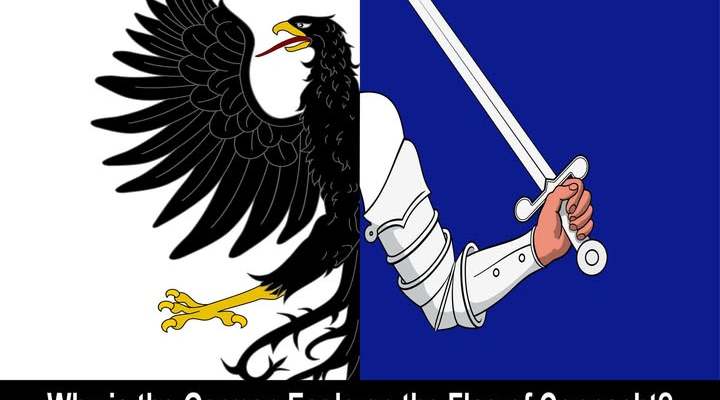
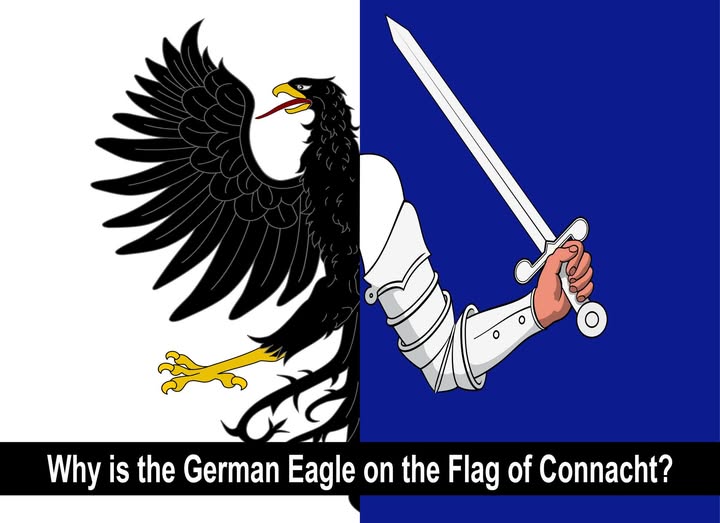
One of the most remarkable reminders of that influence is hidden in plain sight, in the flag of Connacht.
It’s a strange but striking design. It is half an eagle and half an arm, wielding a sword. It is more than medieval flair. The image comes from the arms of the Abbey of St. James in Regensburg, Germany, a monastery founded by Irish monks in the 11th century.
The black eagle was the emblem of the Holy Roman Empire. It symbolized the Abbey’s imperial protection. The eagle also represented high status in continental scholarship.
The abbey’s original arms show an arm holding a short dagger. Here’s the twist: the dagger was deliberately shown upside down.
Why? Because its hilt formed the Cross of St. James, patron of pilgrims. The weapon wasn’t meant as aggression, it was a devotional emblem, representing the Abbey’s spiritual mission under imperial protection.
When the design returned to Ireland, the motif evolved. The dagger became a sword. The arm grew stronger and more defiant. Together, they symbolized Connacht’s warrior lineage.
It was likely inspired by the O’Connor kings of medieval Connacht. Some scholars also see echoes of Nuada Airgetlám (‘Nuada of the Silver Arm’). He was the mythic High King of the Tuatha Dé Danann. His arm of silver was both a sign of loss and divine restoration.

LEFT: Click Pic to access our online bookstore
The arm and sword likely represent the native rulers of Connacht, the O’Connor kings. Their strength defended the faith at home. Their monks carried the faith abroad.
Every time you see the Connacht flag flutter at a match or civic event, remember this. The eagle once flew over an Irish monastery in Bavaria. The sword once guarded the learning of a people. These people taught Europe how to think again.
In that single flag, two worlds meet. The imperial and the Gaelic converge. The continental and the monastic are present. This flag is a living reminder. Medieval Ireland was never a backwater. It was a bridge between civilizations.
Connacht’s flag doesn’t just tell a provincial story, it tells Europe’s. You can and should share this story on social media: TELL US WHAT YOU THINK

FORTY SHADES OF VERSE by Michael Walsh. In legend, verse and stories, this perfect gift provides the enigmatic mirror image of the ancient Irish Nation. The Bard of Ireland’s illustrated verse crosses frontiers. The award-winning poet’s Irish blood alchemy reveals Ireland’s soul, its yearning for peace, love, justice, hope, charity and romance. CLICK PIC OR LINK FOR MORE INFORMATION https://www.lulu.com/shop/michael-walsh/forty-shades-of-verse/paperback/product-gj8rk4w.html?page=1&pageSize=4

Share this:

Categories: Ethnic traditions



 Michael Walsh Stories and Books