




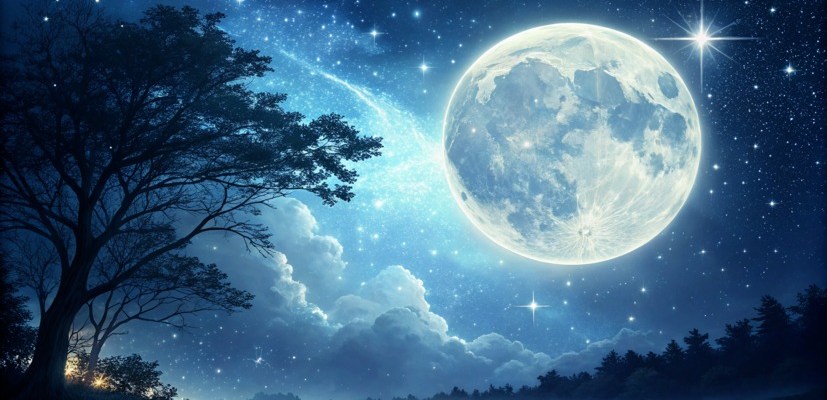


The August full moon in 2025 promises to be especially spectacular and will occur on August 9.
The August full moon is known as the Sturgeon Moon, a name that comes from the traditions of the indigenous peoples of North America.
This year, the full moon will coincide with a rare planetary parade: Saturn, Venus, Jupiter and Mercury will be visible in the sky next to the Moon, and with the help of a telescope, even Uranus and Neptune. Where and when to watch the planetary parade?
The name Sturgeon Moon has ancient roots and is associated with the traditions of the indigenous peoples of North America. Many names for full moons were given by Indian tribes, so they reflect the natural features of the month, typical for their latitudes.
Thus, for the people living near the Great Lakes, August was considered the time when sturgeon was best caught, hence the characteristic name of this full moon.
The August full moon traditionally marks the beginning of the harvest in northern latitudes. For example, some indigenous tribes in North America knew it as the Corn, Rice, or Cherry Moon, depending on which crop was most important to their culture. The Anglo-Saxons called it the Grain Moon.
The Cree people poetically named the August full moon the Moon of First Flight, because it was the time when young birds left their nests to try their hand at flying. In addition, in folklore, the August Moon was often called the Red Moon, due to its hue arising in the hot, dusty atmosphere of late summer.
In different cultures around the world, the August Moon has its own special names:
China – the Harvest Moon;
The Celts – the Moon of Disputes;
Wiccans – Grass Moon;
Cherokee – Fruit Moon;
Southern Hemisphere — Snow, Storm, Hunger or Wolf Moon, since it is winter there now.

The full moon in August 2025 will occur in the astronomical constellation Capricorn. However, astrologers believe that this full moon will occur in the sign of Aquarius. A natural question arises: why do different systems indicate different locations?
The answer lies in the difference between an astronomical constellation and an astrological zodiac sign.
Astronomy relies on real parts of the sky and the position of the luminaries relative to them.
But in Western astrology, the zodiac is divided into 12 equal parts of 30°, starting from the vernal equinox. Due to the precession of the Earth’s axis (the shift of the axis of rotation), astrological signs are more than one sign behind their corresponding constellations.
Therefore, the Moon can be in astronomical Capricorn, but from the point of view of the astrological system, in the sign of Aquarius.
Many doctors, crime experts, and emergency responders say that during a full moon, there is an increase in calls, accidents, and erratic behavior. However, scientific research does not support a consistent statistical link between the phases of the moon and such events.
Recommendations based on astrological traditions are free to be perceived by everyone as they see fit. According to astrology, the full moon strengthens and expands all processes.
It can multiply both positive moments, plans, dreams and ideas, facilitating their implementation, and negative ones; the slightest carelessness can lead to undesirable consequences.
Not only do astrologers believe that the Moon influences a person. For example, the spiritual teacher, yogi and mystic from India, Sadhguru, notes that on the night of the full moon, energy activity increases, and the power of the Moon enhances the natural qualities of each person.
This can enhance both positive and negative characteristics: any internal states of a person become brighter and more noticeable.
It is believed that the full moon gives energy and heightened awareness. If a person practices meditation, it is on such nights that it is easier to delve into this activity, because attention and perception are enhanced.
What a woman should do during a full moon: advice from an astrologer
Astrologers’ recommendations are not mandatory. The main thing is to listen to yourself and focus on your own feelings and needs.
1. Emotional cleansing
The full moon is considered a time of culmination and completion. Astrologers advise using this phase to let go of old grievances, fears and negative emotions. Meditations, forgiveness rituals or simply sincere conversations will help free yourself from excess emotional burden.
2. Strengthening intuition and inner strength
During the full moon, energy increases, which helps develop intuition. Women are advised to pay attention to their inner voice, trust their feelings and make important decisions during this period.
3. Self-care and rest
The full moon is a time of heightened sensitivity. Astrologers advise women to rest more, avoid stress, and pay attention to their health, for example, practice yoga, take relaxing baths, or do breathing exercises.
4. Setting the tone for creativity and new ideas
The energy of the full moon stimulates inspiration. Women are advised to use this moment for creative activities. You can draw, write texts, compose music, and try any other types of self-expression.
5. Planning and goal setting
The full moon is a time to take stock and form new intentions. Astrologers advise writing down your desires and goals, formulating plans for the near future in order to direct energy towards their implementation.
Parade of Planets on August 10: About the Celestial Phenomenon and the Number of Planets
August 9 will not only be the day of the full moon, but also the starting point for a rare planetary alignment, a bright astronomical event that will be especially visible in the morning hours in clear weather.
A planetary parade is an astronomical phenomenon in which several planets in the solar system line up in a row, visually approaching each other on the celestial sphere.
Although the planets are actually located in different orbits and at significant distances from each other, to us, observers on Earth, they appear to be almost aligned.
Such alignments do not occur often and are especially noticeable when they coincide with other celestial events, such as a full moon.
On August 9, 2025, the day of the full moon, several bright planets will be visible, lined up near the ecliptic line. Early in the morning, before sunrise, when the full moon will set on the western horizon, Saturn, located in the constellation Pisces, will appear in the sky – it will be noticeable next to the moon and stand out with a steady light.

Where and how best to observe the parade of planets
From August 9 to 12, the planets will gradually converge, and on August 12, Saturn will be near the Moon. And closer to the eastern horizon, Venus and Jupiter will be visible in the constellation Gemini; they will be at their closest distance from each other.
Below, in the constellation Cancer, Mercury will be located, although its visibility may be limited due to its proximity to the horizon and the brightness of the dawn.
You can also use binoculars or a telescope to try to see Uranus and Neptune, which are also in the morning sky and form part of this visual chain of planets.
To observe the parade of planets, it is recommended to go to an open space with a good view of the horizon before sunrise, approximately from 04:00 to 05:30 local time. The best viewing conditions will be created in clear weather.
This phenomenon will be clearly visible at latitudes in Europe, Russia, Asia, Africa and North America. The farther from large cities and sources of light pollution, the brighter and clearer the chain of planets will be visible in the morning sky.

Perseid meteor shower 2025
The peak of the Perseid meteor shower will also occur with a minimum interval from the full moon on August 9. An active meteor shower is expected on the night of August 11-12. However, two such astronomical events in a row are not the most favorable story.
The thing is that during the maximum activity of the Perseids, the Moon will be almost full, about 92% of its disk will be illuminated. That is, the sky will be heavily illuminated and will make dim meteors less noticeable.
However, if you choose the right time and place, you can still see the meteor shower. The best solution is to look into the sky closer to dawn, when the Moon has already gone beyond the horizon, in search of the Perseids.
Such a natural screen can significantly improve the visibility of falling stars already in the first hours of the night. You can share this story on social media:

TELL US WHAT YOU THINK

NEW GENERATION BOOKS AND NOVELS MAKE GREAT HAND-DELIVERED GIFTS TO FAMILY AND FRIENDS ON ANNIVERSARIES: Romance, Travel, Maritime, War and Culture: Britain and Europe’s most successful writer, Michael Walsh, also available on Amazon https://michaelwalshbooks.wordpress.com/

Share this:

Categories: Ethnic traditions



 Michael Walsh Stories and Books
1 reply »