





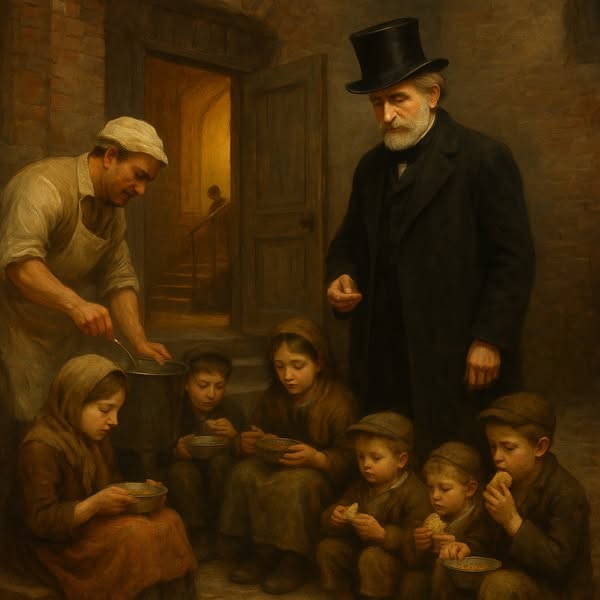
By the mid-19th century, Giuseppe Verdi had become one of Europe’s most sought-after opera composers.
His works drew full houses from Milan to Naples, from Paris to Vienna, and the rehearsal process for each premiere was often a demanding affair, sometimes stretching over weeks.
During such stays, Verdi took up residence near the theaters, becoming a familiar presence not only to performers and orchestra members but also to the surrounding neighborhood.
It was during one such period, most likely in Naples, though similar incidents occurred elsewhere, that Verdi revealed not only his artistic command but his deeply human instincts.
Children at the Door
In Naples, while rehearsing one of his major operas—possibly Alzira or Luisa Miller- Verdi began to notice a recurring sight that deeply moved him.
RIGHT: WHY PAY AMAZON PRICES FOR A GREAT READING EXPERIENCE? AUTHOR RECEIVES AMAZON’S PROFITS. Writers Award-Winning author Michael Walsh books have a global readership. https://books.by/michael-walsh

Each day, as he and the performers worked through difficult passages, a group of poor children gathered outside the theater, peering through the open doors or windows.
They were quiet and respectful, but their clothes were threadbare and their faces marked by obvious hunger.
They were not watching the music—they were smelling the food that was being served to the theater staff. Verdi asked a stagehand about them, and upon learning they were local orphans and street children, he was visibly disturbed.
A Simple, Generous Order
Without fanfare, Verdi gave instructions to the theater’s manager: ’Feed them.’

He did not want them to be turned away, nor pitied, nor subjected to sermons. He simply wanted them to eat.
From that day onward, the children were served warm meals daily at the back of the theater kitchen. It became part of the daily rhythm: rehearsals in the hall, food in the courtyard.
Verdi made sure the expense came out of his own pocket. He never asked for public credit or applause. In fact, he insisted the arrangement be kept discreet, ’just do it, and don’t talk about it.’
Kindness Beyond Music
The incident is just one of many that reflect Verdi’s quiet philanthropy. He was not only a man of towering talent, but one who carried the concerns of the poor with him, even in places of luxury and privilege.
Whether helping build hospitals, founding the Casa di Riposo per Musicisti in Milan for retired musicians, or feeding hungry children in Naples, Verdi acted on his belief that music and morality were inseparable.
His actions during rehearsals in Naples show a side of Verdi that history sometimes forgets: not just the genius of opera, but a man who refused to ignore suffering, even while creating immortal art. TELL US WHAT YOU THINK
PLEASE SHARE OUR PUBLIC INFORMATION STORIES

GREAT SAYINGS AND STORIES OF HISTORY, a popular Michael Walsh Compilation. The best book ever, containing hundreds of quotations, many of which could not be published today. https://books.by/michael-walsh#great-sayings-and-stories-of

Share this:

Categories: Music Notes



 Michael Walsh Stories and Books