




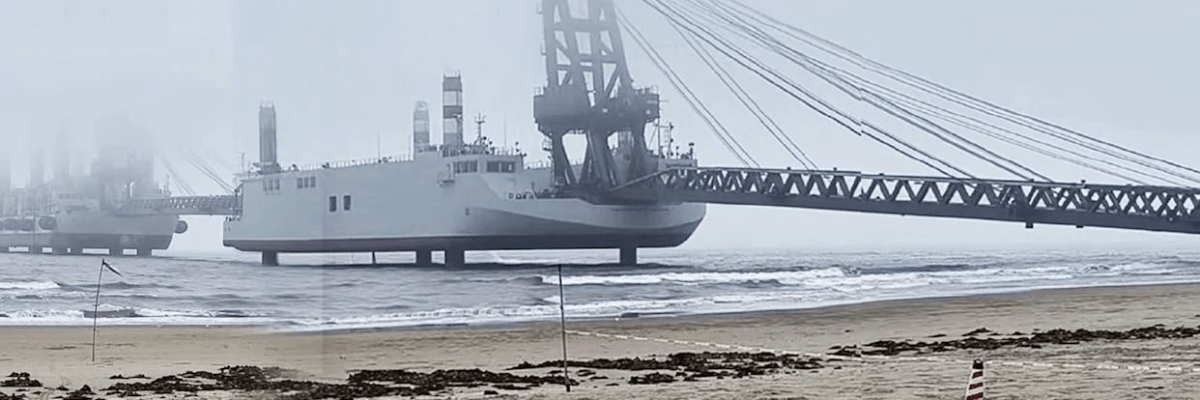


A video has been published on Chinese social media showing the action of the Chinese navy’s newest ‘walking’ ships.
Hold on: Why does the Chinese army need them, and how does it expand its capabilities?
The footage shows several ships that seem to be standing ‘on their feet’ in the water. The ships are connected by a ramp, and another ramp is lowered onto the shore.
The video was filmed in the Chinese province of Guangdong. The footage shows Shuqiao-class amphibious warfare ships. The ships were built at the Guangdong Naval Shipyard. Three ships have been built so far. China plans to increase their number and build at least three more.
Shuqiao ships are flat-bottomed self-propelled barges. In essence, they combine the features of several types of vessels: self-elevating platform vessels; transport and landing ships; floating piers.
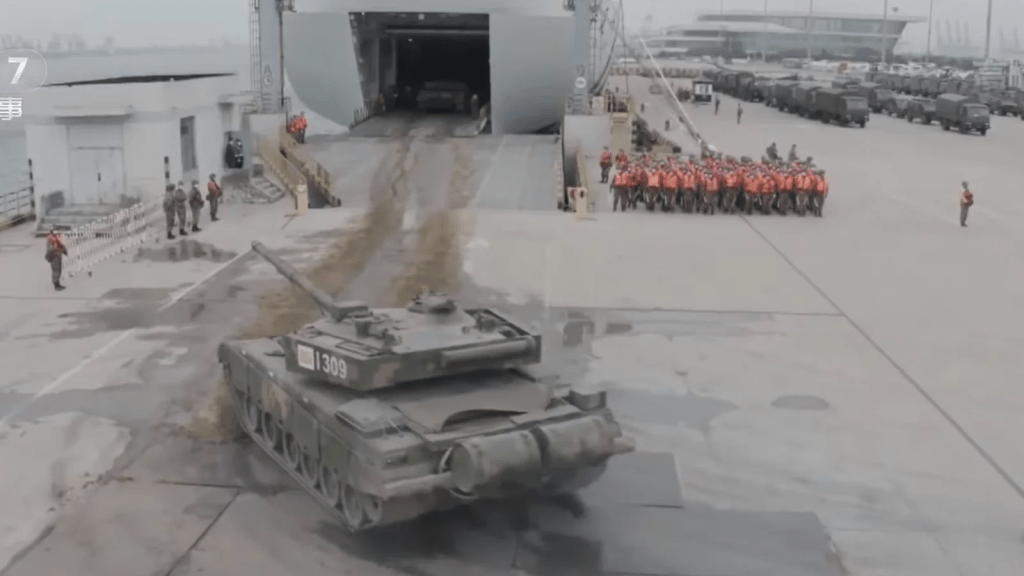
Each vessel is equipped with a retractable ramp bridge estimated at 120 meters. The ramp can be lowered to the shore, or it can serve as a span of an improvised bridge between two such vessels.
Considering the length of the vessel itself is about 120 meters, three Shuqiao vessels can form an improvised bridge almost a kilometer long.
At the same time, the ramp can not only be lowered but also raised relative to the vessel. That is, it can be used to unload troops and equipment on any shore, even a rather high and rocky one.
But perhaps the main feature of these vessels is the hydraulically driven support columns. They are lowered into the water independently of each other and allow the ship to rise above the water and confidently rest even on an uneven bottom with a depth difference.
The ship, having stood ‘on its feet’, is not afraid of waves, and the bottom relief at the landing site is not important.

BRITANNIC WAVES THE RULES in this beautifully illustrated book Michael Walsh, the last deck rating of the White Star Line (1845-1960) reveals incredible experiences never to be repeated. https://books.by/michael-walsh#britannic-waives-the-rules
On the side opposite the retractable ramp, a ramp section of another Shuqiao ship can be attached or cargo can be received. The ship can serve as a pier for unloading transport ships.
It can also act as a pier for ro-ro ships, from which wheeled and tracked vehicles can quickly move along the Shuqiao ships and their ramps directly to the shore.
All the technologies used in the newest Chinese ships are not new. But in the Shuqiao-type ships, they are combined for the first time, creating a unique means of conducting amphibious operations.
The presence of these ships will allow Chinese troops to land on completely unprepared shores. Large transport ships with a large draft will be able to quickly land troops without approaching close to the shore. Such ships will also be able to act as pontoon bridges in sea straits and on large rivers.

Watch out! You’re on Candid Camera
Meanwhile China tests all-seeing ocean monitoring: 14 years in development. The technology can detect ships at any time of day or night, even in extreme weather conditions. There are no problems with blind spots or blurred images.
A team of Chinese scientists has successfully completed the first tests of a new omnidirectional ship monitoring system that can detect and identify ships in extreme conditions.

ALL I ASK IS A TALL SHIP Mariner Michael Walsh is a beautifully illustrated collection of maritime verse. The First Edition sold 3,000 + copies. https://books.by/michael-walsh#all-i-ask-is-a-tall-ship
The technology uses algorithms to analyze visible light and infrared images, making it look like a high-tech AI-powered camera array rather than traditional radar, Science and Technology Daily reported.
The monitoring system is the culmination of 14 years of research, during which a team of scientists from Harbin Engineering University focused on solving key problems of intelligent vision perception.
In particular, the specialists managed to get rid of three main problems of environmental sensing and target detection: blind spots, image blur, and difficulty of identification in practice.
As a result, the system optimizes the balance between wide-area perception and high-resolution detail and improves all-weather adaptability.
In essence, the technology combines dual-mode visible light and infrared data, which improves detection efficiency in complex conditions and improves panoramic image quality in low-light conditions.
If the scientists’ findings are correct, the system could improve surveillance of military movements, including enemy warships. China’s coast guard and law enforcement agencies could theoretically use it to improve monitoring of contested waters.
It could also be useful for autonomous maritime operations, providing greater situational awareness for unmanned vessels. TELL US WHAT YOU THINK
PLEASE SHARE OUR PUBLIC INFORMATION STORIES

THE LEAVING OF LIVERPOOL Illustrated best-seller of the greatest Merchant Navy in history (1955-1975) by ex-mariner Michael Walsh


Share this:

Categories: Sea Stories



 Michael Walsh Stories and Books