





Multifaceted, complex, intelligent, exuberant, and very interesting and ever so typically Russian and Russian Orthodox brotherhood.
A reconstruction of Chersones as it was in 1000 AD, when it was an eastern Roman Christian Byzantine city, with actors re-enacting life and trades of that age.
A bold testament to the truth of Christianity. A missionary project.
Museums of Christianity, Antiquity and Byzantium, Russian history, the history of Crimea and Novorossiya, the lands currently suffering from the war in the artificial political entity known as Ukraine. The whole complex is envisioned as an open-air museum.
A newly founded male monastery of 20 monks and novices was rebuilt on the site of a 19th c. monastery founded by the Romanovs.

Sumptuously restored major cathedral.
Place of pilgrimage with a pilgrim welcome center and accommodation. Very large state-run children’s summer camp and year-round art school for children capable of engaging 10s of 1000s of children per year.
Byzantine crafts centre where you can take lessons from craftsmen dressed in costumes from around 1000 AD. Large reconstructed Roman open-air amphitheatre for plays and concerts. Presentation space for Christian art and design, a place to reflect beauty in architecture and art.
Huge public space for large-scale Christian events, rituals, and historical re-enactments, including an open-air outdoor church with regular services.
Major ongoing archaeological excavation and preservation sites dating to 500 BC, when Chersones was part of the Roman empire.

Academic research institution dedicated to studying antiquity.
Propaganda project (in the good sense of that word), seeking to demonstrate why these lands have been part of Russia for centuries, at times playing roles of utmost importance to her very founding, including her conversion to Christianity 1000 years ago, and Russia’s Christian wars of liberation against the Turks in the 18th century, her inheritance from Constantinople.
Draws a parallel between Russia and the Eastern Roman Empire based in Constantinople. The idea that Russia is the 3rd Rome.
Major family-oriented tourist destination, with hotels, restaurants, and recreation. It is the brainchild of Metropolitan Tikhon Shevkunov (metropolitan means senior bishop), the most influential churchman in Russia after the Patriarch, who might very well be the next Patriarch, and well-known in Orthodox circles in the US and Europe because of the success of his book Everyday Saints. He’s been working on this for 10 years. He says the main idea of the place is:

‘… to remember our Christian faith and history, to remember the amazing art that today, yesterday, and many years ago ennobled people’s souls and lives.’
Tikhon is a force of nature in Russian Orthodoxy, repeatedly pulling off feats and mega-projects which strain reality. He became one of Russia’s leading celebrities after writing Everyday Saints, first published in 2011, and not just a best-seller, but one of the most-read Russian books of all time, like in the top 5 or something, which is quite something considering the competition.
It sold in the area of 10 million copies but was also available free online, and there were many pirate print editions, so it was probably read by several 10s of millions of Russians, opening Christianity to them.
It is beautifully translated into English by an absolutely brilliant American translator, and if you haven’t looked into it, I recommend it very much to get a picture of Orthodoxy in Russia today.

Tikhon is one of those people who when you look at how much is going on around him, you think this just isn’t realistic, there must be a team or something. He has influence on Russian cabinet choices related to social and cultural issues.
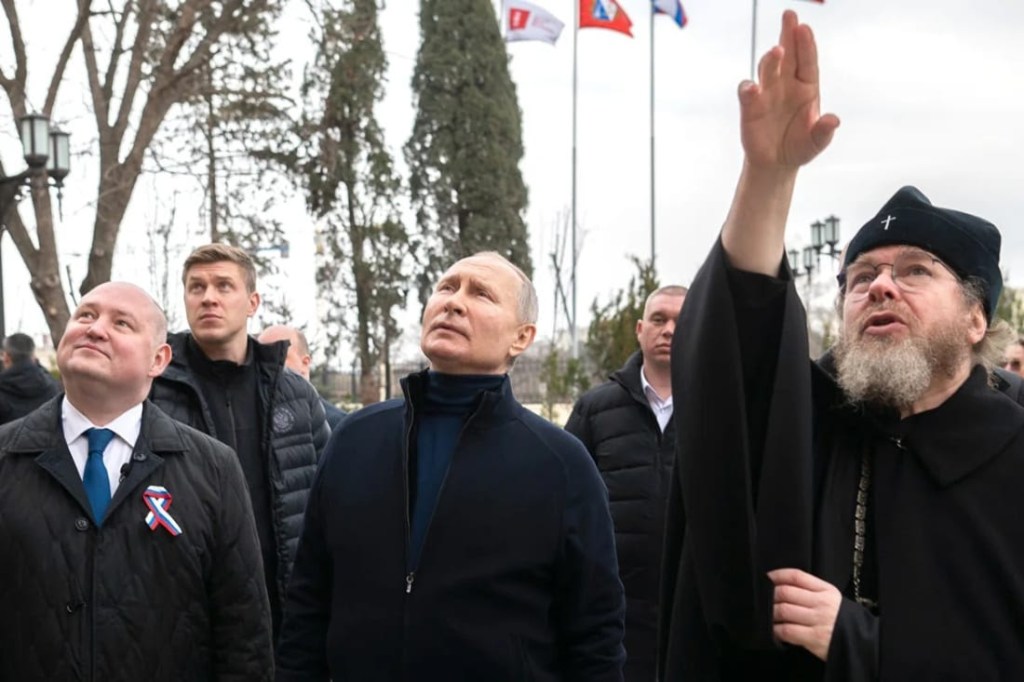
He has had a close and friendly relationship with Putin going back to the 2000s, which apparently continues to this day, which certainly likely helps him secure part of the funding for these very expensive projects.
Both of Tikhon’s films are excellent – links are to Russian language versions on YouTube. The most recent, Downfall of Empire – a Russian Lesson (2021) is a 5-hour tour-de-force which provides a radically revisionist analysis of what really caused the Russian revolution.
It will soon be available with English subs – watch this space and my Twitter for info. But it is his first film, similar in approach, Downfall of Empire – a Byzantine Lesson (2008), which is relevant to New Chersones.

In it, Tikhon examines the amazing and largely unknown history of the Eastern Roman Empire, inaccurately named ‘Byzantium’ long after it was gone in an act of Vatican subterfuge.
He argues that Constantinople fell after 1200 years of success because the Christian autocratic monarchy allowed the oligarch class to get too powerful, and these men eventually conspired with the evil Venetians, the globalists of their day, to collapse the Christian Eastern Roman Empire.
The Turks were simply the partial beneficiaries who did the actual military work. The film appeared when Putin was doing battle with Russian oligarchs, and the message was clear: A strong centralized state, ideally an Orthodox monarchy, has to be in charge, otherwise expect disaster.
Tikhon has had the East Romans on his mind for a long time and immersed himself in their history and connections to Russia, which begins to explain the genesis of New Chersones.
So how is Crimea connected to antiquity, how did it become Russian, and how did Russia come to be converted to Christianity 1000 years ago, long before the modern Russian state truly took shape in the 15th c., if Crimea was still part of the Eastern Roman Empire 1000 years ago?
The first mentions of it are from 500 BC. when Greek colonies were established. It was a subject of Rome from 63 BC to 341 AD.
Then for 900 years, from 341 – 1204, it was part of the Eastern Roman Empire (‘Byzantium’).
For the next 250 years the Mongols, Venetians, Genoese and others fought over them, with respective periods of control, before finally coming under the Ottomans in 1449, where it stayed until 1774, when Catherine the Great conquered it. Since then, it has been part of Russia.
And Russia’s conversion? In a nutshell, in 988 the Russian ruler Vladimir, based in Kyiv, had decided to convert to the Orthodox Christianity of the Eastern Romans, but he felt that this might imply that he was subjugating his nation to them, so he decided to invade a province of theirs which neighbored one of his, to make it clear he wasn’t.

So, he marched down to Chersones, conquered it, and had himself baptized there. He then relinquished the town back to the Romans, returned to Kyiv, and proceeded to convert his kingdom. That is a ridiculously simplified version of what happened. Here is a good article from Orthodox Christianity with the details.
Catherine the Great’s wars against the Turks bear some explanation. Russia was growing more powerful due to strong economic development driven by technology coming from Europe.
The Turks who controlled Crimea and lands to the north were mainly slavers, and they regularly raided the hapless Slavs living to the north, prized as slaves by the Ottomans. For centuries news of these raids caused outrage in Moscow, and Russia finally had the military strength to put a stop to it, so she conquered most of what is now southern Russia, including Crimea, from the raiding and pillaging Turks.
So, these wars were in part Christian crusades against evil enslavers, and wars of liberation after centuries of humiliation. Many of the victories were miraculous against mighty odds, and the whole episode is replete with Christian significance.
It is also important to understand that because of the centuries of raiding and pillaging by the Turks, this incredibly fertile land was essentially empty, sparsely populated by Slavs willing to risk their luck.
No towns or industry or any substantial population could take root there because of the danger. When Catherine conquered it, Russians settled it from scratch, it was a virgin territory. But I digress, back to today’s New Chersones.
It was built at breakneck speed in under 2 years (1 year 8 months to be exact) by the Military Construction Company of the Russian Armed Forces (VSK) on 60 acres next to the naval stronghold of Sevastopol, home of the Russian fleet. The land previously housed military installations.
Work started in mid-2022, shortly after the most recent phase of the war began. The complex was officially aptly opened to the public on July 18, 2024, the anniversary of Vladimir’s conversion more than a millennium ago. Tikhon conceived of the whole thing already more than a decade ago, and has been actively working on it for 10 years.
Nobody seemed to have a number about how much it cost. I think this is because when big ministries do this sort of thing, especially the military, it’s rather hard to do comprehensive accounting, and partly it’s a military secret, and well, whatever.

Russia is happily carefree that way sometimes. But it is very well done. They didn’t scrimp at all that I could notice. We had lunch at a very fancy restaurant which is part of the complex and was embarrassingly luxurious. Typical Russian exuberance I suppose.
I asked the clerics who hosted us the same question I asked the administration of Mariupol – wasn’t it rash to build this massively expensive and beautiful complex in the middle of a war right next to a naval base which was hit many times by NATO rockets and drones, where Russian ships were sunk?
A well-aimed NATO munition could wreck things pretty quickly. They admitted that there were some close calls, a feeling of danger, and times when work had to stop due to attacks, but at every point, Tikhon was in touch with military command, and would always order the work to continue – apparently, he had information the risk was lower than you might think, or was counting on Divine intervention.

Our tour guide was thirtyish Fr. Daniel Soloshenko, a parish priest in Evpatoria, two hours up the coast, who had studied history, literature, and ancient Greek (yet did not know English) in Moscow.
He also works with the pilgrimage department of the patriarchate in Crimea. As our minivan trundled the 2 hours down from the Crimean capital of Simferopol (more about that in a future article) he delivered an absolutely stellar lecture over the intercom worthy of an Oxford don on the Christian history of Chersones, part of which described how two Roman popes were exiled there.
Pope Clement I (2nd c.), the fourth pope, a disciple of Peter the Apostle, was martyred and worked to death in Crimea’s mines. In the 7th c., Pope Martin I was also banished there, where he promptly passed away.

Bein a Pope has always been a high-risk occupation. Listening to this erudite and well-spoken young man, I was struck again by how often one encounters men of the highest competence across Russia, so well-educated, mannered and articulate – but especially in the church. It was a genuine pleasure. He then shepherded us through the entire complex, dropping more pearls of knowledge. Fascinating.
New Chersones is yet another example of so many in Russia of Christian culture being promoted top-down, by the government and elites, a complete anomaly in our age. Russia is the only white country to do this, and it is deeply gratifying when one sees it. It speaks volumes for the future success of this enormous country.
This was my 4th visit to Crimea, the first pre-2014 when it seemed drab and run-down, the second in 2015, still down at the heels, and I was struck again this time by how lovely and livable it is, and I am sure it will attract migrants from the West under the government’s new drive to open Russia to immigration from there.
It is also unmistakably Russian through and through. The years of it being part of the artificial political absurdity called ‘Ukraine’, seemed not to have left a trace, and it is noticeably much better off now.

World opinion too seems to have lost interest. In 2022 the government in Kiev launched something called ‘the Crimean platform’, a kind of global support group of governments for returning Crimea to ‘Ukraine.’
It attracted 100 countries at the time, but only 60 countries remained part of it in 2024, with little enthusiasm. The idea that the Jewish, Christianity-hating, homo-promoting, sexually depraved carpet-baggers in Kyiv could ever wrest it militarily from Russia was always ridiculous, a lie sold to the public to steal money.
Russia has started building a massive 750-mile (1200 km) 4-lane highway around the Sea of Azov, to be opened in 2028, which will link Crimea to the new territories in Novorossiya and southern Russia, reducing driving time from Rostov to 3 hours, dramatically increasing access to Russian tourists. This is precisely the kind of big-budget infrastructure projects Russia and China do so effectively and relatively inexpensively compared to the West, with great economic benefits. TELL US WHAT YOU THINK
PLEASE SHARE OUR PUBLIC INFORMATION STORIES

MICHAEL WALSH BOOKS are available globally from all major bookstores, Amazon and LULU. The award-winning writer was followed by 500,000 readers of Europe’s Largest Free Newspaper group. CLICK THE LINK TO THE BOOKSTORE. https://michaelwalshbooks.wordpress.com/

Share this:

Categories: Art and Culture, current events, Ethnic traditions


 Michael Walsh Stories and Books
1 reply »