




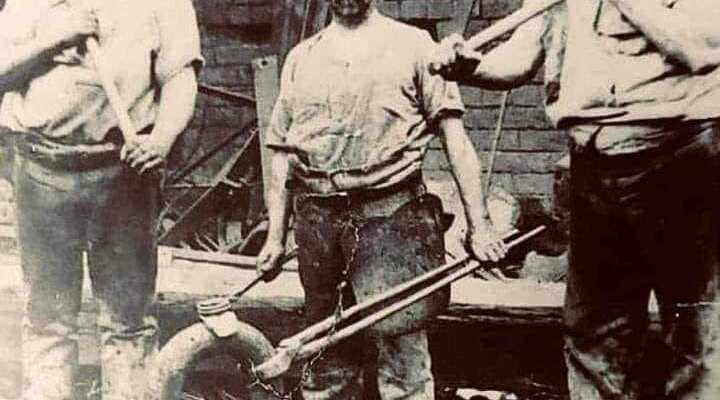

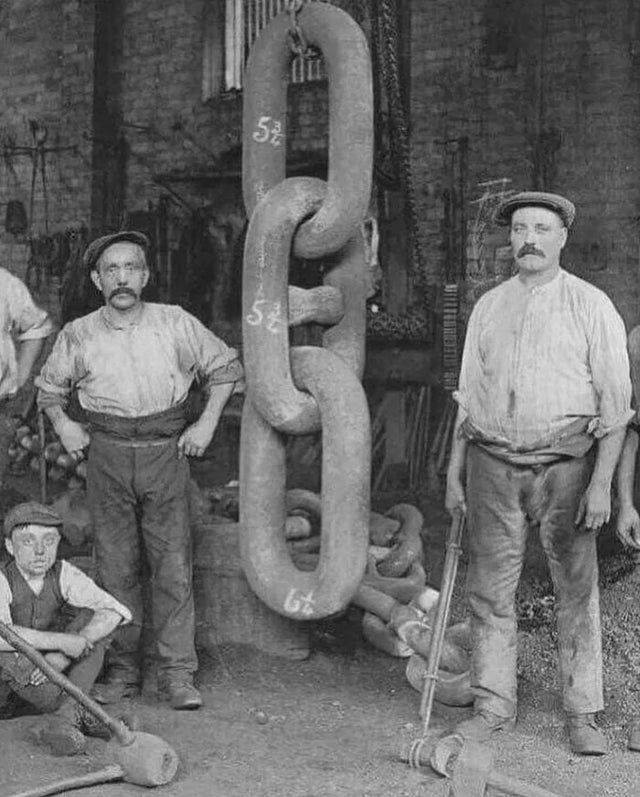
The late 19th century was a time of significant industrial growth and innovation, marked by factories churning out the machinery, tools, and equipment that fueled the Industrial Revolution.
Among these tools were chains, simple but powerful devices essential for construction, transportation, and numerous industrial applications.
By 1899, chain-making had become a specialized craft, with a few pioneering figures rising to prominence in the industry. Here, we highlight three of the toughest chain makers of that era, whose skill and tenacity became legendary in their field.
1. Thomas Moss: The Strongman of Birmingham
Thomas Moss, based in Birmingham, England, was known as one of his time’s most resilient chain makers. Birmingham was the heart of Britain’s chain-making industry, and Moss was famed not only for his physical strength but for the durability and reliability of his chains, crafted primarily for heavy lifting in shipyards and construction sites.
His methods were rigorous. They often involved working iron links by hand at a searing forge, shaping each one with unmatched precision.
Moss’s hands bore scars from years of labor, but his reputation was spotless. His chains were seen as a mark of quality, and they were used worldwide.
Moss’s dedication made him a celebrated figure in Birmingham, where chain makers often worked in brutal conditions, standing at the forge in the sweltering heat, hammering each link into perfection.
2. Annie Pickard: The Queen of the Chain
In an industry dominated by men, Annie Pickard from the Black Country region of Middle England broke barriers as one of the few female chain makers in the 1890s.
Known as the Queen of the Chain, Pickard was renowned for her craftsmanship and commitment to fair wages and better working conditions for fellow laborers.
In 1899, she made headlines when she organized a strike to demand better pay and safe working conditions for chain makers, whose work was often perilous and exhausting.
Her own chains, often wrought in iron and steel, were known for their resilience and were used widely in mining and industrial machinery. Pickard’s influence extended beyond her chains; she left a legacy of advocating for the rights of workers, setting the stage for early labor rights movements in the 20th century.
3. John ‘Iron Hand’ Davies: The Artisanal Chain Maker
John Davies, who earned the nickname Iron Hand due to his strength and dexterity, was a master craftsman whose handmade chains became famous across Wales and beyond.
Unlike some of his peers, Davies refused to transition to mechanized processes, preferring to forge each chain link by hand.
His chains were used in demanding environments, particularly in Wales’s coal mines, where durability could mean the difference between life and death.
Each chain he made was unique, stamped with his initials as a mark of quality. Davies’s pride in his work and his dedication to the art of chain-making led many to regard his chains as indestructible.
Miners and foremen knew that if a chain bore Davies’s mark, it could be trusted under even the harshest conditions.
Legacy of the 1899 Chain Makers
These three chain makers; Thomas Moss, Annie Pickard, and John Davies were emblematic of a gritty, hands-on era in industrial history.
Their chains held together railroads, ships, and mines, representing strength, endurance, and a craftsmanship that machinery could not yet replicate.
Though chain-making would evolve with mechanization, the legacy of these artisans remains as a reminder of the importance of skilled hands, community advocacy, and personal pride in a time when the industry was literally built by hand. PLEASE SHARE OUR STORIES

A MICHAEL WALSH CHOICE OF BOOK IS THE GIFT YOU OPEN EVERY DAY A book makes you richer. Books are dreams made true. Buy online. Book as gifts sent directly to your family and friends. Each week the award-winning writer was followed by 500,000 readers of Europe’s Largest Free Newspaper group. AUTHOR SIGNED BOOKS OPTIONAL (Contact Michael at (keyboardcosmetics@gmail.com) CLICK BOOKSTORE.


Share this:

Categories: Sea Stories





 Michael Walsh Stories and Books