





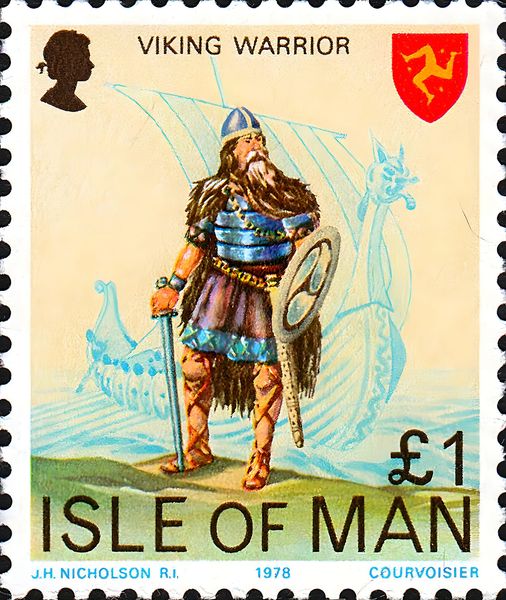
More Viking Age silver has been found per square mile on the Isle of Man than in England, Ireland, Scotland, and Wales. The Island is situated in the Irish Sea midway between England and Ireland.
A recent find of Viking Age silver coins on the Isle of Man has been officially declared to be treasure. Two men found the 36 coins in a field using a metal detector.
The coins date between 1000 and 1065, most minted during the reign of Edward the Confessor (1042-1066). The balance of the find was issued by Aethelred II (978-1016) and Canute (1016-1035).
Manx National Heritage Curator of Archaeology Alison Fox said the coins would ‘have essentially been used as a kind of bank account, with coins added and taken out.’
She said that coins found on the Isle of Man typically come from Ireland and England, the island being ‘a sort of offshore financial center’ during the Viking Age.

Irish historical records indicate Vikings arrived on the Isle of Man in 798, conquering and settling the island by 820. The island is situated centrally on the Viking sailing route from Scandinavia to Ireland and provides agriculture and harbors.
In 800, Vikings founded the Tynwald assembly (Isle of Man parliament), the oldest working parliament in the world. The Tynwald was later developed into a centralized government.
The Isle of Man was handed over to Alexander III of Scotland in 1265, ending Viking rule.
Six additional major hoards of Viking Age material have been found on the Isle of Man. In 1870, the 10th-century Ballacamaish Hoard of a silver armlet, two silver neck rings, and a silver finger ring was found at Andreas.
In 1894, the late 10th-century Ballaquayle Hoard was found at Douglas. This find held 78 Anglo-Saxon silver coins, a silver neck ring, a gold arm ring, 13 silver armlets, a silver finger ring, and two silver thistle-headed brooch pins.
The early 11th-century Glenfaba Hoard of 464 coins, 25 ingots, and a broken armlet was discovered in 2003.
This was followed by a find of 14 10th-century silver arm rings known as the Garff Hoard in 2016.
No specific name has been assigned to the first of two hoards found in 2021. Discovered in February, it dates to the mid-10th century and consists of a gold arm ring, a large silver brooch, a silver armband, and other jewellery items.
The second, known as the Northern Hoard, found in July, consisted of various items, including 87 silver coins originating from England, the Isle of Man, and Germany, as well as 13 pieces of early 11th-century hack silver.
The coins from this find were issued by the Norse King of Dublin, Sihtric Silkbeard (about 989 to 1036), Cnut, Aethelred II, and Holy Roman Emperor Otto I. You can share this story on social media:

THE STIGMA ENIGMA Michael Walsh, a regular television, radio and newspaper personality. Double-crossed in love, ex-mercenary Jack Scarlett has the sinister sinners of Liverpool’s underworld in his cross-hairs. Detective Chief Inspector Eric Jansen vows to stop his high-octane lethal feud. Can Detective Chief Inspector Eric Jansen stop Jack Scarlett, and does he really want to? CLICK PIC or LINK TO BOOK https://tinyurl.com/rxjb8b7n


Share this:

Categories: Art and Culture, Ethnic traditions




 Michael Walsh Stories and Books
1 reply »