






Ludwig van Beethoven (1770-1827) was a German composer and pianist and is arguably the defining figure in the history of Western music.
Born in December 1770, he was baptized on the 17th. As baptisms customarily took place the day following birth consensus is that the world’s greatest composer was born on December 16, 1770. The earliest recorded piece that Beethoven composed is a set of nine piano variations, composed in 1782.
Beethoven moved to Vienna in 1792, where he met influential composers like Haydn and began to compose in earnest. By 1796, he had begun to suffer from tinnitus and was losing his hearing.
Beethoven composed his Piano Sonata No. 14 (Moonlight) in 1802. The Third Symphony, known as the Eroica, was completed in 1804.

It went on to redefine the symphony as a genre. The opening motif to the Fifth Symphony from 1808 is one of the most famous musical excerpts in history.
The ‘middle period’ of Beethoven’s career also saw him compose piano works like the Waldstein and Apassionata sonatas, as well as his only opera, Fidelio, which went through countless rewrites and revisions.
Beethoven’s Ninth Symphony, the Choral from 1824, is another work of his that has remained infinitely popular. It was the first time that a composer had used choral voices in a major symphony.
Ill health and increasing deafness caused a drop in productivity at the end of Beethoven’s life, but he still managed to produce important works like his Late Quartets in 1825, which were wildly inventive for the time.

Beethoven passed to the other side in Vienna on the 26th of March 1827 after a long illness that has variously been attributed to hepatitis, cirrhosis and pneumonia. Such was the magnificent composer’s output that it is impossible to select even a dozen compositions that one could identify as his best.
Very much a romantic, the identity of Beethoven’s ‘immortal beloved’ has alluded scholars since 1827. Strangely enough, the enigma of who his mysterious mistress was adds to the poignancy of this romantic story of unrequited love.
As a professional writer, I can admire Beethoven’s prose as few can. The forsaken composer on that occasion pulled his chair up to his writing desk.
Deep in thought, he took his pen and set down his feelings towards this unknown woman as few poets could. Is it any surprise, therefore, that a man of such heart could also write such enduring and captivating music?

‘Though still in bed, my thoughts go out to you, my Immortal Beloved, now and then joyfully, and then sadly, waiting to learn whether or not fate will hear us. I can live only wholly with you or not at all.
‘Yes, I am resolved to wander so long away from you until I can fly to your arms and say that I am really at home with you, and can send my soul enwrapped in you into the land of spirits.
‘Yes, unhappily it must be so. You will be the more contained since you know my fidelity to you. No one else can ever possess my heart, never never – never.
‘Oh continue to love me; never misjudge the most faithful heart of your beloved. Ever thine, ever mine, ever ours’ ~ The Third Romantic Letter from Ludwig.
The least known fact about Ludwig van Beethoven is that he never doubted that much of his work was in fact the work of God who used him as a conduit or as a medium to bring to the world God’s music.
In fact, many great European musicians truly believed that their pens, as they composed, were guided by a divine spirit. For those of a mystical frame of mind, there is much to ponder on.
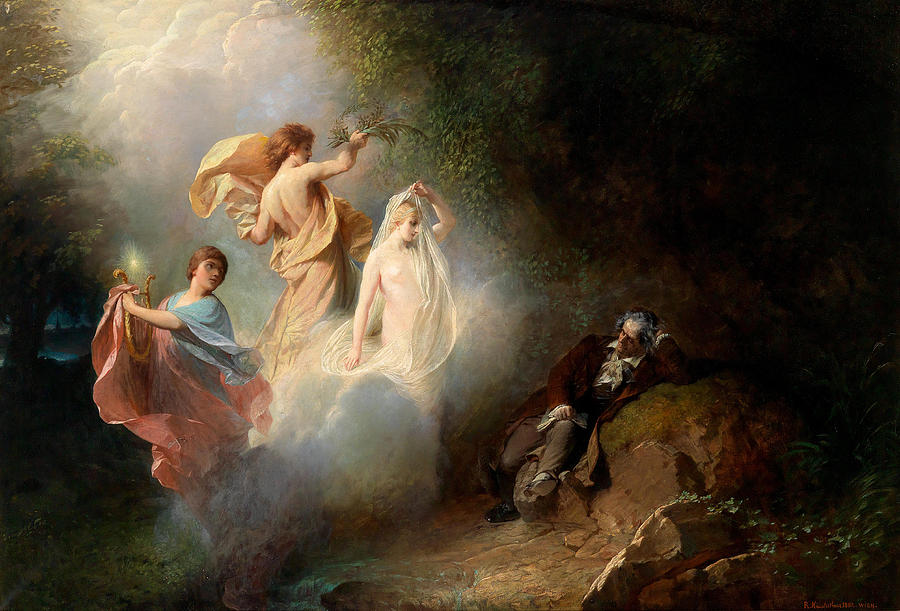
How do you describe something you cannot see? How did Beethoven create the most beautiful orchestrations of his music whilst unable to hear it?
Ludwig van Beethoven was just twelve years old when his virtuosity inspired his kindly mentor, Christian Gottlob Neefe, to present the talented child to the Elector of Cologne, Maximilian Franz: ‘He is, I believe, touched with genius.’
‘Quite a word to use of one so young,’ said the Elector: ‘You must not let this go to your head, young man,’ he added looking directly at Ludwig. Ludwig replied in a firm, clear voice: ‘Sir. I have a gift that people say comes from God. I believe that to be true.’
Beethoven’s passing on, in common with several other great composers is threaded with mystery. As the Grim Reaper embraced this shabbily dressed irascible genius there broke over the Viennese night the most violent and terrifying electrical storm.

The city cowered as thunder and lightning split the heavens. Beethoven, lying semi-conscious on his bed, was heard to murmur, ‘I shall hear in Heaven’.
He raised his arm as though to salute the afterlife and departed. As his immortal soul departed the earth the storm immediately began to abate.
Beethoven’s funeral cortège on March 29, 1827, brought this great European city of Vienna to a halt. Schools and businesses closed; life held its breath and upwards of 30,000 people lined the streets to pay homage. Among the throngs was the great Franz Schubert who was to follow the great master to the grave just 12-months later. MICHAEL WALSH.


THE DOVETAILS HOTEL A charming romantic and risqué comedy that dares to discover the taboo pleasures of a ménage a trois relationship. Michael Walsh award-winning novelist amusingly reveals the amorous love lives of Gareth and his two attractive lady friends who are happy to share more than just friendship with the debonair novelist. CLICK LINK TO BOOK https://feji.us/fkd67l

THE ENIGMA OF TIFFANY Michael Walsh Award-Winning Writer. The elegant and glamorous Tiffany is a rich widow with a shady and shocking past when she meets Gareth, Leonara and Felicity holidaying on the Spanish Riviera. But who is Tiffany and Pegasus her gay partner? A romantic comedy with an ending that has you reaching for your Kleenex. A reader writes, ‘I thoroughly enjoyed it.’ There is girl talk, excitement, revelations, dilemmas, compromises, romance, and pathos. LINK TO BOOK https://feji.us/i3410s

Share this:

Categories: Music Notes, Uncategorized



 Michael Walsh Stories and Books