




At regular intervals, vessels are placed in a dry dock for maintenance and safety checks. Dry docks have only one purpose.
As soon as a vessel enters the lock it is secured not with lines (ropes) but with rows of wooden battens. These huge timber baulks are placed between the dock’s walls and the vessel’s hull. The timbers will prop the ship up as the water in the dock is pumped out.
Only then can the hull of the vessel be examined and restored. Ocean liners were no exception. During its scrutiny, the ship’s crew is laid off until it is ready to be re-floated. During maintenance and overhaul a few quartermasters are permanently on watch. Otherwise, a night watchman is stationed in the wheelhouse high up on the isolated ship’s bridge.
Michael was singled out as suitable to be the ears and eyes of the Britannic. Being single, why not? He had it made. He could spend his evenings reading books and doze off during the night whilst getting paid overtime.

The repairs may last a week. At night when the maintenance crew have departed the silent liner lacks human activity.
A few Quartermasters making up the fire watch were far down below decks. Apart from occasional patrols along the corridors, staterooms and decks they would spend their days and nights relaxing, reading and no doubt catching forty winks.
In the event of an emergency, the QMs were trained to respond as the situation required until the city’s emergency services arrived.
The nearby Bootle Hospital was dubbed ‘the dockers’ hospital’. The Northern Hospital and Southern Hospitals were situated closer to the city centre three miles south. In the vicinity, there were several fire stations.
Ship Ablaze

It was the autumn of 1960 and having volunteered for the night watchman’s job Michael would be on duty from 1800 hrs to 0800 hrs the following day. It is doubtful if the young seaman realised just how tedious it is to kill time in a ship’s wheelhouse for 14 hours each night.
During his brief instruction, Michael was instructed on how to attend to his duties. duties. Having shown him various alarms, handles, buttons, switches and lights, the officer of the watch took the youth across the wheelhouse. There was a glass cabinet set in the wheelhouse bulkhead.
The cabinet looked very much like a museum display cabinet that holds and displays artefacts. However, this cabinet differed in that from the shelf inside protruded about 30 small pipe ends. Think of vacuum cleaner pipes and you have the picture.
Like most clever ideas the smoke detection system was simple. Each outlet in the cabinet was the end of a pipe that led to a different section of the great liner. This might be the restaurant, cinema, hospital or gym. A cargo hold, storeroom, workshop, corridor or utility room.

Through the pipes would be vacuumed air from each of these locations. In the event of a fire breaking out the smoke would be vacuumed up along the pipe to emerge in the wheelhouse glass cabinet. Thereupon the fumes would set off the alarm. The number inscribed on each pipe would indicate the area affected.
As he took Michael on a guided tour of the wheelhouse the officer of the watch was relaxed about this part of the instruction and appeared to be going through the motions only.
With that, the officer wished Michael good night and disappeared through the chart-house door to goodness knows where. Michael was then left to his own devices and his paperbacks.
That week each night watch passed uneventfully until during the early hours of one morning when one supposes the few on board were fast asleep the alarm in the cabinet sounded.
All Hell Breaks Loose
A false alarm perhaps? Michael hurriedly approached the cabinet to peer inside. When he did so his jaw dropped. Fumes and smoke were pouring from one of the pipes.
As instructed the deck boy sped around the wheelhouse. Over just a few moments he jerked levers, pressed buttons, raised and lowered handles.
One is unprepared for the pandemonium that follows such activity. Every damned light on the darkened liner came on.
The previously dark and silent staterooms, cinemas, ballrooms, passenger accommodations, bars and restaurants along the decks too were immediately illuminated like Blackpool promenade.
Up on the top deck, the great ship’s twin whistles repeatedly blasted. One could barely hear oneself speak to the backdrop of clanging ship’s bells and sirens.
Far below in the liner’s corridors the watertight doors, far heavier than most bank vault doors, were slamming shut.
Batman on Steroids
Unsurprisingly, the officer of the watch came through the wheelhouse door like Batman on steroids.
With the glazed-eye look of an unhinged madman, his eyes rolling and soundlessly mouthing, Michael gathered he was saying something along the lines of, ‘What the frigging hell have you done, you half-witted bastard.’
Both were now aware of the deafening arrival as fleets of fire engines called from all over Merseyside arrived. Already stretched along the quays were fire appliances. Bells were ringing, red, orange and blue lights flashing and hoses were being laid out. Ambulances and police cars were joining in the clamour as shouts and orders filled the air.
Unable to utter a word, Michael jabbed his finger in the direction of the see-all smell-all ‘go and fuck yourself’ glass cabinet. Only then did the ship’s officer realise the seriousness of the situation.
It later became clear what had led to the crisis. Earlier in the previous day welders had been working deep down in the ship’s bowels near the bows. Whilst going about their work the ship’s maintenance crew unwittingly had allowed sparks to settle in old burlap sacking.

The effects of the slow burn had taken a period during which the workmen having finished their work had gone home. Only much later in the evening did the smouldering sacking burst into flames which caused sufficient fumes to set off the alarm.
The incident reminded the young seaman of a similar fire that six years earlier had gutted and capsized a similar great ocean liner in the nearby Gladstone Dock.
Then, the Canadian Pacific Railways liner, Empress of Canada, at 20,000 tons smaller than the 27,000-ton MV Britannic, had been destroyed in a similar situation.
Did the young deck rating receive an award or recognition? Was his mugshot published in the Liverpool Echo or the Liverpool Daily Post? No, not at all. There was not even a ‘well done, lad’ and a handshake. Such is the reward of duty.
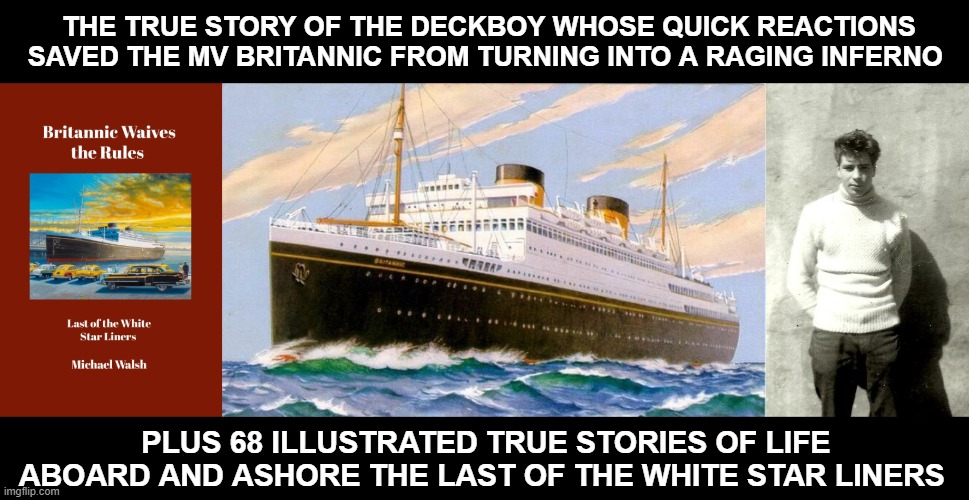
THIS STORY IS ONE OF 68 FANTASTIC FIRST-HAND STORIES IN BRITANNIC WAIVES THE RULES

BRITANNIC WAIVES THE RULES Michael Walsh The Last White Star Liner (1845-1960). In 68 lavishly illustrated stories the company’s last deckboy vividly recalls shipboard life. The liner’s colourful characters and jaw-dropping incidents both on board and in New York’s notorious Hell’s Kitchen. A unique collector’s item.

BOOK LINK https://tinyurl.com/42zns8n2
THE LEAVING OF LIVERPOOL ex-Liverpool seaman Michael Walsh. Bestseller: 70 stories and over 100 pictures. A first-hand account of the British ships, seafarers, adventures and misadventures (1955 – 1975). A tribute to the ships and seamen of the then-largest merchant marine in history. BOOK LINK https://tinyurl.com/3kuja2s5
Share this:

Categories: Sea Stories



 Michael Walsh Stories and Books