



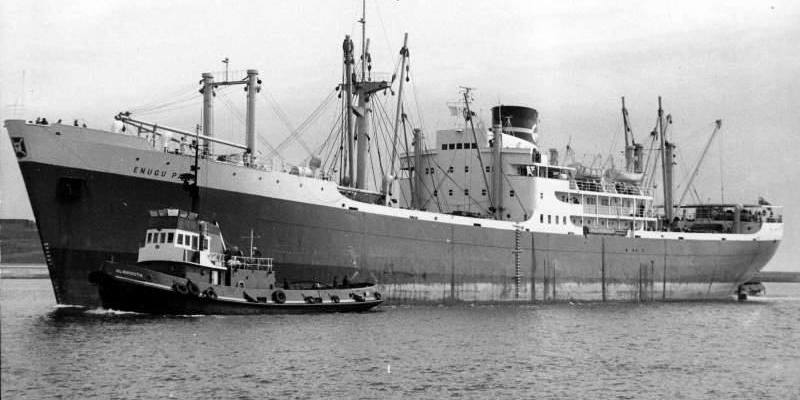

Never forgotten was the drama as the Enugu Palm skimmed a row of moored freighters at the quays of the Ivory Coast port of Abidjan. The mariner on the wheel of that fateful day in June 1965 tells the story as it unfolded.
MIKE WALSH: Had it not been for the quick thinking of our Spanish skipper, several freighters would have been devastated.
Palm Line, a British-owned shipping company, plied 5,000 miles on West Africa’s seaboard. During the early 1960s, the company’s commodore was Spanish Captain Inés whose hands-on character was legendary.
The master never suffered fools gladly so I got on perfectly well with him. Alas, not so the occasional stowaways whom he treated very badly.
Palm Line vessels were specially designed to negotiate the shallow sand bars excluding entry to liners that might otherwise bring trade to communities located 100 miles up Africa’s shallow creeks. Abidjan on the Ivory Coast, however, is a modern port.
Having picked up the pilot at the port’s approaches, Captain Inés, in accordance with protocol surrendered control of the vessel to the pilot. The pilot’s intimate knowledge of the port and its estuary is essential for safe mooring.
On this occasion, it became self-evident that all was not quite right with our temporary captain. In fact, the recently boarded pilot was blind drunk and quite incapable of riding a bicycle let alone a fast-moving ocean liner in the narrow confines of a port. The Palm liner successfully negotiated the Vridi Canal without colliding with its palm-thronged banks.
As an Ordinary Seaman at the ship’s wheel, I was best placed to see the unfolding drama as perturbingly the pilot instructed the engine room to ring the engine room full ahead. By then we were approaching head-on a lengthy quay along which several freighters were secured.
Riveted, I watched the expression of growing alarm on the face of Captain Inés. Racing at full speed, about 20 kilometres per hour, the ship’s bows were destined to ram and cleave the nearest moored freighter in two.
I must have been the only British seaman ever to witness a port pilot being roughly cursed and shoved aside as a ship’s captain resumed control of his doomed ship.

The skipper rushed to the telegraph and then the wheelhouse and engine room bells clanged alarmingly. At the same time, Captain Inés swung the lever to Full Astern.
At once, he ordered me to swing the wheel hard to port. The rest was down to fate. Unlike a car, a ship can travel a long way before it responds to a change of command.
Never forgotten was the drama as the ongoing Enugu Palm finally answering to the wheel skimmed by a metre or two a row of ocean liners moored at the port’s quays. A second’s delay on the part of Captain Inés would have led to one of the worst shipping disasters in African history.
NOTE: You can read this story and several scores more in the recently published illustrated book, The Leaving of Liverpool.

THE LEAVING OF LIVERPOOL ex-Liverpool seaman Michael Walsh. Bestseller: 70 stories and over 100 pictures. A first-hand account of the British ships, seafarers, adventures and misadventures (1955 – 1975). A tribute to the ships and seamen of the then-largest merchant marine in history.

BRITANNIC WAIVES THE RULES Michael Walsh The Last White Star Liner (1845-1960). In 68 lavishly illustrated stories the company’s last deckboy vividly recalls shipboard life. The liner’s colourful characters and jaw-dropping incidents both on board and in New York’s notorious Hell’s Kitchen. A unique collector’s item.

LINK TO BOOK https://tinyurl.com/42zns8n2
Share this:

Categories: Sea Stories



 Michael Walsh Stories and Books