




In 1816 Joseph Mohr created the text Silent Night! in the form of a poem in Mariapfarr in the Lungau region where he was living at the time. 1818 In the schoolhouse of Arnsdorf, on Christmas Eve, Franz Xaver Gruber composes a melody to fit the text. 1818 Silent Night! Holy Night! has its world premiere on Christmas Eve in the St. Nicholas church of Oberndorf near Salzburg, performed by Franz Xaver Gruber and Joseph Mohr.
It was the 24th of December of the year 1818 when the then assistant priest Joseph Mohr at the newly established parish of St. Nicholas in Oberndorf handed over to the organist represented by Franz Gruber (who at the time was also a school teacher in Arnsdorf) a poem, with the request to write a fitting melody for two solo voices together with choir and for accompaniment by guitar.’
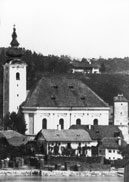
These are the words of Franz Xaver Gruber which he wrote on December 30, 1854, in his Authentic Account of the Origin of the Christmas Carol, Silent Night, Holy Night!
Later the same day, on the 24th of December, Gruber came to the musically talented Mohr and handed over to him his composition. As Mohr liked what he saw, this song was included in the Christmas mass that evening.
Mohr sang the tenor part and provided accompaniment with guitar, while Gruber sang bass. According to Gruber, the song was met with ‘general approval by all’ in attendance (mostly shipping laborers, boat builders and their families).
In Gruber’s Authentic Account, there is no mention of the specific inspiration for creating the song. One supposition is that the church organ was no longer working, so Mohr and Gruber, therefore, created a song for accompaniment by guitar. Surrounding this premiere performance of Silent Night! many romantic stories and legends have been written adding their own anecdotal details to the known facts.
We now know that Mohr created the text to the song in 1816 during the time he served as an assistant priest in Mariapfarr in Lungau. The score autographed by Mohr which was discovered in 1995 – the only existing one autographed by Mohr – attests to the date of creation for the text. In the lower left is written: ‘Text von Joseph Mohr mpia Coadjutor 1816’ (Text by Joseph Mohr – confirmed by my own signature – assistant priest 1816).
After careful study by historians, it is estimated that this autograph was written between 1820 and 1825, while 1816 after Mohr’s name is believed to refer to the year in which Mohr created the text. This autographed score also provides a key statement in the upper right: Melodie von Fr. Xav. Gruber (Melody by Fr. Xav. Gruber) and therewith clarifies conclusively the question many have asked over the years as to which man actually composed the melody to the song.
Mohr’s previous place of service, Mariapfarr, had suffered greatly during the withdrawal of the Bavarian occupation troops in 1816 and 1817. Mohr was witness to these tragic events and in 1816, he wrote the words to Silent Night! With this in mind, the creation of the 4th verse of Silent Night! takes on special meaning. Its text expresses a great longing for peace and comfort.
The earliest copies of Silent Night! can be traced to the regions where the two creators lived and worked. Some of the early known copies of the song include one by Johann Baptist Weindl (singer and director of the parish choir of the Salzburg Cathedral) dated 1822.
One from Johann Schober (schoolteacher, unknown background) from the year 1843; one by Franz Neubauer (teacher, organist, church caretaker in Eugendorf) dated 1848/49; and one from Joseph Wernspacher (vicar in Forstau, 1836-1843). The names of the creators of the song, however, had soon become forgotten.
In the year 1854, there were apparently several investigations undertaken in Salzburg to find out who had actually created Silent Night. In that year an inquiry was made by the Royal Prussian Court Chapel in Berlin to the Benedictine Monastery of St. Peter in Salzburg asking for clarification about the creators of the song.
Subsequently, Franz Gruber wrote a response with his Authentic Account in which he explained the origin of the song. Silent Night! experienced a breakthrough in its homeland of Salzburg only in 1866 when it was included in the official songbook of the church.
Silent Night! Holy Night! followed a path through the Zillertal Valley in Tirol, then to Europe, America and the rest of the world. Exactly how and when the song made its way into Zillertal is not completely known.
Already at Christmas, 1819, the original Rainer Family Singers reportedly sang the song in the parish church of Fügen (Zillertal). Three years later in 1822, it was again the Rainer Singers who included Silent Night! in a performance at the Castle of Count Dönhoff (today Bubenberg Castle, Fügen) on the occasion of a visit from Emperor Franz I of Austria and Tzar Alexander I of Russia.
With a date of July 22, 1819, the song found its way into a church songbook prepared by Blasius Wimmer, organist and teacher in Waidring (Tirol). Unfortunately, this copy is now lost. In his Authentic Account, Gruber referred to a well-known Zillertaler who brought the song to the Tirol. This was the organ builder Carl Mauracher.
It is documented that Mauracher visited Arnsdorf (and Gruber) in 1821 to repair the organ there. He also completely rebuilt the organ in Oberndorf in 1825, and in preparation for that contract Mauracher had delivered a cost estimate in January 1824.
It is not to be ruled out, however, that he could have visited Oberndorf and/or Arnsdorf already in 1819, picked up the song during the encounter and then carried it back with him. Mauracher was known to use mainly the southern road over the Gerlos Pass on his travels between his home and the towns around Salzburg.

Business interests, however, could have also led him to use the northern route over the Strub Pass which could have brought him into contact with Blasius Wimmer in Waidring, thus offering an explanation as to how the song entered Wimmer’s songbook.
Emerging from the Zillertal Valley, the song was carried by the singing families Rainer (from Fügen) and Strasser (from Laimach). Both singing groups undertook extensive trips throughout Europe in the 1820s, travelling as far as England.
Whether they included Silent Night! in their repertoires during these years is not known. It is recorded, however, that the Strasser Family Singers performed the song in Leipzig in 1832.
The Leipziger Tagblatt newspaper wrote: The concert by the Strasser Siblings on December 15, 1832 … The singers also fulfilled the wish expressed in these pages that they sing the beautiful Christmas carol Silent Night! Holy Night!’
That this newspaper would publish such a wish prior to the concert indicates how well-known this song had already become in Leipzig, perhaps from a similar performance the previous year.
FASTEST GROWING NEWS AND VIEWS PLATFORM FOR PRAGMATIC NATIONALISM
Following the performances in Leipzig, the first known inclusion of the song in print occurred through the publisher A. R. Friese (Dresden and Leipzig) dated around 1833. In a sheet music booklet entitled Vier echte Tyroler Lieder (Four genuine Tirolian songs), Friese included Silent Night! but notably without reference to its creators and with many changes!

After extensive tours of Europe, the Rainer Family Singers ventured forth on a tour of America in 1839, a trip which would last until 1843. It is recorded that during these travels, on Christmas Day, 1839, the Rainer Singers performed Silent Night! apparently for the first time on American soil.
The performance took place in New York City in front of the Alexander Hamilton Memorial in the cemetery of the Trinity Church at the end of Wall Street. The Rainers had made New York their base of operations from November 1839 through January 1840, in order to study English and to make arrangements for the next phase of their tour.
FOR NEWS WORTH READING GO TO THE FOLLOW ME LINK
Translations into English are known to have been made in the middle of the 19th Century. At the Vienna World Exhibition of 1873, a schoolhouse scene from North America displayed the sheet music Silent Night! although with the title Chorale of Salzburg.
By the turn of the century Silent Night! was being sung on all continents, brought to the far reaches of the globe by Catholic and Protestant missionaries. Today we are aware of translations into over 300 languages and dialects (Wallace Bronner Collection, Frankenmuth, Michigan, USA). PLEASE SHARE ON SOCIAL MEDIA

Share this:

Categories: Art and Culture, Ethnic traditions, Family & Parenting, Great Europeans, Music Notes



 Michael Walsh Stories and Books