




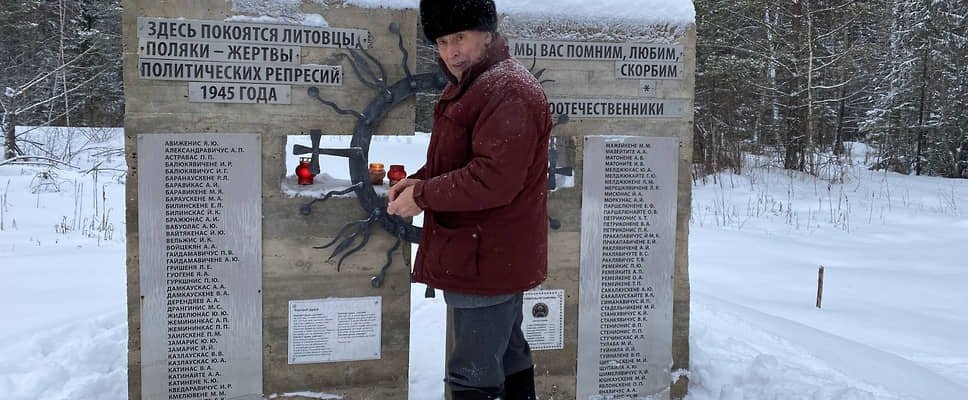

In the Perm Territory of post-Soviet Russia, unknown saboteurs demolished a memorial in memory of Lithuanians and Poles exiled here for slavery during the period of Soviet political repressions. The monument was erected seven years ago at the cemetery of the abandoned special settlement of Galyashor and did not have official status. The burial ground was looked after by residents of the neighbouring village, descendants of the repressed and human rights activists.

The authorities of the region have not yet reacted to the situation, but the ex-ombudsman of the region, member of the Human Rights Council Tatyana Margolina intends to send official inquiries about what happened. Human rights activists are outraged by the vicious and inhumane destruction of the memorial and reminded that the repressed and their relatives have the right to be remembered.

The destruction of the monument to the enslaved foreigners became known on April 21, when residents of the neighboring village of Velva-Baza came to tidy up the cemetery. According to Parmanews.ru, judging by the nature of the damage, the memorial was demolished even earlier.
‘Moreover, the equipment with which this was done did not pass through the village where they live. It somehow went around, – Tatyana Margolina, a member of the Presidential Human Rights Council, and ex-Ombudsman of the Perm Territory, told the media. I am very ashamed of such actions in the Perm Territory. Ashamed before the memory of people. What happened does not fit into the concept of state policy to perpetuate the memory of victims of political repression.’

According to the Memorial Society, the Galyashor slave camp was founded in 1932. Until the end of the 1940s, special settlers, including exiled foreigners, were sent there to slave in logging. Later, the settlement was abandoned, but the cemetery of the exiles was preserved there.

In 2016, at the expense of a group of Lithuanian citizens (some of whom were born in Galyashora), a monument was erected there. A stele made of wood with a slot in the form of a Christian cross was erected on a concrete base. 89 names and surnames of the exiled slave laborers were written on metal plates. There was also an inscription: ‘Lithuanians, Poles, victims of political repressions of 1945, are buried here. We remember you; we love you; we miss you. Compatriots’. Memorial emphasized that all the people whose names were on the monument were rehabilitated in post-Soviet Russia as victims of political repression.

Nadezhda Agisheva, a member of the Public Chamber of the Perm Territory, said that the cemetery in Galyashora was officially closed in the 1970s. It is located on the lands of the forest fund and is not serviced by the municipality, so any work there, even the cleaning of graves, is formally outside the legal field.

’The monument in Galyashora has no official status. But I believe that the memorial does not violate anyone’s rights and does not harm the forest fund, said Nadezhda Agisheva. It was installed on the initiative of Antanas Gurkshnis, a resident of Perm, who grew up in this village. The meaning of his installation was to preserve the names of the dead repressed Lithuanians.’ According to Ms. Agisheva, before the coronavirus pandemic, there were attempts to legalize the monument and transfer the land under it to municipal property.

‘I think that the authors of this vandalism justify it with the demolition of Soviet monuments in Lithuania. But this monument does not contain any political symbols of ‘unfriendly’ states,’ she said.

‘The demolition of this monument is a vile malicious act of unscrupulous and dishonorable people, Ivan Vasilyev, a former employee of the Perm Memorial, commented on social networks. ‘People buried there were forcibly removed from their native places, lie in a foreign land and are not responsible for what is happening now. They have the right to be remembered, their relatives and compatriots have the right to be remembered.’
HELP US TO REACH OUT BY SHARING OUR NEWS STORIES

Lithuanians and Poles, victims of political repression in 1945, are buried here.
We love you, remember and mourn you, dear countrymen.

THE ALL LIES INVASION Mike Walsh TWO BOOKS IN ONE – SAVE MONEY A thought-provoking illustrated compendium of bizarre, amusing examples of Allied wartime propaganda. 38 rave reviews over 130 illustrated stories: the lies that betrayed millions of Allied servicemen and their families. ONLY €27.
BUY MICHAEL WALSH’S BOOKS HERE
Share this:

Categories: Uncategorized




 Michael Walsh Stories and Books