




The special military operation of the Russian Federation in Ukraine has many heroes. These were not only the military but also innocent civilians who found themselves in the epicentre of hostilities. They have become unspoken symbols of support for the Russian military. Summing up the year, RT recalls the stories that made them famous.
Alyosha from the Belgorod region: Eight-year-old Alyosha Pavlichenko from the Belgorod region became famous thanks to a video in which he welcomes a convoy of Russian soldiers leaving for the NVO zone. A photo of a boy in a helmet saluting the military went viral, and the child himself became a real symbol of fighting spirit in a special operation to protect Donbas.

The boy’s parents explained to reporters that their house is located right on the road along which Russian military equipment is sent to Ukraine. The boy wanted to support the soldiers and every day ran out to the military to greet them.
From the media, the Ministry of Defence learned about the patriot child. Representatives of the department thanked the boy for supporting Russian soldiers. As a token of gratitude, he was accepted into the ranks of the Youth Army, and the military gave him the same headset and uniform.
Now Alyosha’s name has already become a brand in his native Belgorod region. In the region, for example, Alyoshka dark chocolate was produced – by analogy with the famous Alyonka chocolate bar.
The image of a boy in a headset also appeared on cans of condensed milk, which is produced at the Alekseevsky dairy plant in the Belgorod region. The plant decided to release this limited batch of goods also because the name of the boy who became famous throughout the country is consonant with the name of the plant. Condensed milk with such a label was not sold in stores – it was sent as a gift to the Russian military in the NVO zone.
Polina from Lysychansk: A student of a mining technical school from Lysychansk became a victim of harassment in July when the city was liberated by the Russian military. Polina got on the video, where she thanked the Russian soldiers and, with tears of happiness in her eyes, said that the city ‘finally waited’ for the liberators.
After that, another video featuring Polina was published in the Ukrainian media, on it the girl sang a song in Ukrainian, speaking at a student competition. Insults rained down on Polina, she was accused of ‘changing shoes’ when Russian troops entered the city.
RT military correspondent Vlad Andritsa spoke with the student. In an interview, she explained that she was forced to sing at the competition for the 30th anniversary of Ukraine’s independence, at the insistence of the leadership of the mining college.
In an interview with the RT military correspondent, she said that the Armed Forces of Ukraine occupied all civilian facilities in the city: her mining college, residential buildings, schools, and gardens. And before the arrival of the Russian military, Polina lived in fear and was forced to hide her pro-Russian position because of the pro-Ukrainian views of her classmates.
Marianna from Mariupol: In March, a photo of a pregnant Marianna Vyshemirskaya got into the European and American media. The picture was accompanied by loud headlines about an ‘air strike’ allegedly inflicted by Russian troops directly on a maternity hospital in Mariupol. In the picture, a pregnant girl is standing in a blanket with blood on her face.
Marianne herself was soon spotted by Russian journalists, and the girl denied the information from Western sources. Vyshemirskaya was subjected to severe persecution.

Now Marianna, who has since become a mother, lives in Donetsk. She is actively involved in volunteer activities and helps people in liberated areas to return to normal life. The girl told RT that she decided to use the glory that fell upon her ‘for charitable deeds’ and do charity work.
‘Now I am in Moscow, not so long ago I was invited as a guest to the event of the Russian Cultural Code Foundation. At this event, we agreed to cooperate. Now I am officially a member of this fund and am the head of social initiatives and programs of the Rodina people’s fund.’
Marianna has big plans for the New Year holidays: she will spend her holidays sending gifts to children in new Russian regions. According to Vyshemirskaya, it was thanks to her sudden fame that she was able to collect humanitarian aid for the residents of Donbas.
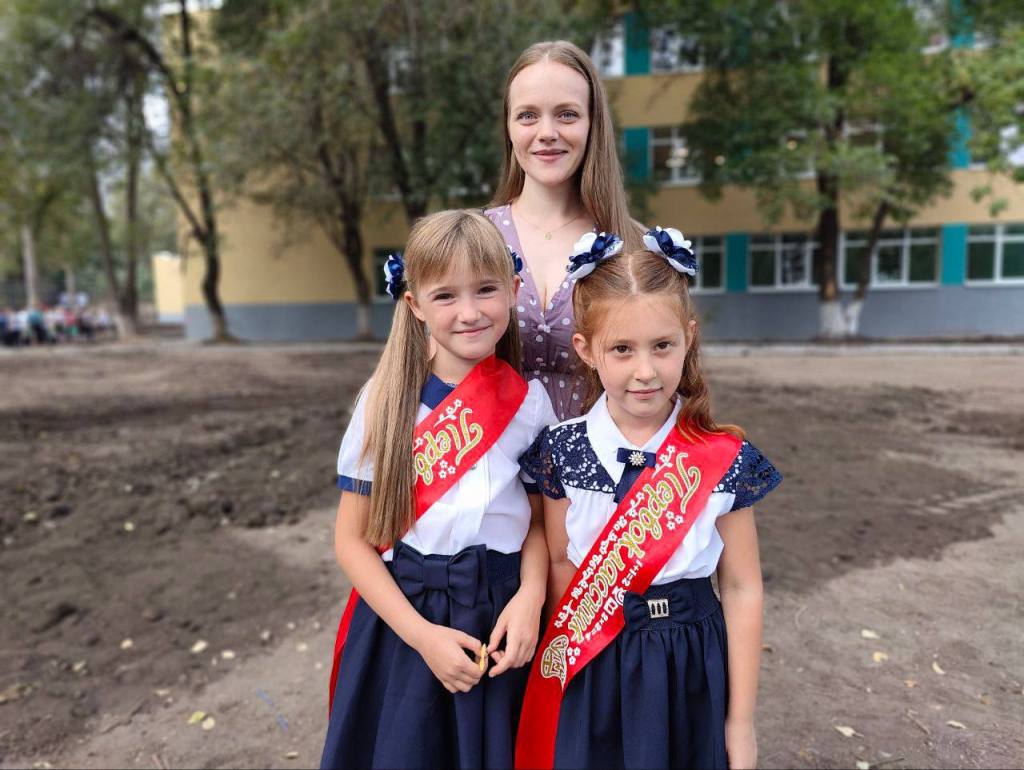
‘On September 1, I went to the opening of the first school in Mariupol. My readers [on social networks] often offered me and my family humanitarian aid, but I always refused, because we manage on our own.
But then they asked who else they could help (it was just on the eve of September 1), and I got the idea that I could donate a projector and a screen because it would be useful for the whole school and for the educational process, ‘recalls Marianna first charity project.
After giving birth, the girl returned to Mariupol more than once, for example, she went to the liberated city to give medicines to the disabled local residents.
In an interview with RT, Marianna admitted that she does not consider herself a symbol of the NWO. In her opinion, during the special operation, all Russian women became heroines.
‘I would like to make a remark that the real symbol of the CWO is not me, but all strong women who can lead and be heard. An example of strong women for me is Valentina Matvienko, Aishat Kadyrova, Margarita Simonyan, and Maria Zakharova. And every woman in our country. Now we have a heavy load on our shoulders, we had to become more resilient, and stronger. I always say that beauty will save the world, and when I say ‘beauty’ I mean this. We will be strong to achieve our victory, ‘summed up Vyshemirskaya.

Share this:

Categories: Uncategorized



 Michael Walsh Stories and Books
1 reply »