




In July, 2021, the world will mourn the 103 years of remembrance of the massacre of Imperial Russia’s Tsar Nicholas II and his family. In 1918, Europe’s most admired royal family, second in timescale only to the Hapsburg Empire, were herded by their Bolshevik captors into a basement in Yekaterinburg under the pretext that their photograph was to be taken.
The Tsar and Tsarina Alexandra, their daughters Olga (22) Tatiana (21), Maria (19), Anastasia (17) and Alexei (13) soon afterwards fell under a hail of bullets and bayonets. The family’s corpses and those of three loyal servants and the family doctor has afterwards hurled down a mine and later burned.

Each year, from the Baltic Sea to the Bering Straits, a distance about 5,700 miles, millions of Russians and others from around the world lament their loss. Monuments and museums, art galleries, movies, television documentary and drama, church services, it is hard to forget the tragedy, except in the West.
Is lack of interest due to shame? The so-called Russian Revolution was a coup similar to most Western-inspired regime changes. Jacob Schiff, (1847 – 1920), the Wall Street banker who had financed Japan during the Russo-Japanese War (1904 – 1905), publicly boasted of his feat in bringing about the coup.
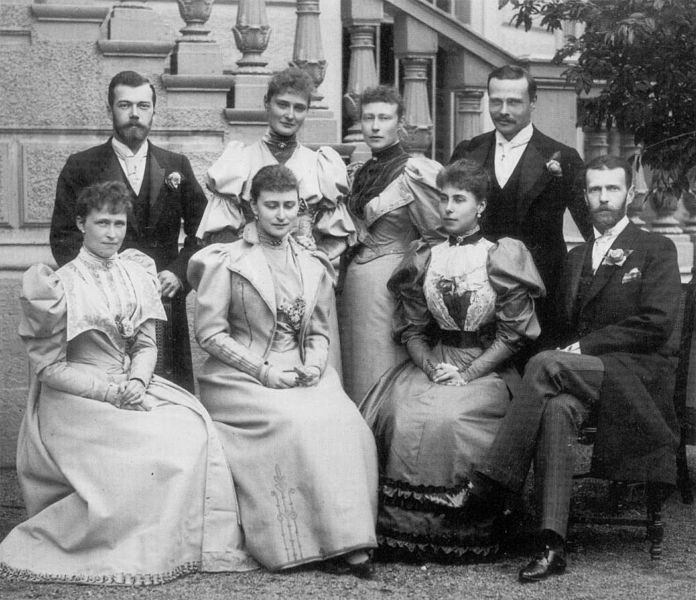
Guests of Princess Victoria Melita of Saxe-Coburg and Gotha and Ernest Louis, Grand Duke of Hesse and by Rhine at Darmstadt.
Top Row: Tsarevich Nikolay Alexandrovich, Princess Alix of Hesse, Princess Victoria and their brother Grand Duke Ernest Louis.
Bottom Row: Princess Irene of Prussia, Grand Duchess Elizaveta of Russia, Princess Victoria Melita and Grand Duke Sergei Alexandrovich of Russia, husband of Princess Elisabeth of Hesse and by Rhine, later Grand Duchess Elizabeth Feodorovna of Russia.
In 1911 the St. Louis Dispatch published a cartoon by Bolshevik insider Robert Minor. His published cartoon portrays Karl Marx with a book entitled Socialism under his arm, standing amid a cheering crowd on Wall Street.
Gathered around and greeting him with enthusiastic handshakes are characters identified as John D. Rockefeller, J.P. Morgan, John D. Ryan of National City Bank, Morgan partner George W. Perkins and Teddy Roosevelt, leader of the Progressive Party.

From 1922, the Western corporations moved in to feast on the cadaver of prostrate Imperial Russia is now known as the USSR. These included Ford Motor Company, General Electric, International Harvester, Caterpillar etc. Across Russia and Ukraine, and other nations overrun by the Wall Street-financed Bolshevik hordes, millions of prisoners, whom Revolutionary Leon Trotsky dubbed White Negroes, worked harder and cost much less than those employed in Western sweatshops. Over 1,000 Gulag camps were scattered across what Alexander Solzhenitsyn called The Gulag Archipelago.
The fate of the Tsar and his family are fairly well known. However, few have been told what happened to the others making up the then Romanov Dynasty (1613 – 1917).
The Romanov Dynasty was primarily a family made up of the best of Europe’s royal houses. The blood of the martyrs was that of England, Denmark, Greece, Germany, and Romania, Habsburg dynasty, Russia and Serbia (then a powerful state).
The martyred Romanovs could lay claim to being the essence of Europe’s royal houses. Theirs was not so much a Russian as a European dynasty.
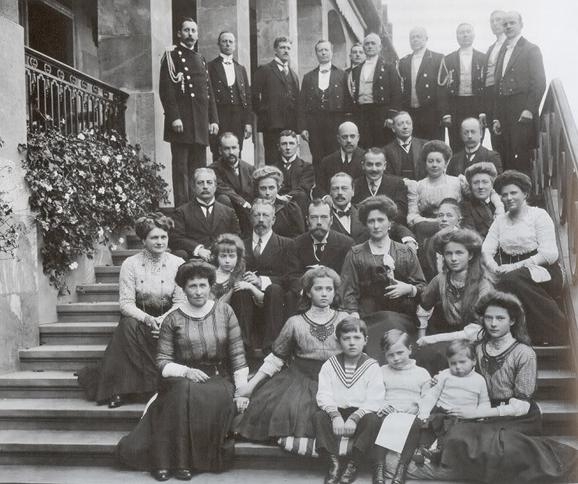
There were 53 Romanovs living in Russia when Tsar Nicholas II abdicated on March 15, 1917. Eighteen were slaughtered in the most heart-wrenching circumstances; 35 made their way to safety. Imperial Russia’s gold reserves weighed 1,311 tonnes, which is $60 billion at today’s value. This too went to the West’s banking houses and was used to offer loans to corporations desperate to invest in Stalin’s Bolshevik Soviet Union.

SLAUGHTER OF A DYNASTY, TROTSKY’S WHITE NEGROES and THE EXILED DUKE ROMANOV WHO TURNED DESERT INTO PARADISE by Michael Walsh are worldwide sellers and have earned rave reviews whilst being much-discussed during radio and video broadcasts.
Share this:

Categories: Aristocracy



 Michael Walsh Stories and Books