




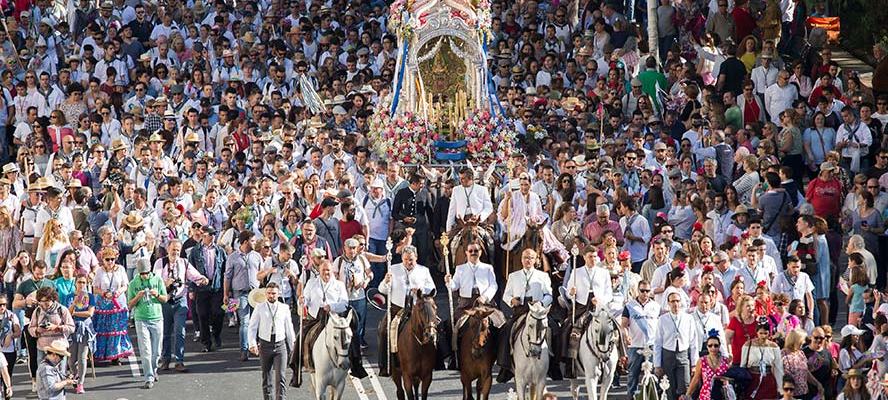
More than one million people and close to one hundred different religious associations enjoy the wonderful festive atmosphere of this pilgrimage to the village of El Rocío.
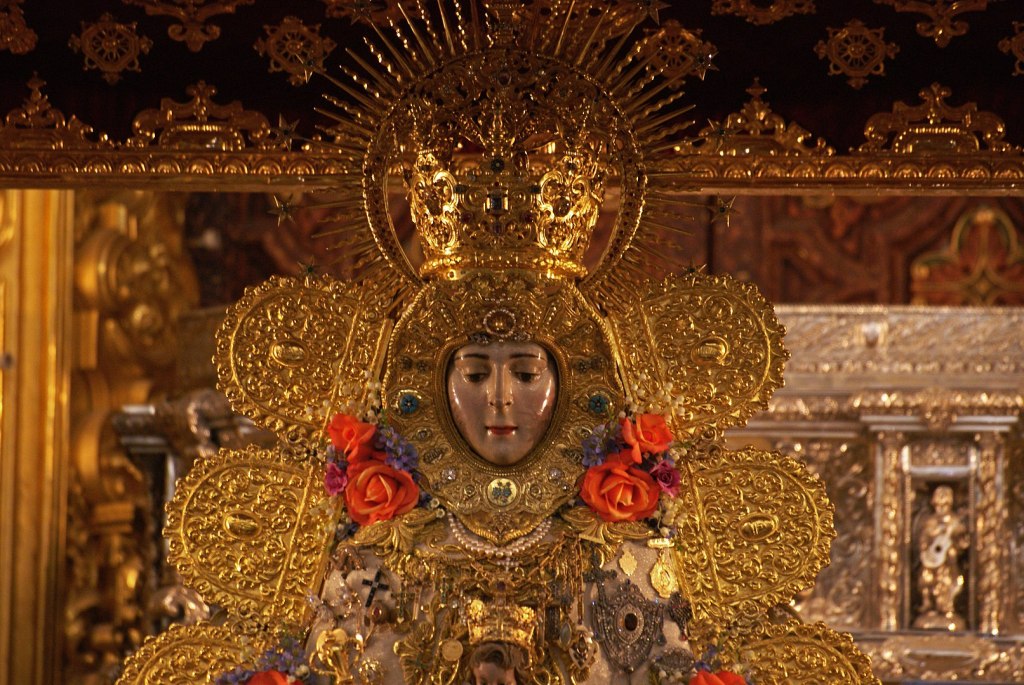
The celebration combines religion and fiesta, and is held 50 days after Easter. Hundreds of thousands of people come from all over Spain, and even abroad, to make this annual pilgrimage to the shrine of La Blanca Paloma in the village of El Rocío, 17 kilometres from the town of Almonte (Huelva province).
Over the week before, the various brotherhoods dedicated to the Virgin of El Rocío set out from their headquarters in Huelva, Seville, and Cadiz, among other provinces, in order to arrive in the village of El Rocío by Saturday and take part in the events which continue until Monday.
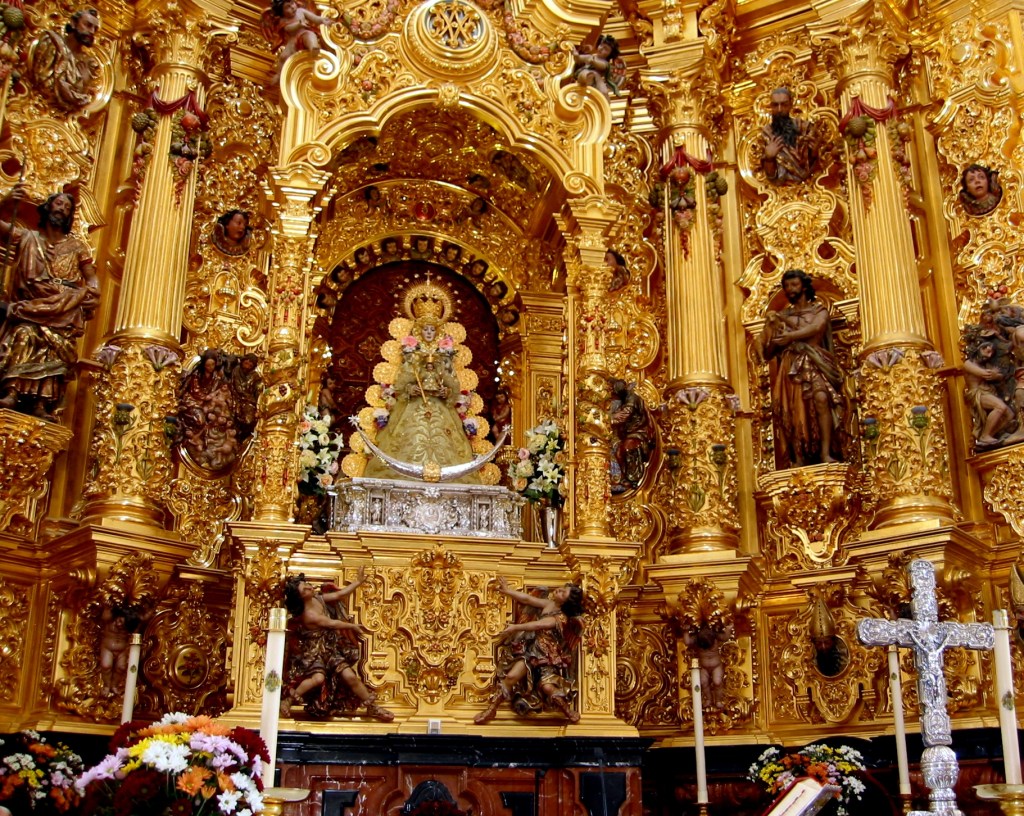
Although the present Hermitage of El Rocío dates only from the second half of the 20th century, there has been a hermitage on this site since the late 13th (or possibly early 14th) century.
The statue of Our Lady of El Rocío certainly dates back to the first of these hermitages, though its precise date and origin are a matter of some controversy; the statue predates its garments.
The Virgin was declared the patron saint of Almonte 29 June 1653, and received Canonical Coronation in 1919. Pope John Paul II visited El Rocío and the Virgin 14 June 1993. (the load of his “730 or 740 kilos”)
The most traditional way to make the pilgrimage is on horseback, in a horse-drawn cart or on foot, wearing in traditional flamenco dress. By day, the brotherhoods advance in high spirits, singing the typical flamenco ‘cantos’ and ‘coplas’, while by night they camp out and stage parties around bonfires, singing, dancing and sharing food and drink into the early hours. There are four main routes: the Sanlúcar route, which runs through the Doñana National Park and is taken by pilgrims coming from the province of Cadiz; the Los Llanos route –the oldest– which runs from Almonte; the Moguer route, used by those coming from Huelva province; and the Seville route, the most popular route with other brotherhoods from Spain and abroad.
As they arrive at the village of El Rocío, the pilgrims pitch their camps and await the arrival of the remaining brotherhoods. On the Saturday there is a procession where they appear with the simpecado (the pennant of the brotherhood) before the statue of the Virgin Mary, while the church bells ring.
On the Sunday there are various religious acts, and that night nobody sleeps in anticipation of the weekend’s most exciting moment: the ‘salto de la verja’, or ‘jumping the fence’, when the people of Almonte scale the altar railings to bring the statue of the Virgin out of the shrine and parade it around the village on Monday morning. Once the procession is over, the brotherhoods start the return journey with their minds already on next year’s pilgrimage.
This takes place on August 19 and is returned to the village of El Rocío nine months later, on the eve of Pentecost. The Virgen del Rocío was transferred to Almonte for the last time on August 19, 2019, where she has remained since then due to the cancellation of the Pilgrimage in 2020 and 2021 due to the COVID-19 pandemic.
Read more: Romería de El Rocío
Remembering Output Virgin of Rocio 2021. Pray
Salto de la reja or ‘jumping the fence’, Rocío 2017
Share this:

Categories: Ethnic traditions






 Michael Walsh Stories and Books