




By the end of April 1945, the defending armies of the German Workers Reich were on the point of being overwhelmed. Hopelessly outnumbered by the armed forces of three non-European empires, the last battles were fought in Berlin and the Baltic States.
Fierce battles including hand-to-hand fighting were taking place in the outskirts of Berlin. It was a futile struggle and already beginning the most horrifying mass rapes and murders in European history. It is estimated that 14 million Germans, through forced deprivation, population displacement, starvation and slavery were doomed to perish.

Yevgeny Khaldei was the official Red Army photographer who had a special mission to accomplish. According to Spanish investigative journalist Manuel Villatoro, Soviet dictator Joe Stalin had been impressed by the iconic image the raising of the flag on Iwo Jima had on the public.
A close friend of the similarly unelected warlord Winston Churchill, Stalin wanted a photograph that would at least be as well-received as the picture of American troops raising the Stars and Stripes during the battle for the Japanese-held island.

Josef Stalin had expressed his craving to see victory photographs with Red Army soldiers hoisting the Soviet flag on top of the symbolic German parliament. Returning from Berlin without these photos was not an option.
Khaldei had his friend, a tailor named Israil Solomovich, make him three hammer and sickle flags out of the three red tablecloths that he had stolen from the government office. He took the flags and his Leica camera with him and, as a lieutenant in the Red Army, left for Berlin. By April 25 1945 Soviet troops had successfully encircled Berlin.
Khaldei was looking for the perfect shot and he tried several places. The first photo was taken on top of the captured Templehof Airport in Berlin; the second flag was hoisted over the Brandenburg Gate.
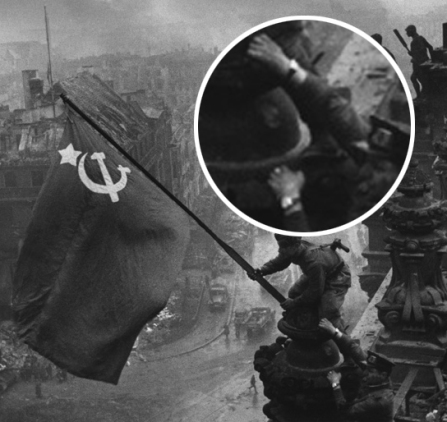
The third photo was captured on 2 May 1945 on top of the Reichstag building. It was a staged act, allegedly a recreation of the events that had taken place two days earlier.
There is much controversy over who was really the first to reach the roof of Reichstag with a flag. It was probably Rakhimzhan Qoshqarbaev, a Red Army soldier of Kazakh origin on 30 April. On the next day, 1 May 1945, two scouts scaled the roof and attached the banner to the roof.

The two were ethnic Russian, Mikhail A. Yegorov (1923-75) and a Georgian named Meliton Kantaria (1920-93). The Reichstag building was still under fire and there is no photo of the event as it was too dark.
When the fighting was finally over, Yevgeny Khaldei invited two random soldiers, who scaled the now deserted ruins of the parliament and staged his perfect shots.
He made altogether 36 shots, the best of which was published in the Ogonek magazine. Even these photos were heavily modified and the one most published was actually made up of two photographs. The required impression was to give the appearance that there was still fighting going on in the streets below. This became the most iconic photo of the World War II victory.
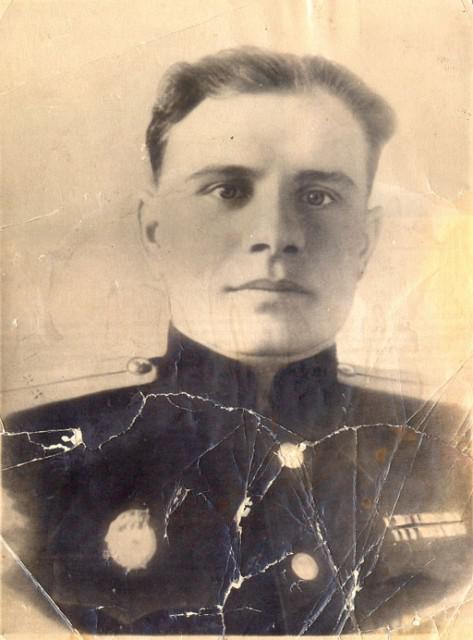
Kantaria and Yegorov were proclaimed Heroes of the Soviet Union. But it is little known that there was also a third participant Oleksiy Berest (1921-70). Berest was a Ukrainian political officer of the Red Army. His role was hushed down obviously for ideological reasons.
It was best to glorify Yegorov as ethnic Russian and Kantaria as Georgian because Stalin was also Georgian. Oleksiy Berest was quiet about the whole thing until 1995 when he revealed that the NKVD had asked him just to keep his mouth shut.
Of the many images obtained the published ones were usually those modified after the arm-filled looted watches were removed from the supporting soldier’s arm. These prove that the men had actually been looting their way to Berlin. The watches were quickly scratched out by the author and some dramatic smoke was added to the background.

Share this:

Categories: Uncategorized




 Michael Walsh Stories and Books
1 reply »