




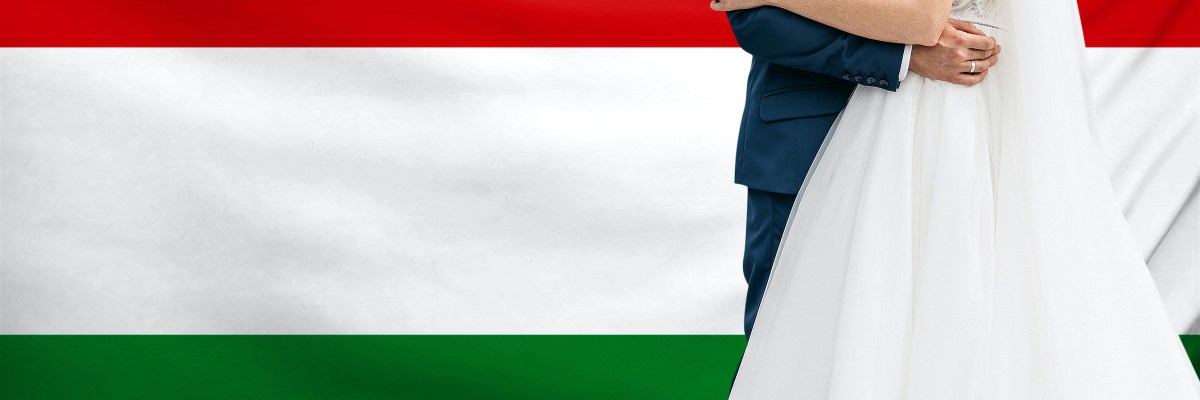
Hungary’s pro-family policies are getting results and could help dramatically boost the country’s birth rate over the coming years. The rate of marriages has risen sharply in Hungary since the government of Prime Minister Viktor Orbán assumed office in 2010, according to the figures published by the European Union’s statistical agency Eurostat. The figures, going back to 1960, break down the number of marriages per 1,000 people in the EU.
According to the data, the European Union average is 4.5 marriages per 1,000 people per year, and those numbers have not shown significant changes in the past 20 years.

In 2010, when the Orbán government had taken office, the number was as low as 3.6, well below the European average. A succession of left-liberal regimes had seen the Hungarian economy sliding close to bankruptcy, with the national debt rising from 50 percent to 80 percent of the GDP, which left little room to enact social policy projects. The lack of financial support that married couples experienced was coupled by a lack of a supportive family and child-oriented political narrative from the socialist governments.
The change of government had seen a rapid rise in the introduction of pro-family policies that have meant financial and systemic support for those having one or more children.

By the end of the Orbán government’s first term in 2016, the number of married couples exceeded the European average at 5.3 per 1,000 people. According to Eurostat, by 2019, the number went up to 6.7, and the latest figures from 2020 published by the Hungarian statistical agency KSH show that marriages are currently standing at 6.9. The last time the numbers were as high as this was in 1985, which is before the fall of the communist regime.
Historic examples, at least within the Hungarian context, show that family and child-friendly policies have a direct impact on people’s appetite to tie the knot and to bear children. Replicating the family-friendly policies of the 1960s and 1970s, the Orbán government introduced significant tax reductions for couples with two or more children, special mortgages for couples, and government aid for large family cars among others.
Alongside financial incentives, the Orbán government had fundamentally changed the political dialogue regarding the importance and role of marriage, family and that of bearing children. In stark opposition to the Brussels policy of topping up the dwindling numbers of an ageing European population with migrants from overpopulated regions of the world, it promoted the introduction of policies directly designed to stop long-standing downward trends.
For example, Orbán said in 2018 that ‘in all of Europe there are fewer and fewer children and the answer of the (suicidal) West to this is migration. They want as many migrants to enter as there are missing kids so that the numbers will add up. We Hungarians have a different way of thinking. Instead of just numbers, we want Hungarian children. Migration for us is surrender.’

In contrast to left-wing politicians who see the future of Europe in mass immigration, the Orbán government had managed to successfully slow down the negative birth-rate in Hungary. Hungary had also rejected the attack on nuclear families rampant in radical green and leftist movements such as Black Lives Matter.
Furthermore, identifying European culture as a fundamentally Christian culture helped to strengthen the Church’s anti-abortion narrative, in contrast with the vocal pro-abortion lobby within the European Union. The year 2020 also saw the introduction of a change in Hungary’s constitution that defines gender roles, where a father is a man and a mother is a woman, thus defining the nuclear family in terms of a reproductive couple.

While in 2010, at the end of the term of the last left-wing government, Hungary was at number 23 out of 27 in terms of marriages in the European Union, in 2020 it had reached third position behind Cyprus and Lithuania. From neighbouring countries, only Romania has numbers similar to Hungary, while the number of marriages in Slovakia stands at 5.4, in Czechia at 5.1 and Poland at 4.8. Source

Share this:

Categories: Uncategorized



 Michael Walsh Stories and Books
1 reply »