




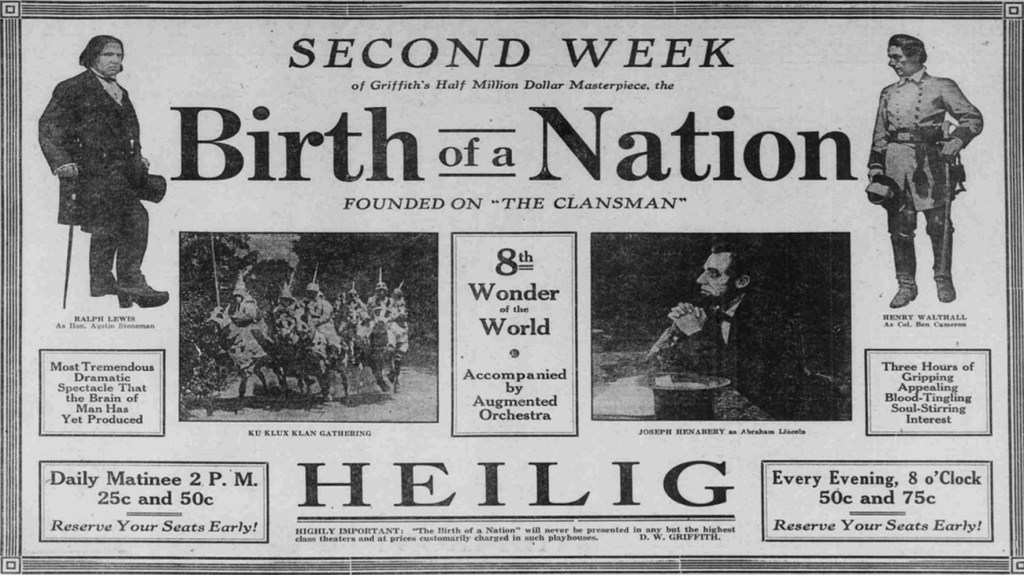
Thomas Frederick Dixon Jr. (January 11, 1864 – April 3, 1946) was an American white supremacist, politician, lawyer, Baptist minister, lecturer, novelist, playwright, and filmmaker. Dixon wrote two best-selling novels, The Leopard’s Spots: A Romance of the White Man’s Burden – 1865–1900 (1902) and The Clansman: A Historical Romance of the Ku Klux Klan (1905), that romanticized Southern white supremacy, endorsed the Lost Cause of the Confederacy, opposed equal rights for blacks, and glorified the Ku Klux Klan as heroic vigilantes. Film director D. W. Griffith adapted The Clansman for the screen in The Birth of a Nation (1915), which inspired the creators of the 20th-century rebirth of the Klan.

The son of a wealthy southern landowner, he grew up during the Reconstruction period following the American Civil War. In 1879 he graduated from the Shelby Academy in his hometown and enrolled at Wake Forest University in Winston-Salem, North Carolina, earning a Master’s Degree in 1883. He then attended John Hopkins University in Baltimore, Maryland on a scholarship but left soon afterwards to pursue a career in journalism and acting. He moved to New York City, New York and enrolled in the Frobisher School to study drama but when it did not pan out, he returned to North Carolina and enrolled in Greensboro law School in Greensboro, North Carolina and in 1885 he was awarded his law degree at the age of 20.

He then ran and was elected to the North Carolina General Assembly but only served for one term. During his short political career he became widely known for championing Confederate veterans’ rights. He decided to pursue a law practice but soon became disenchanted and left the law profession to become a Baptist minister and was ordained in October 1886. He pastored churches in Goldsboro and Raleigh, North Carolina before being offered a church in Boston, Massachusetts and while there, he became immensely popular.
In August 1889 he accepted a position in New York City but within five years he became disillusioned with the Baptist denomination and in 1895 he resigned and became affiliated with a non-denominational church.
Four years later he quit preaching entirely and became a full-time lecturer. He felt a need to tell the story of living in the South following the American Civil War and in 1902 he published his first novel “The Leopard’s Spots,” the first of his “Trilogy of Reconstruction” which would later be followed by “The Clansman” (1905) and “The Traitor” (1907), and they all became best-selling books. His other notable works include “The One Woman: A Story of Modern Utopia” (1903), “Comrades: A Story of Social Adventure in California” (1909), “The Root of Evil” (1911), “The Sins of the Father: A Romance of the South” (1912), “The Foolish Virgin: A Romance of Today” (1915), “The Fall of a Nation” (1916), “A Man of the People” (1920), “The Sun Virgin” (1929), and “The Flaming Sword” (1939). He saw his career rise and fall over the years during which he earned and lost millions of dollars. His last job was as a court clerk in Raleigh, North Carolina, where he died at the age of 82.

SINCE THE DAWN OF HISTORY
‘Since the dawn of history, the Negro has owned the continent of Africa rich beyond the poet’s fancy, crunching acres of diamonds beneath his bare black feet. Yet he never picked one up from the dust until a White man showed him its light. His land swarmed with powerful and docile animals, yet he never built a harness, cart or sledge.
A hunter by necessity, he never made an axe, spear or arrowhead worth preserving beyond the moment of its use. He lived as an ox, content to graze for an hour. In a land of stone and timber, he never carved a block, sawed a foot of lumber or built a house save of broken sticks and mud.
With league on league of ocean strand and miles of inland seas, for 4,000 years he watched their surface ripple under the wind, heard the thunder of the surf on his beach, the howl of the storm over his head, gazed on the dim blue horizons calling him to worlds that lie beyond, and yet he never dreamed of a sail. He lived as his fathers lived, stole his food, worked his wife, sold his children, ate his brother, content to drink, sing, to dance, and sport as the ape.
And this creature, half child, half-animal, the creature of impulse, whim and conceit, pleased with a rattle, tickled with a straw; a being who left to his will roams at night and sleeps in the day, whose speech knows no word of love, whose passions once aroused, are as the fury of the tiger, they have set this thing to rule over the Southern people … Merciful God … it surpasses human belief.’ ~ Thomas Dixon Jr. The Clansman: An Historical Romance of the Ku Klux Klan.

Share this:

Categories: Great Europeans






 Michael Walsh Stories and Books
I have Birth of a Nation on DVD. First silent movie I’ve ever watched and sat through from start to finish. You’d never find a movie like this being published today. It would be seen as “Hate Speech” Thanks for this information, Mr. Walsh. As an American who admires the South, you’ve got me more curious to check Dixon’s novels.
LikeLiked by 1 person
Like a good Rockefeller controlled anti Catholic Masonic Baptist minister
The Scottish Rite’s KKK Project
http://www.itwasjohnson.impiousdigest.com/kkkmas.htm
http://www.subvertednation.net/kikes-kkk-and-the-racial-divide/
LikeLike