




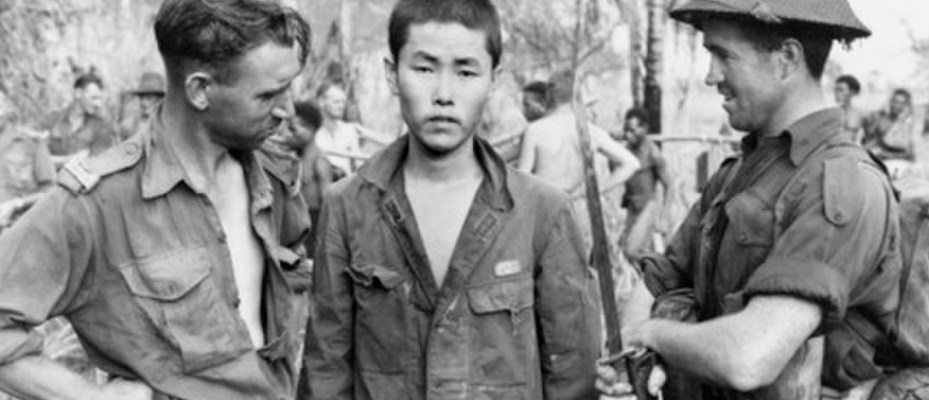
Much has been said and written about Japanese brutality during the war in the Far East. However, little is said about Allied atrocities, which in brutality and magnitude invariably exceeded those of the Japanese.
Yet, little if anything is published about allied POW camps or working conditions in allied camps set aside for Japanese prisoners-of-war… if they were captured and not killed on the spot. .

The reason there were so few concentration camps provided for Japanese prisoners of war was because the British, Australian and American troops were disinclined to take prisoners. In fact, senior officers complained as there were too few Japanese prisoners for the officers to interrogate. As they retreated before the Japanese troops arriving in Singapore on bicycles, the British Army increasingly depended on mercenary tribes and the Ghurkha Regiments.
British inability to defend its Far Eastern was due entirely to Churchill transferring military supplies to the Red Army rather than the British Army and Royal Navy.

The Ghurkha Regiments wouldn’t countenance such limp-wrist squeamishness. These mercenaries simply didn’t understand the concept of prisoners being taken into captivity.
Those captured by Britain’s Ghurkha troops simply had their throats slit or were bayoneted where they stood. It was common practice to disassemble the victims’ body to a condition in which it could neatly be buried in a bucket-sized hole in the ground. A blind eye was turned when Ghurkha troops carried out disgusting ritual practices on the bodies of dead enemy soldiers.

In both world wars the British armed forces used primitive tribesmen and openly condoned native cannibalism. The Cambridge University magazine Cam revealed their practices. These tribes practised the severance of parts of their slaughtered prisoners, cooking and then eating them.
Tropical diseases like Beri Beri and dysentery in Japanese POW camps, or building a railway offered at least some chance of survival and might be considered a reasonable alternative to being cannibalised by Britain’s allied ‘troops.’

As a matter of policy U.S. ships sank Japanese ships on sight irrespective of whether they were carrying passengers or war materials. Such was American enthusiasm for torpedoing vessels that when they later discovered they had sunk a Japanese freighter carrying hundreds of Allied prisoners of war there was no change in policy.
With shades of Libya, Syria, Iraq and Afghanistan, official U.S. communiqués claimed that only military objectives in Japanese cities were bombed with pinpoint accuracy. In fact, the indiscriminate Allied carpet and fire raid bombings, as in Europe caused more casualties than did the dropping of the atom bombs on Japan’s only two Christian cities, Hiroshima and Nagasaki.

Over 250,000 civilians were incinerated during the fire raids on Tokyo; eight million were made homeless. One raid alone on March 10, 1945, killed 140,000 people and left 1 million civilians homeless. There was little or no military reason for such attacks, which were out of all proportion to their war value.
The west has never been slow to make a fast buck out of recounting tales of Japanese atrocities. But, the Japanese, for cultural reasons have never spoken of the war crimes committed against them by the Allies, which they see as humiliation.
During a riot by Japanese prisoners of war at a camp in Australia, 221 Japanese prisoners were either gunned down or took their own lives. No mention was ever made of the tragedy and, of course, there is no movie made of the war crime. For the Japanese, there is no Great Escape or similar movies. For the Land of the Rising Sun capture was shameful; it was not something to parade and make money from.

‘We shot prisoners in cold blood, wiped out hospitals, lifeboats, killed or mistreated enemy civilians, finished off enemy wounded, tossed the dying into a hole with the dead, and in the Pacific boiled the flesh of enemy skulls to make table ornaments for sweethearts, or carved their bones into letter openers.
‘We topped off our saturation bombing and burning of enemy civilians by dropping atomic bombs on two nearly defenceless cities, thereby setting an all-time record for instantaneous mass slaughter.
‘As victors we are privileged to try our defeated opponents for their crimes against humanity, but we should be realistic enough to appreciate that if we were on trial for breaking international laws, we should be found guilty on a dozen counts. We fought a dishonourable war, because morality has a low priority in battle.
I have asked fighting men for instance, why they, or actual we regulated flame-throwers in such a way that enemy soldiers were set afire, to die slowly and painfully, rather than be killed outright by a full blast of burning oil. Was it because they hated the enemy so thoroughly? The answer was invariably, No, we don’t hate those poor bastards particularly; we just hate the whole goddam mess and have to take it out on somebody.
‘Possibly for the same reason we mutilated the bodies of the enemy dead, cutting off their ears and kicking out their gold teeth for souvenirs, and buried them with their testicles in their mouths, but such flagrant violations of all moral codes reach into still unexplored realms of battle psychology,’ writes Edgar L. Jones, U.S. Second World War Veteran. Atlantic Monthly, February 1946. Source
Share this:

Categories: Uncategorized



 Michael Walsh Stories and Books