




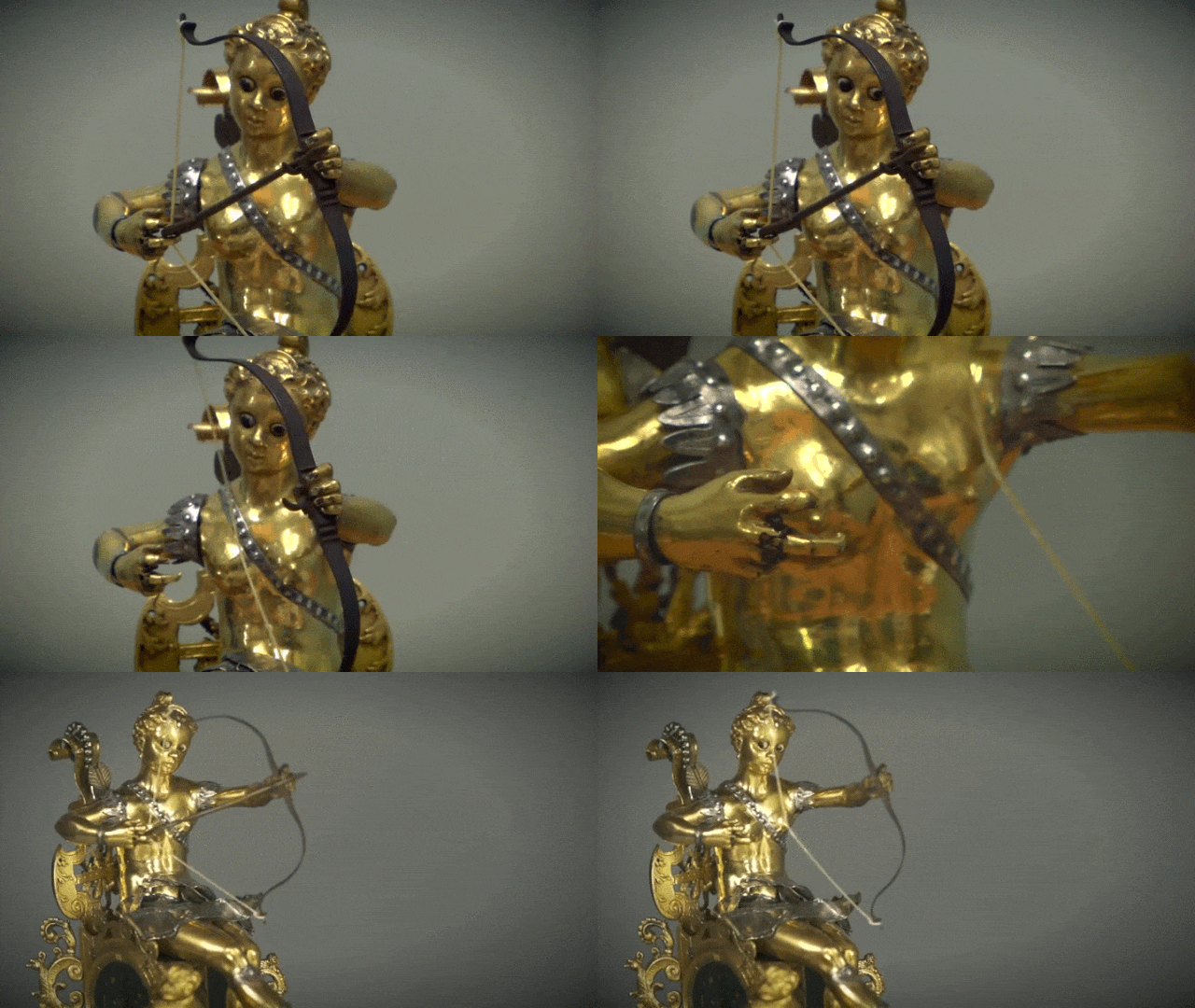
One of the most interesting clocks, as well as one of the most representative of clockmaking during the transition from the late 16th to the early 17th century, is this rather spectacular automaton of Diana On Her Chariot, as it’s called. In addition to being a clock, it’s also a “tabletop chariot” – pressing a switch puts the entire apparatus into motion, with the leopards appearing to draw Diana (Roman goddess of the hunt) across the table.

The Luxury of Time: European Clocks and Watches at the Metropolitan Museum of Art is a one-room exhibition showcasing some of the most beautiful horological art from the museum’s collections, as well as a stunning visitor: an automaton clock of Diana on her chariot on loan from Yale University Art Gallery. Made in 1610, the clock features the Roman goddess of the hunt seated on an incredible construction of gilded bronze, silver, and ebony, her metal and wood chariot pulled by two leopards. When the device was wound, the clock would move across the table, with the leopards leaping, a bird on the back moving forward, a monkey along for the ride eating an apple, and the eyes in Diana’s head shifting back and forth. As the grand finale, her metal finger would launch an arrow from her bow. (You can watch the whole sequence in the video from Yale below.)
Below is a watch which has, as many watches do, something of a story behind it. This is one of the earliest examples of a watch in which jeweling is used. The movement – very elaborately pierced and engraved, especially the circular balance cock (which covers the entire balance) has as its centerpiece a half-pierced, pink diamond endstone. Jewels in watches are used as bearings both for their durability and to reduce friction at train wheel pivots and especially at the balance. The Swiss began using jeweled pivots in their watches as a general practice during the first quarter of the 19th century.

Interestingly enough, the first patent applied for in England for jeweled bearings in watches was from over a century earlier. In 1704, a Swiss watchmaker named Nicolas Fatio de Duillier applied to Parliament for a patent to use drilled gemstones as watch pivots. This was apparently “vigorously” opposed by the English horological guild (the Clockmaker’s Company) and James Delander – the maker of the above movement – was paid 3 guineas for his aid in opposing the patent application. The exhibition catalog goes on to remark, “The watch can be dated with certainty before 1720, but many English watchmakers continued to use jeweled endstones throughout the eighteenth century, or about a hundred years before they were in general use by Swiss watchmakers.”
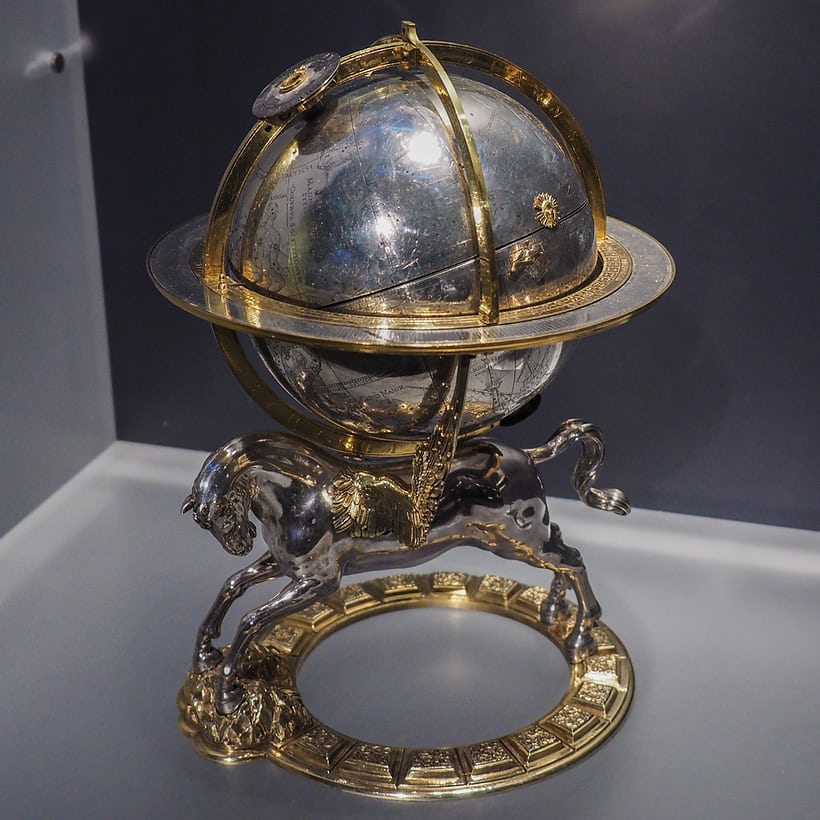
Celestial globe with clockwork, Vienna, 1579.
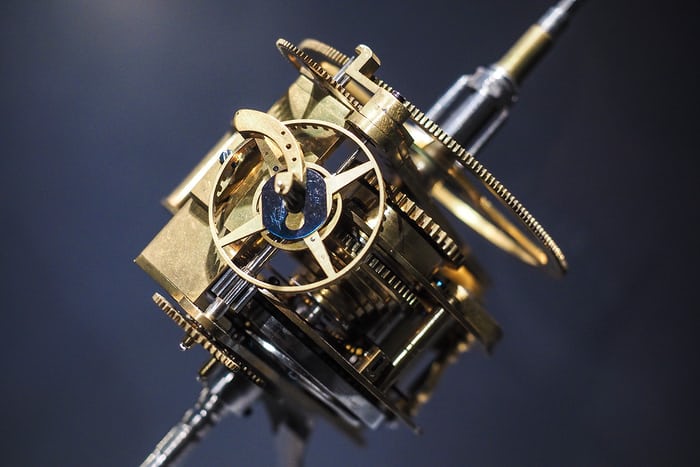
One of the most incredible clocks is this one: a clockwork celestial globe, finished in 1579 in Vienna. This was part of the collection of the Holy Roman Emperor Rudolf II. The globe is engraved with 52 constellations, and the movement is by Gerhard Emmoser, clockmaker to the Holy Roman Emperor. The catalog entry is fascinating reading, and notes, among other things, that the symbolism of this technically extremely challenging, and artistically very beautiful, work of horological art was inspired by the Protestant reformer Philip Melancthon, who wrote, in the preface to his Arithmetic:
” . . . the wings of the human mind are arithmetic and geometry . . . Carried up to heaven by their help, you will be able to traverse with your eyes the entire nature of things, discern the intervals and boundaries of the greatest bodies, see the fateful meetings of the stars, and then understand the causes of the greatest things that happen in the life of man . . . For I know that you are certainly convinced that the science of celestial things has great dignity and usefulness.”
From The exhibition, The Luxury Of Time. Source
Share this:

Categories: Mechanical Splendours



 Michael Walsh Stories and Books